STARSHIP'S WAKE IN THE IONOSPHERE
Signals from navigation satellites have to cross the ionosphere, the part of the upper atmosphere that holds free electrons and ions. Receivers on the ground can use those signals to measure the total electron content along each line of sight. Remove the slow trend over ten minutes, and what remains are small ripples, counted in a unit called the TECU: 10¹⁶ electrons per square metre.
Rockets are already known to stir up such ripples. Moving exhaust plumes leave V-shaped disturbances, and a similar geometry was reported for a Starship flight on 18 November 2023.
A bow wave with the engines off
Starship’s 14th flight lifted off from Starbase, Texas, on 28 September 2026. Juha Vierinen, a physicist at UiT The Arctic University of Norway in Tromsø, looked at that day’s data in HEIMDALL, a database that pools receivers from many networks around the world.
At 13:09 and 13:11 UTC, a narrow bow-shaped disturbance, like the wave pushed by the front of a boat, shows up along the ship’s path across South America: alternating bands of more and fewer electrons that spread away from the track as the ship moves on. That was during the coast phase, engines off, before a brief engine burn. A new disturbance appears at 14:47 UTC, on the next pass over South America, about 14 minutes before the deorbit burn.
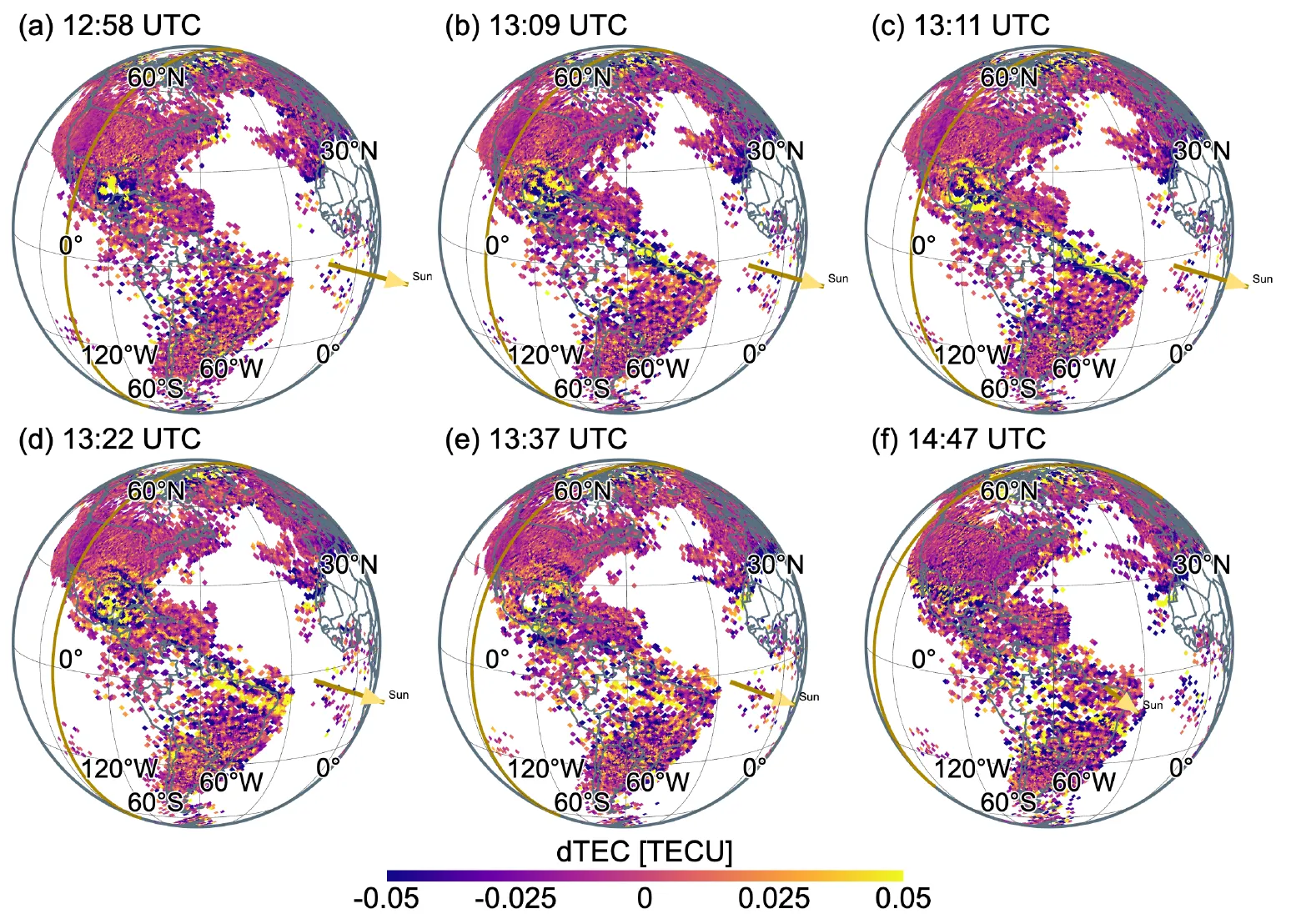
Ripples in the electron content measured on 28 September 2026: the bow over South America stands out at 13:09 and 13:11 UTC and returns at 14:47. — Figure 3, Vierinen (2026), arXiv:2611.20379.
That raises a physical puzzle. At these altitudes, the air is so thin that a molecule travels a long way before hitting another one. A spacecraft hull is small compared with that distance, so it crosses the gas without pushing it along like a fluid. Most spacecraft leave no such wave behind. If the hull alone were enough, these signatures would be everywhere.
Ten kilometres of gas around a nine-metre hull
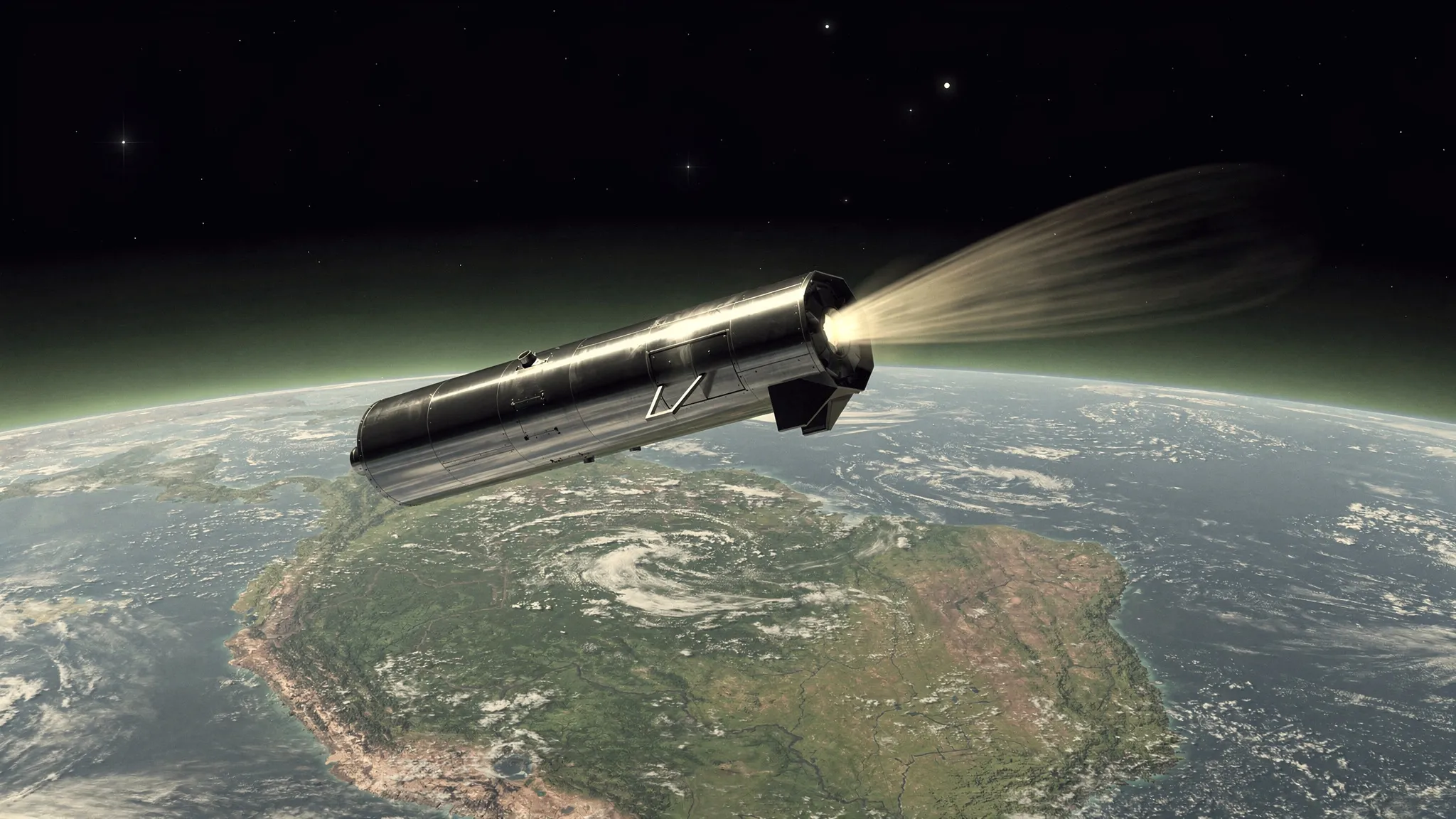
The flight video offers a clue: during the coast, a bright plume of material keeps streaming out of the ship. Vierinen interprets it as unburned propellant being vented, and models it as gaseous methane and oxygen. The images show neither what the gas is nor how much of it there is.
Gas released by the ship leaves at roughly orbital speed relative to the air. As it spreads out and collides with the surrounding molecules, it hands them momentum (its push) and energy — over a region far larger than the hull. No combustion is needed: the energy comes from the motion of the gas itself.
To test the idea, Vierinen simulated, molecule by molecule, a release of 10 kilograms per second moving at 7.6 kilometres per second relative to the air, in the conditions found 265 kilometres above Brazil. There, a molecule travels on average 1.94 kilometres between two collisions. Result: 90% of the energy is handed over within a region 11.4 kilometres across — roughly 10 kilometres, compared with a 9-metre hull.
A wake on the computer
This pattern then became a moving source of mass, momentum and energy in a three-dimensional model of the atmosphere, coupled to the ions of the ionosphere. It follows the ship’s real path, rebuilt from 489 archived positions. Venting starts 502 seconds after launch and continues at 10 kilograms per second.
Over South America, the model produces an elongated bow wave with the same overall shape as the observations, its bands drifting outward at several hundred metres per second. The amplitudes are of the same order: on the two cross-sections furthest along the track — lines drawn across the ship’s path where the ripples are compared — the ripples measure 0.032 and 0.021 TECU in the data, and 0.015 in the model, with no adjustment factor. The model also brings back a disturbance on the second pass.
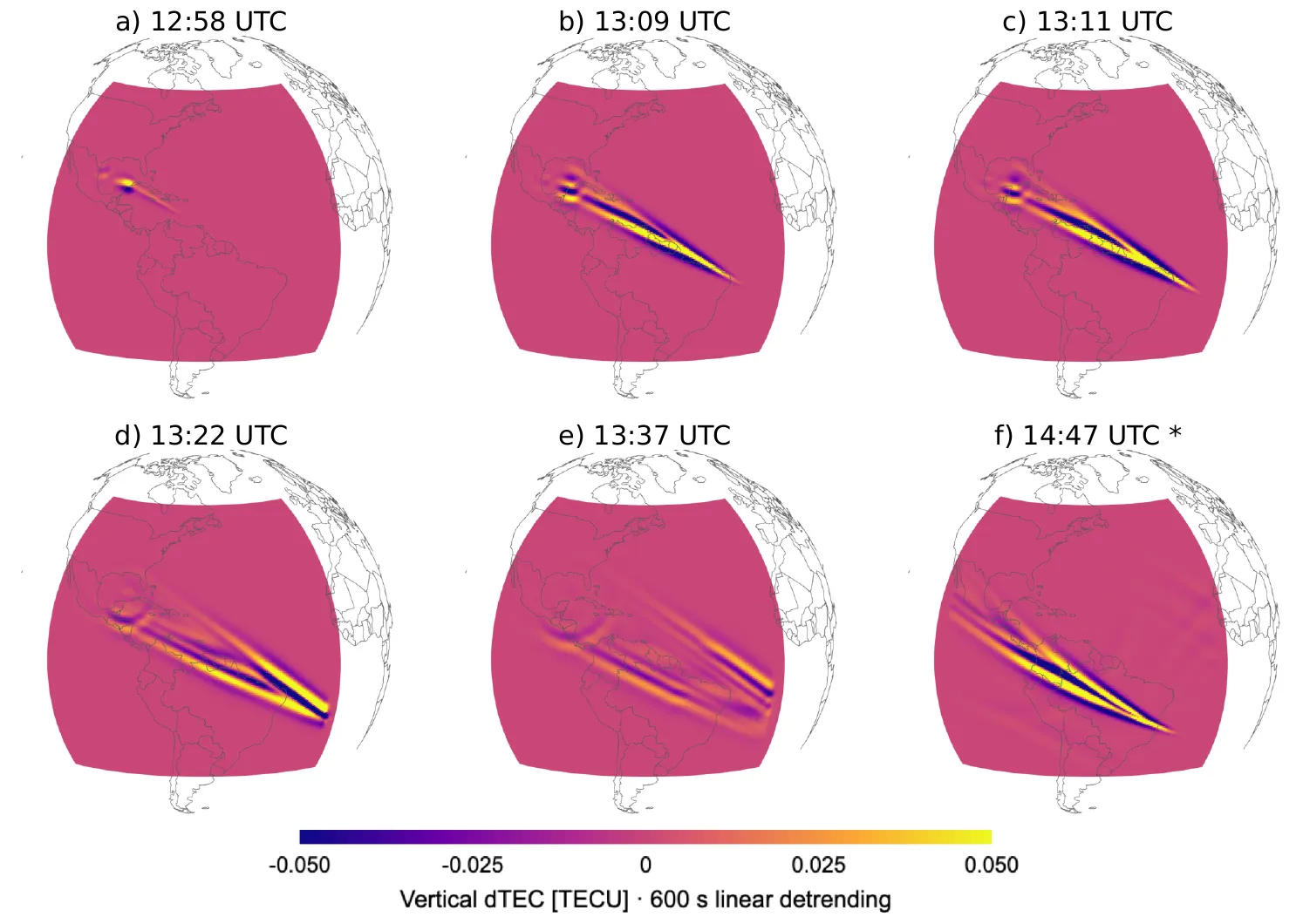
The same times, simulated with 10 kilograms of methane and oxygen released per second: a long wake trails behind the ship. — Figure 5, Vierinen (2026), arXiv:2611.20379.
Where the model falls short
Over North America, during the climb, the simulated ripples are much too weak: 0.00037 and 0.0016 TECU, against 0.012 and 0.032 observed. The rate of 10 kilograms per second is a scenario, not a measurement. And the shape of the wave alone cannot tell a sound wave from an atmospheric “gravity wave”, another kind of wave of the air itself.
Vierinen therefore presents venting as a sufficient explanation, not a unique reconstruction of the event. One piece remains untested: methane and oxygen can also react with the ions and change how fast electrons disappear. Runs with collisions only, with chemistry only, and with both, from the same release, would settle how much each one counts.