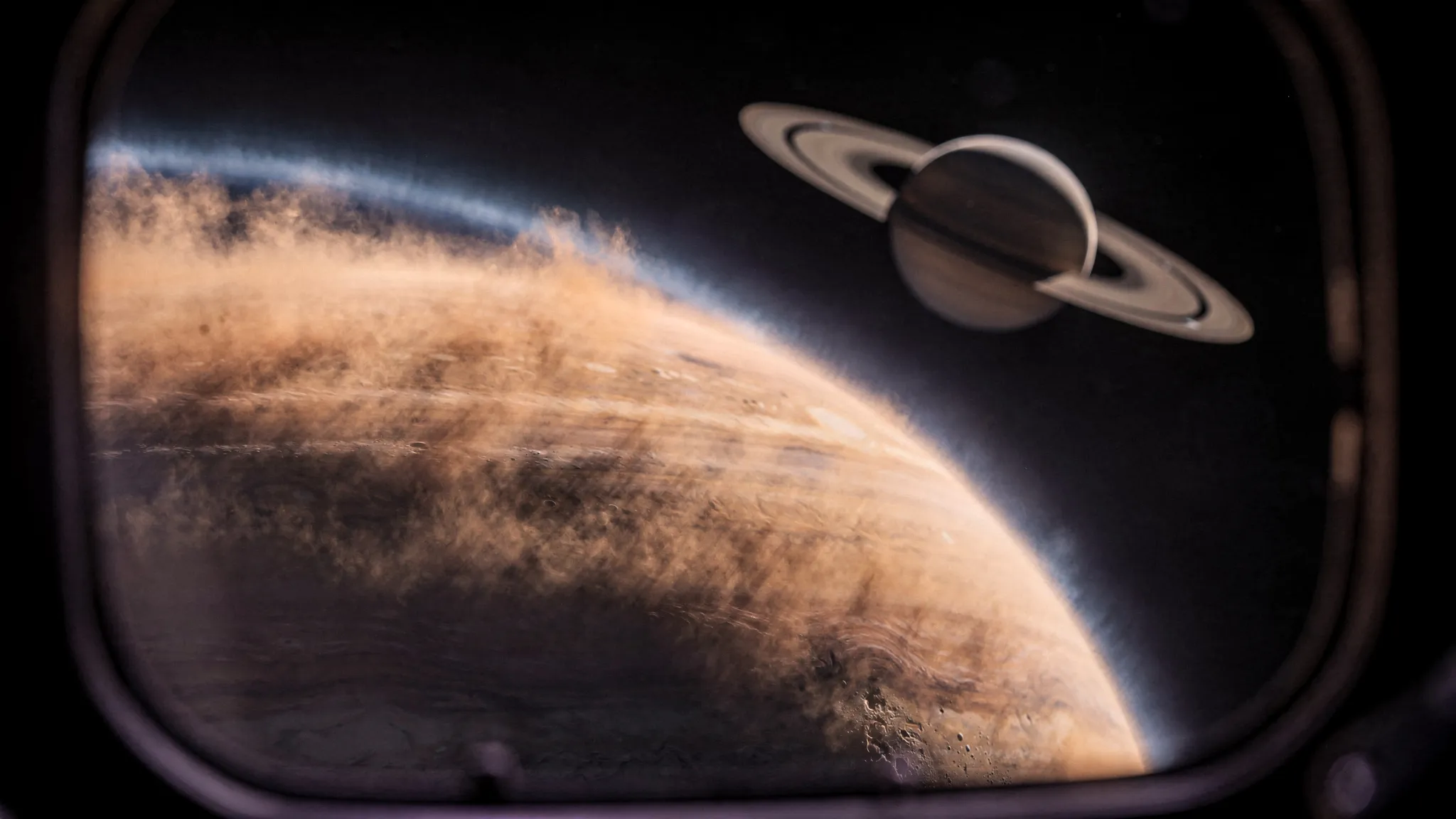
A NEW KIND OF MOLECULE IN TITAN'S SKY
Titan, a moon of Saturn, has a thick atmosphere of nitrogen and methane. Ultraviolet light from the Sun splits these molecules, and their fragments recombine into a remarkable variety of organic compounds; charged particles from Saturn’s magnetic environment stir the chemistry further. The list of chemicals known on Titan is now longer than the one known for Saturn itself. Add a possible ocean under the surface — proposed, though contested — and Titan becomes a prime target for anyone asking how the chemistry of life might start.
A molecule glimpsed, now caught
Almost all the nitrogen-bearing gases confirmed on Titan so far are nitriles, molecules with a triple bond between carbon and nitrogen, like hydrogen cyanide (HCN). Methanimine (CH₂NH) is different: it is an imine, with a double bond, which makes its nitrogen more available for further reactions.
It was already suspected. The mass spectrometer of the Cassini spacecraft recorded a signal that matched the charged form of methanimine, carrying one extra proton, suggesting about 10 parts per million high in the atmosphere. But a mass alone cannot tell apart molecules of the same weight. Methanimine has been seen in clouds between the stars and even in other galaxies — never before as a gas in the atmosphere of another world.
Three faint lines
Alexander Thelen, of Caltech and NASA’s Goddard Space Flight Center, and colleagues in the United States, France, the United Kingdom and Poland pointed the ALMA array of radio telescopes, in Chile, at Titan between December 2024 and January 2025. Each molecule gives off radio waves at its own precise frequencies, which show up in the spectrum as narrow peaks called lines — a kind of fingerprint. A first line of methanimine appeared at a frequency of 245.126 gigahertz. Follow-up time granted by the observatory’s director, in December 2025 and April 2026, captured two more lines, near 317 and 319 gigahertz.
The three lines stand out at 4.7, 5.8 and 3.3 times the noise level. One of them overlaps lines of propane and another gas, which the team modelled and subtracted before measuring the methanimine.
How much is there
Methanimine makes up 0.1 to 1 part per billion of the gas in Titan’s mesosphere, above about 400 kilometres, and its share grows with altitude up to the 10 parts per million inferred from Cassini near 1,000 kilometres. Added up over the whole atmosphere, that is 0.9 to 3 × 10¹³ molecules above each square centimetre.
That is 100 to 1,000 times less than hydrogen cyanide. At 600 kilometres, there are 1 to 5 methanimine molecules for every 1,000 molecules of HCN — a ratio similar to that seen in cold clouds where stars are about to form.
Cosmic rays overrated
The measurements test the computer models of Titan’s chemistry. Models based on reactions between ions (electrically charged molecules) and neutral molecules fit the data in the middle and upper atmosphere, some with very little adjustment — a sign that this chemistry is fairly well understood. Every model had to be scaled up, though, hinting that there may be more methanimine in the middle atmosphere than predicted.
Models that add galactic cosmic rays — particles from across the Galaxy that can break nitrogen molecules apart lower in the atmosphere — fare badly. They predict a second production zone lower down, in the stratosphere, which would make the lines brighter than observed. According to the authors, cosmic-ray chemistry is over-predicted in current models — a problem, because the same process is expected to produce other nitrogen molecules, such as ammonia and methylamine.
A rung on the ladder
Methanimine sits at a crossroads of Titan’s nitrogen chemistry. In the space between stars, it is thought to turn, step by step, into glycine, an amino acid; and its breakdown gives hydrogen cyanide, which can link up into adenine, a nucleotide base. Titan also has carbon dioxide and water. So, the authors write, the ingredients for making amino acids without life exist there.
No amino acid has been found on Titan, and the conditions at its surface remain largely unknown. The Dragonfly mission is due to sample several places on Titan’s surface in the 2030s. Until then, the next step is to hunt with radio telescopes for the molecules methanimine could become.