SOAP BUBBLES MAKE NO PEROXIDE
For about twenty years, chemists have reported strange things happening in tiny droplets of water: reactions that run faster than expected, and transformations that do not occur in a beaker. The most famous and most debated case is hydrogen peroxide (H₂O₂) appearing “spontaneously” in water microdroplets — without any reagent, catalyst, electric voltage or radiation, as the original reports defined it. If the very skin of water were that reactive, the paper notes, the consequences would be enormous.
Explanations range from ultra-strong electric fields at the boundary between air and water to more mundane culprits: oxygen dissolved in the water reacting at solid surfaces, energy injected while making the droplets, static electricity, misread signals in mass spectrometers. “Yet the debate rages,” write the authors.
The soap-film shortcut
Then came a simple idea from another team, led by Dick: if the boundary between air and water is reactive by itself, a soap film — a huge surface for very little liquid, made without spraying or ultrasound — should show it too. They reported soap films loaded with 0.5 to 2.5 millimolar of hydrogen peroxide, and later that soap films turn dissolved gold salts into gold nanoparticles.
The new authors had doubts. The soap was used at about 7.5 times the concentration where its molecules start clumping into micelles, so the surface should be crowded with soap. Why would peroxide there be about a thousand times more concentrated than in the latest droplet experiments?
300 films, six tests
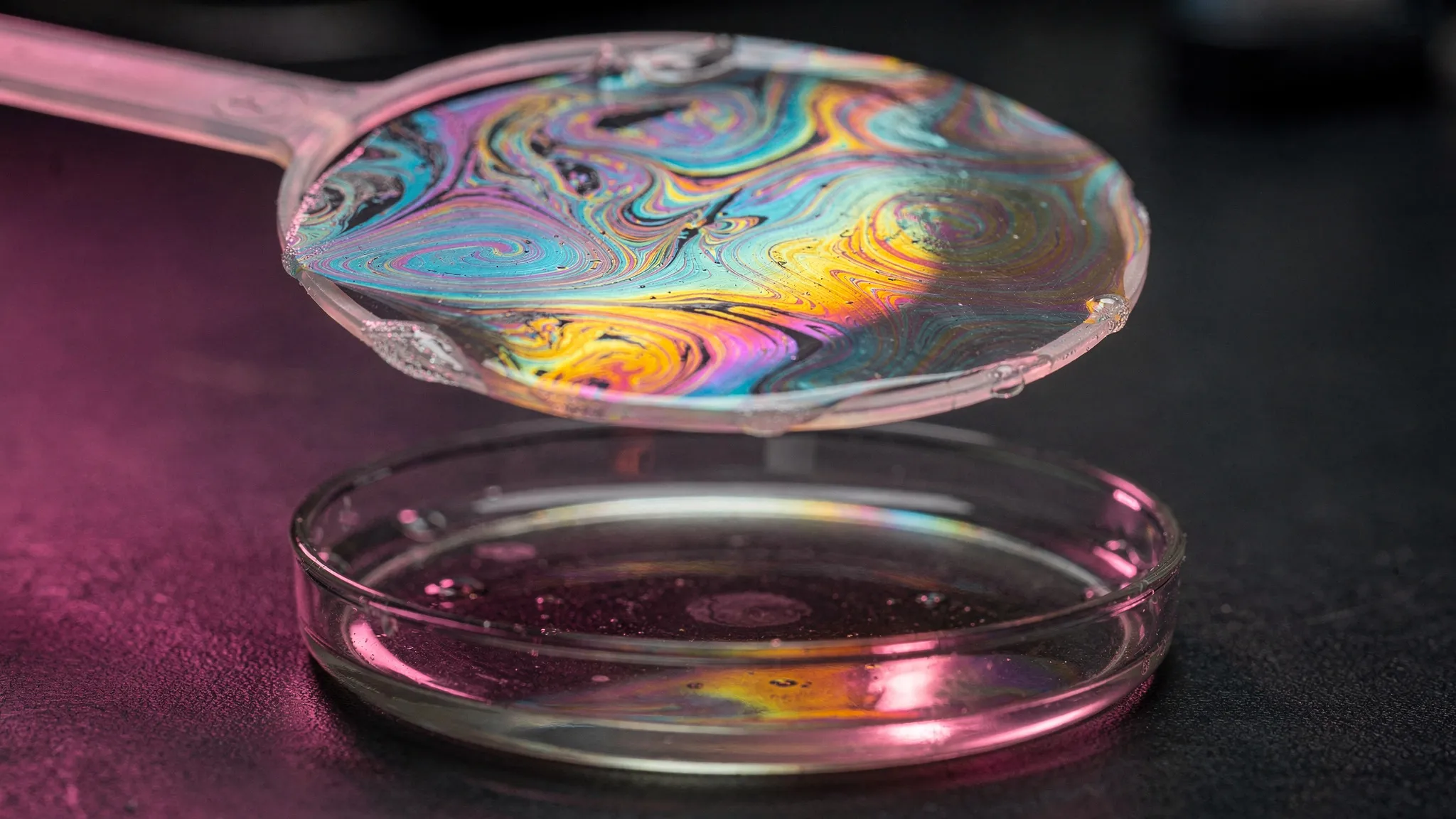
Muzzamil Eatoo, Himanshu Mishra and colleagues at King Abdullah University of Science and Technology (KAUST), in Saudi Arabia, followed the published recipe: a little Triton X-100 detergent in a phosphate buffer, a glass Petri dish, and an ordinary plastic bubble wand bought online. They blew films, let them fall back into the same liquid, and started again — up to 300 times, so that any peroxide would pile up.
Then they looked for it with six methods: the same peroxide test strips as the original report, two fluorescent kits, two colour tests (one of them also used in the original work), and nuclear magnetic resonance (NMR) on a 950-megahertz machine able to see the peroxide molecule directly, down to 50 nanomolar.
Nothing to see
- The test strips stayed blank, even after 300 films, while reference solutions coloured as expected.
- NMR showed no peroxide after 200 or 300 cycles. To make sure the soap was not hiding it, they added 1 micromolar of peroxide to the sample: a clear peak appeared.
- The two colour tests found nothing either.
- The fluorescent kits did show a small signal, equivalent to about 1 micromolar — but exactly the same in soapy liquid that had never been blown into films. The source: the detergent itself, which glows in these tests. A trap for anyone relying on such kits.
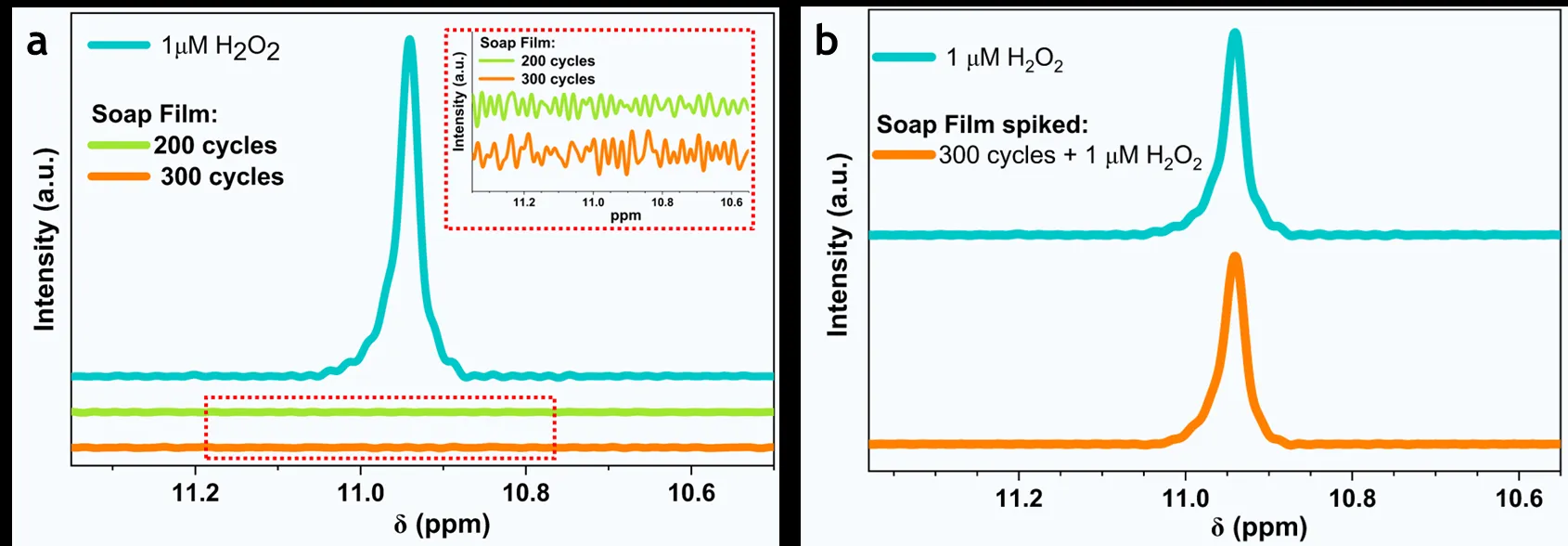
(a) A 1 µM peroxide reference shows a clear peak; soap-film samples after 200 and 300 cycles show none. (b) Adding 1 µM peroxide to the 300-cycle sample brings the peak back. — Figure 2, Eatoo et al. (2026), arXiv:2610.03774.
Gold that reduces itself in the bulk
What about the gold? Gold nanoparticles did form — but just as well in soapy liquid never blown into films. After one hour, the gold still dissolved fell from 19.7 to 16.14 ppm in the plain soapy solution and to 16.18 ppm after 300 films: about 18 percent lost in both cases, with no measurable difference.
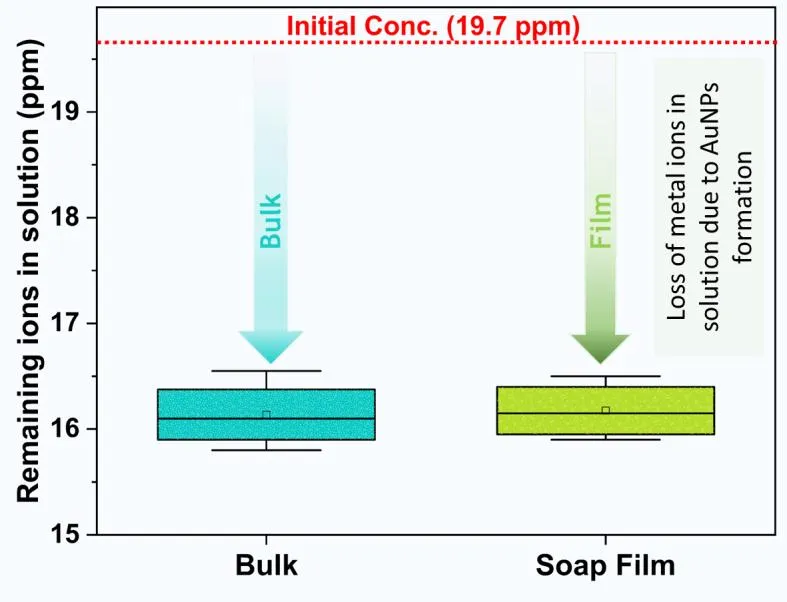
Gold remaining in solution after one hour: the same with or without 300 soap films. — Figure 5, Eatoo et al. (2026), arXiv:2610.03774.
The final test removed everything: gold salt in pure water, no detergent, no buffer, no films. Crystalline gold nanoparticles still formed, and NMR detected peroxide at the same time. In the soapy solution, the amount of peroxide grows with the amount of gold — about 10 micromolar for 50 micromolar of gold, nearly 40 for 200. The authors see an ordinary pair of chemical reactions in the liquid itself: gold ions are reduced to metal while water is oxidised to peroxide.
The skin of water stays calm
The conclusion is a clean asymmetry. Soap films without gold make no detectable peroxide; gold in water without films makes both nanoparticles and peroxide. Neither gold particles nor a peroxide signal can therefore be taken, on its own, as proof of chemistry driven by the soap-film surface. The authors — who have long argued in this debate that peroxide in droplets comes from dissolved oxygen and solid surfaces — call for separating what truly happens at the air-water boundary from what happens in the bulk liquid and at solid walls.