
TWIN PROBES, TWO DIFFERENT FATES
In August 2012, two identical spacecraft left Earth together: the Van Allen Probes, A and B, built to study the radiation belts that surround our planet. They shared the same octagonal shape, the same four solar panels, the same highly elongated orbit tilted by 10.2 degrees. Their science mission over, Probe B was switched off on 19 July 2019 and Probe A on 18 October 2019. According to forecasts made before the mission, both should have stayed in orbit until 2034.
That is not what happened. Probe A re-entered the atmosphere on 11 March 2026. Probe B is still in orbit — even though it was switched off a few months earlier. How can two twins, launched on the same orbit and bathed in the same space weather, end up with such different lifetimes?
Eight years of orbits rebuilt
Ayisha Ashruf and colleagues at the Vikram Sarabhai Space Centre and the Indian Institute of Space Science and Technology, both in Thiruvananthapuram, India, reconstructed the path of each probe from public orbital data, one point every 15 seconds. For each position, an atmospheric model estimated the density of the thin air in the upper atmosphere — the thermosphere — given the activity of the Sun and of the Earth’s magnetic field at that moment.
Low in their elongated orbits, near the closest point to Earth called the perigee, the probes skimmed through this thin air. Each pass slowed them a little. That is atmospheric drag, the main force that brings satellites down.
A small gap that keeps growing
Until 2022, the two probes evolved in step. But from 2021, their perigees began to drift apart. Oddly, Probe B dipped deeper at first — about 180 kilometres against 200 for A — but Probe A stayed low for longer: its perigee lingered near the bottom of each cycle.
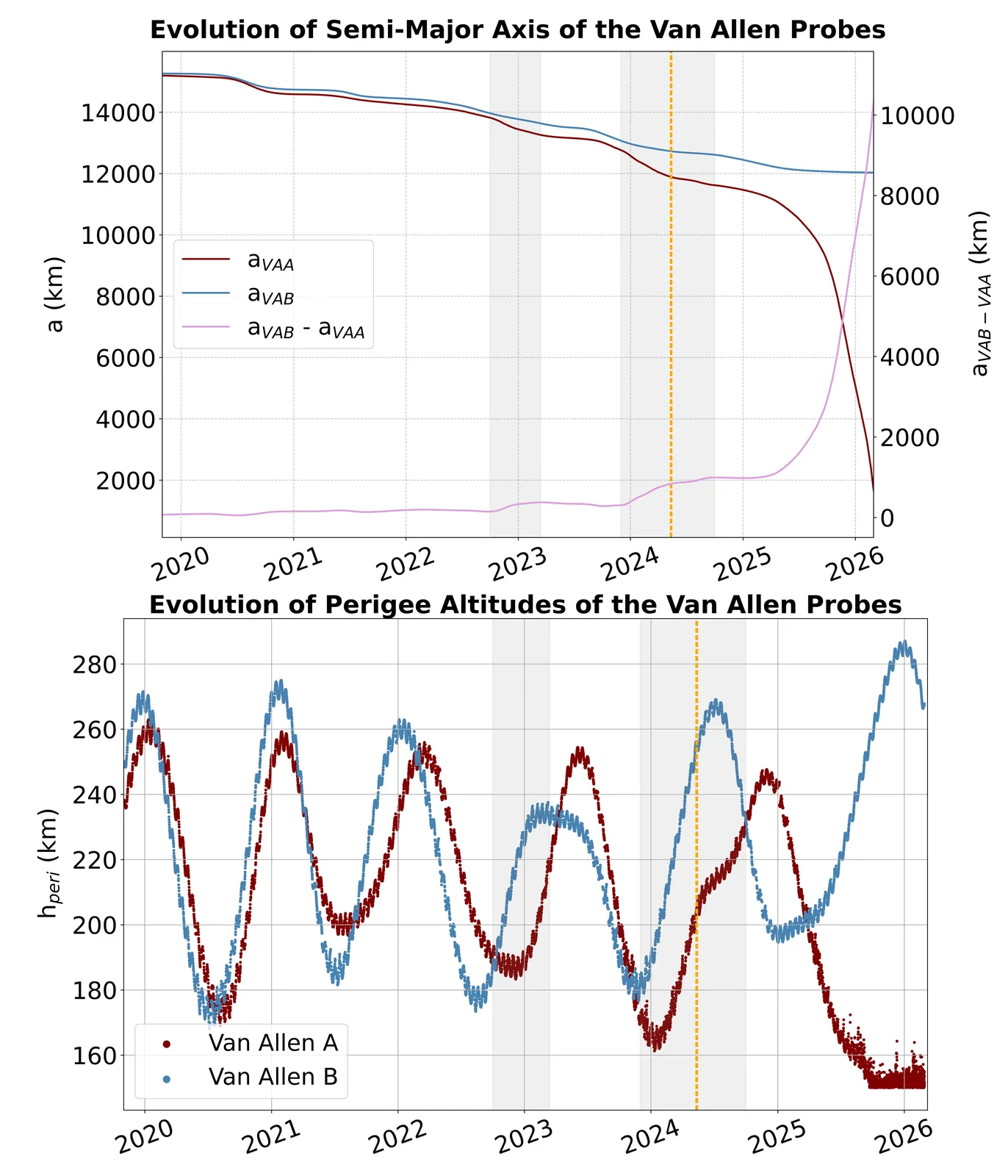
Top: size of the orbits of Probes A (dark red) and B (blue) and their difference (pink). Bottom: altitude of their perigees. Shaded bands: phases where the gap jumps; orange line: the May 2024 storm. — Figure 1, Ashruf et al. (2026), arXiv:2610.05372.
From late 2022, the gap became clear. Probe A’s perigee dropped below about 190 kilometres while B’s stayed above. Between mid-2023 and 2025, A went down to about 160 kilometres, B to about 180. According to the text, by 2025 Probe A had spent about 39 hours more than its twin below 263 kilometres.
Even at the same altitude, the two probes no longer met the same air: they now crossed the low atmosphere at different latitudes, longitudes and times of day. Same Sun, same storms, but not the same atmosphere.
The vicious circle of drag
The air thickens very quickly as one goes down. A little more time spent low means a lot more drag. More drag lowers the orbit, which brings the probe even lower, where the air is even thicker. The authors describe this amplifying feedback as the heart of the story: a small initial difference that feeds itself.
Storms as accelerators
Space weather pushed in the same direction:
- In October 2022, a series of modest geomagnetic storms coincides with the first clear jump in the gap. At that moment, Probe A was already near 180 kilometres, B above 200. The authors recall that a moderate storm in February 2022 had already caused the loss of 38 Starlink satellites by puffing up the air near 200 kilometres.
- Strong storms in December 2023, then in March and August 2024, each coincide with a new widening of the gap.
- During the “Gannon” storm of May 2024, Probe A’s recovery seems to have been slowed, not B’s. The two probes then passed at different times of the evening, which might matter.
- In the background, the Sun was waking up: its ultraviolet output has been rising since 2019 with the new solar cycle, thickening the upper atmosphere and making every small difference in orbit more costly.
Lessons for crowded orbits
No single storm explains it: the divergence results from small differences in orbit, amplified again and again by storms and by the steep rise of air density with depth. The authors acknowledge the limits of their tools — an average atmospheric model that underestimates storms, orbital data that blur during the final plunge, and a computed energy loss that had to be scaled down tenfold to match the observed one. They still conclude that two spacecraft on nearly identical orbits can end up with very different lifetimes under the same sky — a lesson for predicting when satellites and space debris will fall.