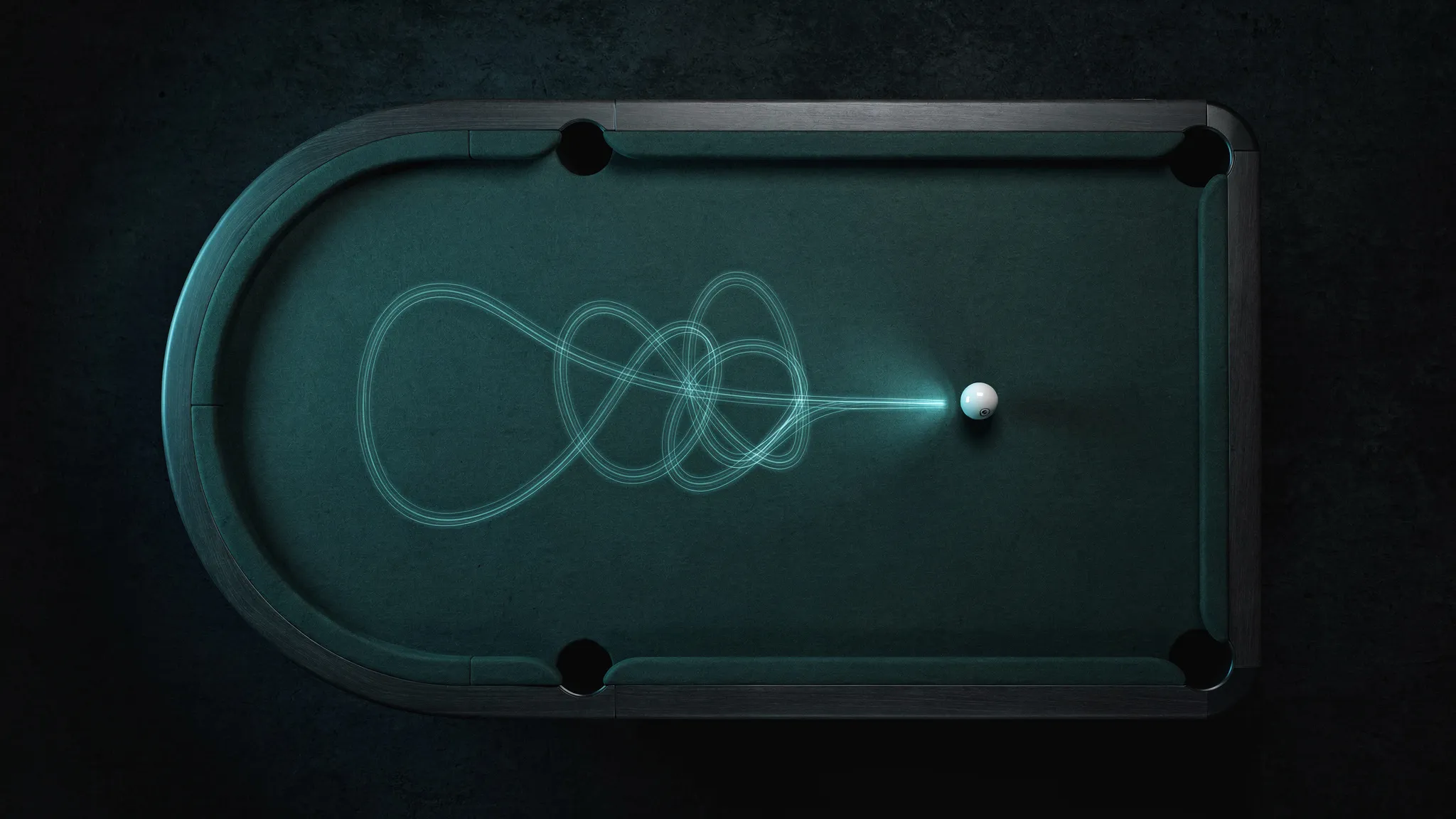
A LEMON-SHAPED BILLIARD TABLE WHERE THE BALL GOES EVERYWHERE
Mathematicians have a favourite toy for studying chaos: the billiard. A point moves in straight lines inside a closed shape and bounces off the edge “the way a photon does in a mirror”, leaving at the same angle it arrived. No friction, no spin, no end. The question is what such a ball does in the long run.
For some tables, the answer is as wild as it gets. The motion is ergodic: almost every trajectory eventually visits the whole range of possible positions and directions, spending in each region a share of time proportional to its size. Wentao Fan and Boris Hasselblatt prove something even stronger for their table, the Bernoulli property: statistically, the bouncing ball behaves like a sequence of independent random draws.
The trouble with round edges
The tables long known to be chaotic have a catch. A set of criteria due to the mathematician Maciej Wojtkowski explains how curved, focusing walls can create chaos — but it requires the full circle of which each wall is only an arc to fit entirely inside the table — which forces the edge to cave in somewhere. That rules out tables that are strictly convex, meaning their edge bulges outward everywhere, with no flat or inward part.
So a natural question stood open: can a strictly convex billiard be ergodic at all?
The lemon
In 2013, Jingyu Chen, Luke Mohr, Hong-Kun Zhang and Pengfei Zhang introduced a family of candidates: lemon billiards. Take two discs, one of radius r and a much larger one of radius R, placed so that the large disc contains both centres. Their overlap is the table — in practice, a small disc with one side shaved off by the gentle arc of a huge circle, meeting the rest at two corners. The four researchers conjectured that such lemons are ergodic when the two radii are very different.
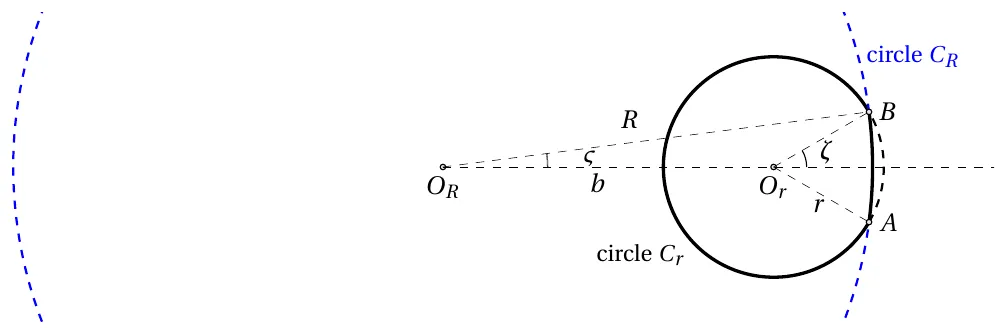
The lemon billiard table L(r, R, ζ): the overlap of a small circle of radius r and a large circle of radius R, meeting at the corners A and B. — Figure 1, Fan and Hasselblatt (2026), arXiv:2610.28247.
The proof
Fan, at Hebei Normal University in China, and Hasselblatt, at Tufts University in the United States, prove the conjecture for sufficiently lopsided lemons. Their main theorem holds when the angle ζ that sets the size of the cut lies between 0 and arctan(1/3), about 18 degrees, and when the large radius exceeds r · 30,000 / sin²ζ — at best 300,000 times r, for the widest cut allowed, and more for a narrower cut. “To our knowledge,” they write, “this is the first instance of a strictly convex billiard for which ergodicity has been proved.”
The work builds on a companion paper by the same authors, which showed that the ball’s returns to a well-chosen set of bounces stretch nearby trajectories apart at a steady rate. What remained was the hardest part: controlling the singularity curves, the trajectories that come from or run into one of the two corners. These curves are drawn not on the table but on a map of the bounces, where each bounce is placed by its position along the edge and its departure angle; in lemon billiards, some of them stand almost vertical there and flip the sign of their slope — a feature “long deemed deeply problematic for standard billiard techniques”. The authors show that after a single bounce, these curves fall neatly into line. That is precisely why they chose to watch the ball not at every bounce, but at the end of each run of consecutive bounces on the small circle — the next-to-last of the run, or the only one when the run has just one.
The rest is a careful check of four technical conditions required by a “local ergodicity” theorem from 2013, adapted to the lemon. It fills almost the entire 58-page paper.
What comes next
The result applies to very asymmetric lemons: with the threshold above, the large circle is hundreds of thousands of times bigger than the small one (at least 300,000). Less lopsided lemons remain unproven.
The authors list their next targets — how fast the motion mixes, and the statistical laws that follow — and end with a more ambitious question. Their lemon still has two corners. Is there a strictly convex ergodic billiard whose edge is perfectly smooth, with no corners at all? They point to old candidates studied “for half a century”: tables made of a rectangle capped by circular arcs that join it smoothly. One line in their acknowledgements also stands out: “No AI was used in any aspect of the preparation of this article.”