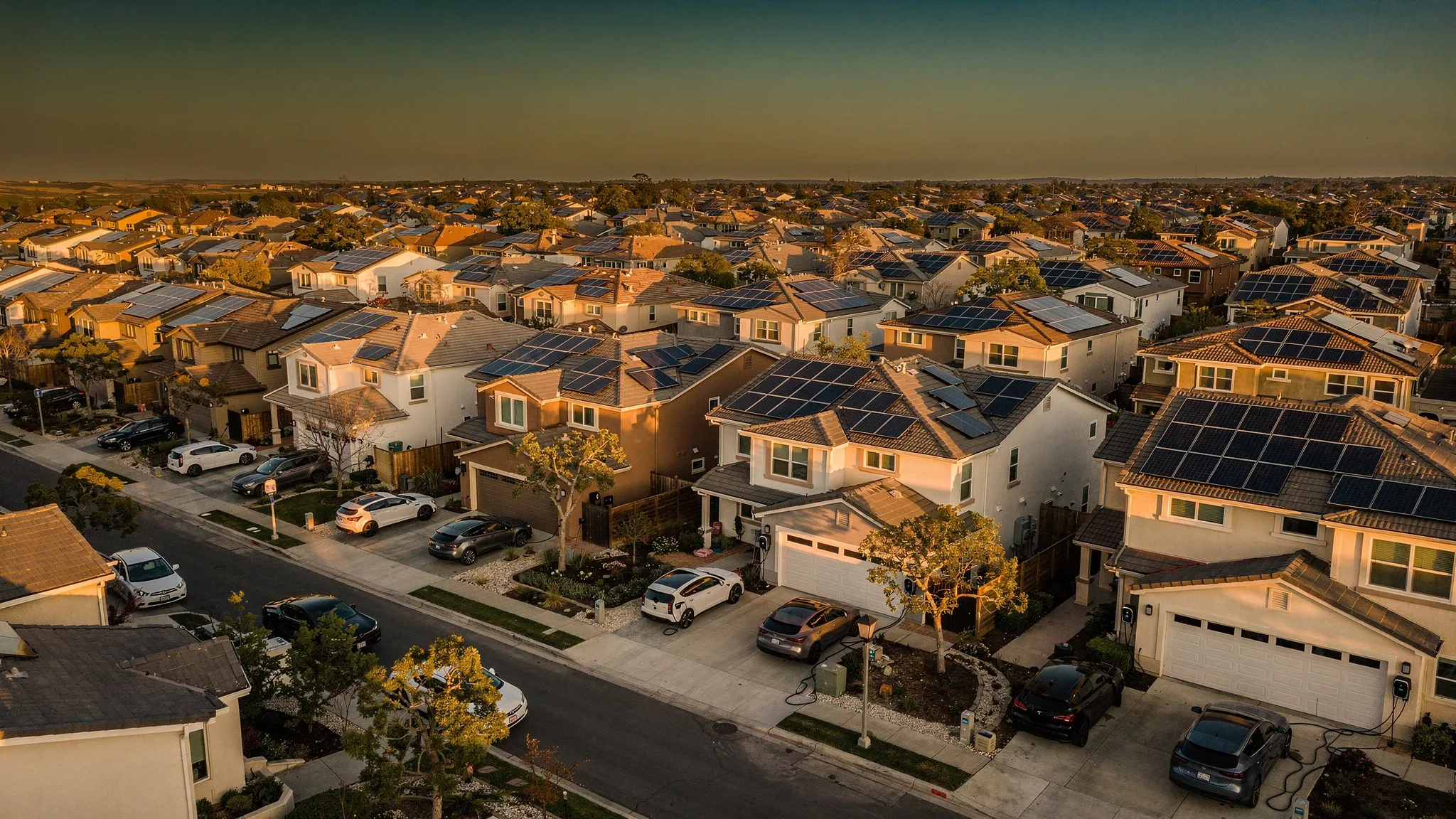
PARKED CARS THAT KEEP THE SUNSHINE FOR THE NIGHT
Solar panels and electric cars are spreading fast, but their timing clashes: panels produce in daylight and stop at sunset, while cars tend to charge in the evening, when people come home. The more of both there are, the harder the grid has to work to balance them.
The “SolarEV City” idea turns the clash into a match: use the batteries of electric cars as storage spread across the city, next to the rooftop panels. Cars soak up the midday surplus and, through two-way “vehicle-to-home” or “vehicle-to-building” connections, release it in the evening and at night.
One city, 5,000 climates
How much does climate alone change the result? Previous studies mixed climate with local differences in roofs, cars and habits. Yuchen Liu and Takuro Kobashi, of Tohoku University in Japan, with colleagues at Delft University of Technology and Japan’s Meteorological Research Institute, ran a controlled experiment on the computer.
They took Kyoto as a standard reference city and kept everything fixed — roof area, number of cars, driving habits, the way people use electricity — while moving it to 5,000 land locations around the globe. Only the local weather changed, and with it the hourly solar output and the demand for heating and cooling.
The standard city has rooftop panels rated at 7.41 gigawatts — the power they deliver together in full sun — and 475,500 electric cars, each with a battery that stores 40 kilowatt-hours of energy and can charge or discharge at 6 kilowatts, its rate of exchange with the house. The cars are away three hours each day. The simulation runs hour by hour, 8,760 hours a year, over a 25-year lifetime, with panels and batteries ageing. The key number is self-sufficiency: the share of electricity for buildings and driving that is supplied locally, directly by the panels or via the car batteries.
What came out
- Self-sufficiency ranged from 21.6% to 84.2%, and topped 60% across most regions south of 45° north.
- Adding the car batteries raised the median by 21.1 percentage points over panels alone (44.8%), even though the cars add their own demand.
- Sunshine is not the whole story. Three factors explain 98% of the variation: the solar resource, how well demand lines up with sunny hours, and how high demand is overall.
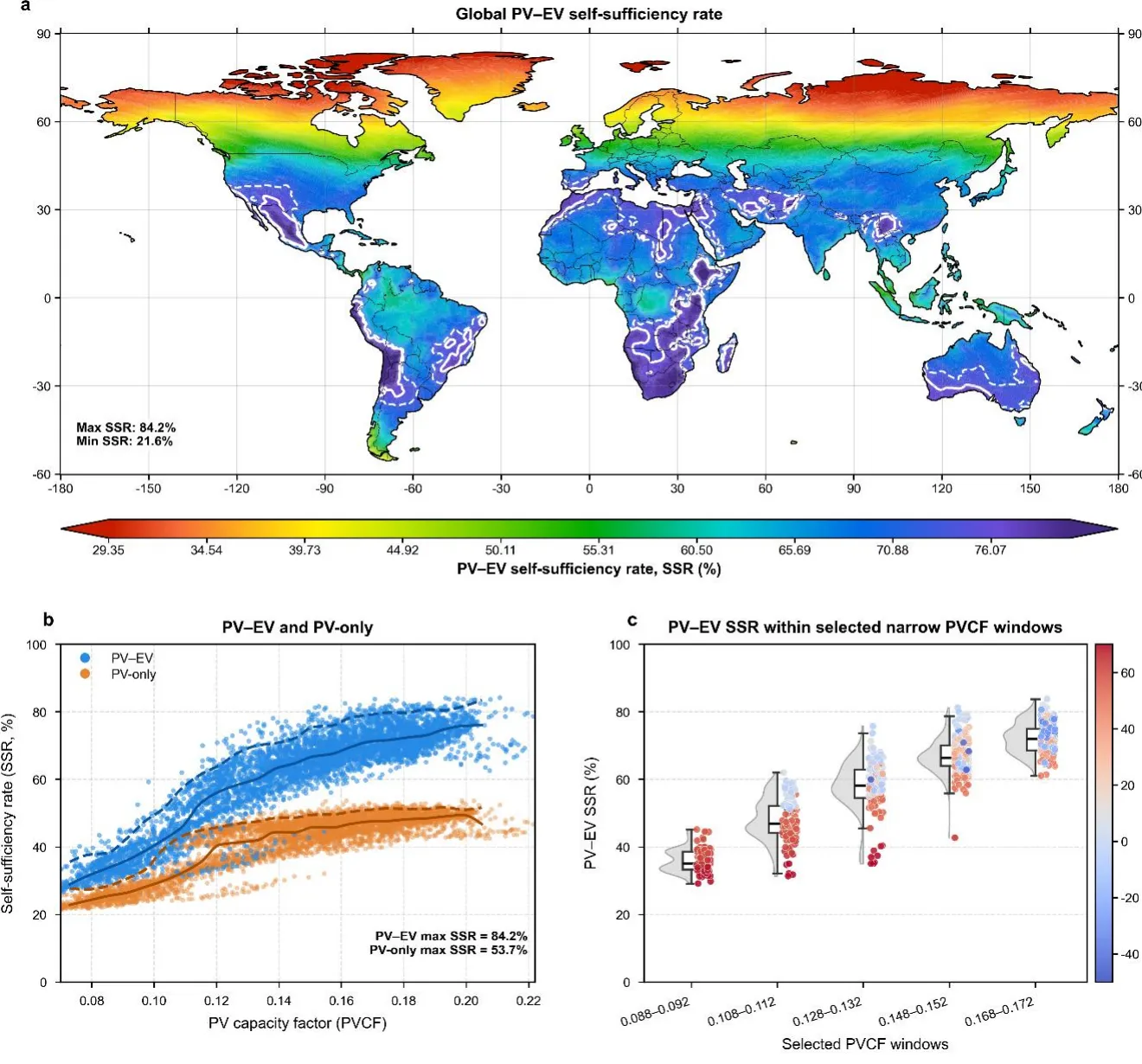
Top: self-sufficiency of the same panels-plus-cars system across the globe. Bottom left: with car batteries (blue) versus panels alone (orange). Bottom right: at equal solar output, latitude still makes a big difference. — Figure 2, Liu et al. (2026), arXiv:2610.29344, CC BY 4.0.
Cairo versus Novosibirsk
In Cairo and Mexico City, self-sufficiency stays near 80% all year. Clear skies help, but the key is timing: in the hottest months, the extra air conditioning peaks at midday, right when the panels produce. São Paulo, helped by its altitude, and Perth, whose rain falls in winter when the sun is low anyway, also rank among the near-ideal places.
In Novosibirsk, winter demand exceeds production even around noon. Self-sufficiency drops to 20–30% in winter and climbs to about 90% in summer. Car batteries cannot bridge a shortfall that lasts months. In Singapore, Port Harcourt and Surabaya, daily storms, monsoon rain or the wet season cut sunshine just when it could match daytime demand.
Good timing can make up for missing sunshine: regions with little sun but well-aligned demand kept 67.7%, about as much as sunny regions with poorly aligned demand (68.9%).
The cities that sunshine maps miss
Ranking places by solar resource alone misclassifies roughly a quarter of the 5,000 locations. Among the 1,000 most populous cities, 219 (21.9%) are severely underrated, and only 37 overrated. East Asia counts 82 of them, Africa 51 and South America 39. Including South and Southeast Asia, 88.1% lie in regions expected to absorb much of the future growth in urban population and electricity demand. In sub-Saharan Africa alone, around 600 million people still lack electricity, according to the International Energy Agency figure the authors cite.
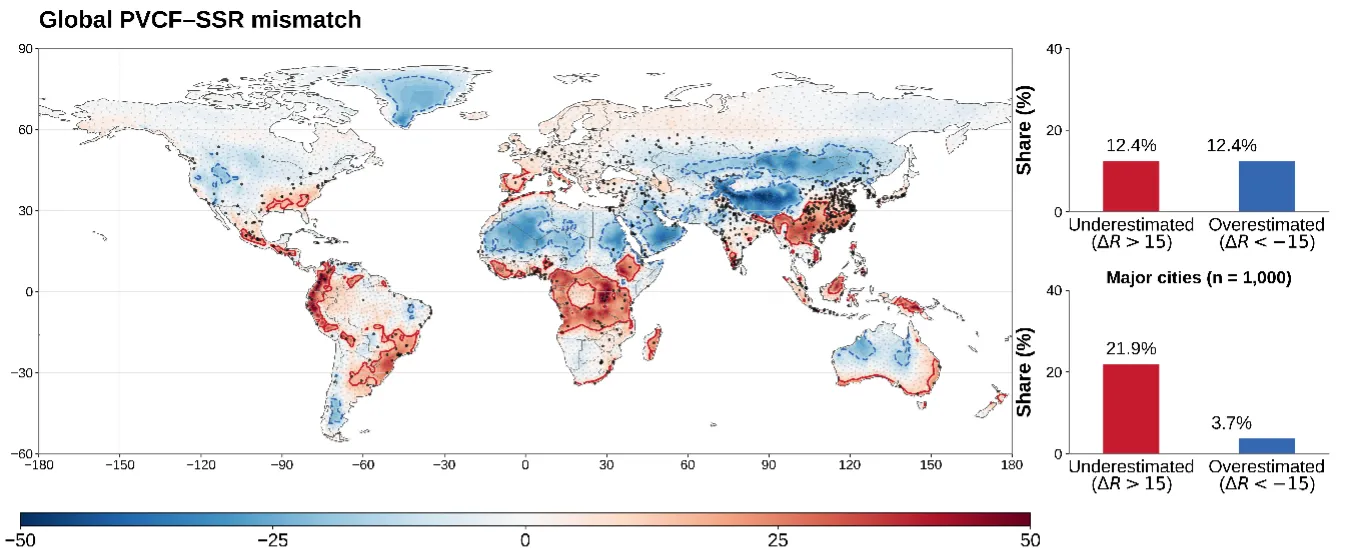
Red: places where a sunshine ranking underrates the panels-plus-cars potential; blue: where it overrates it. Right: 21.9% of the 1,000 largest cities are badly underrated. — Figure 6a, Liu et al. (2026), arXiv:2610.29344, CC BY 4.0.
A reference, not a plan
Kyoto here is a yardstick, not a blueprint. Real deployment depends on local loads, parking habits, buildings, grid capacity, prices and market rules, and future climate change will reshape the map. The authors also note that a car’s battery is not always available just because it exists. Their conclusion: siting decisions should move beyond solar maps to how supply and demand match through the day and the year.