NINE RADIO FLASHES IN 106 SECONDS, THEN SILENCE
Fast radio bursts are brief flashes of radio waves, lasting milliseconds, that reach us from other galaxies. Their origin is still debated, and one question dominates: do they all repeat? Some sources flash again and again; most have been seen only once. In the second catalogue of the Canadian radio telescope CHIME, which scans the northern sky every day between 400 and 800 megahertz, only about 2.4% of 3,641 sources repeat.
Studies of whole populations usually assume that each repeating source fires at a steady average rate. Ryan Mckinven, of McGill University, and some thirty colleagues of the CHIME/FRB collaboration now describe a source that breaks that assumption more than any other.
Two minutes of fury
On 1 June 2021, CHIME recorded nine bursts in 106.5 seconds from a source now called FRB 20210601A. A network problem at the time stopped the automatic alerts, so nobody noticed. The bursts were only found in December 2024, during a systematic audit of the database for the second catalogue.
Then the team looked for more. CHIME does not move: as the Earth turns, that patch of sky crosses its field once a day, for about ten minutes. Between July 2018 and the end of 2025, that adds up to some 320 hours of exposure: about 132 before the storm, 188 after. Not one more burst, not even faint ones just below the detection threshold in the days around the storm. By the end of 2025, the silence after the active window had lasted at least 1,674 days.
Within those 106.5 seconds, the gaps between bursts are consistent with random arrivals, like raindrops, at an average of about 0.075 per second. At that pace, the chance of a further 40 seconds without a burst falls below 5%. Yet when the source crossed the centre of CHIME’s field a few minutes later, nothing came: something had switched off.
The storm was only half seen
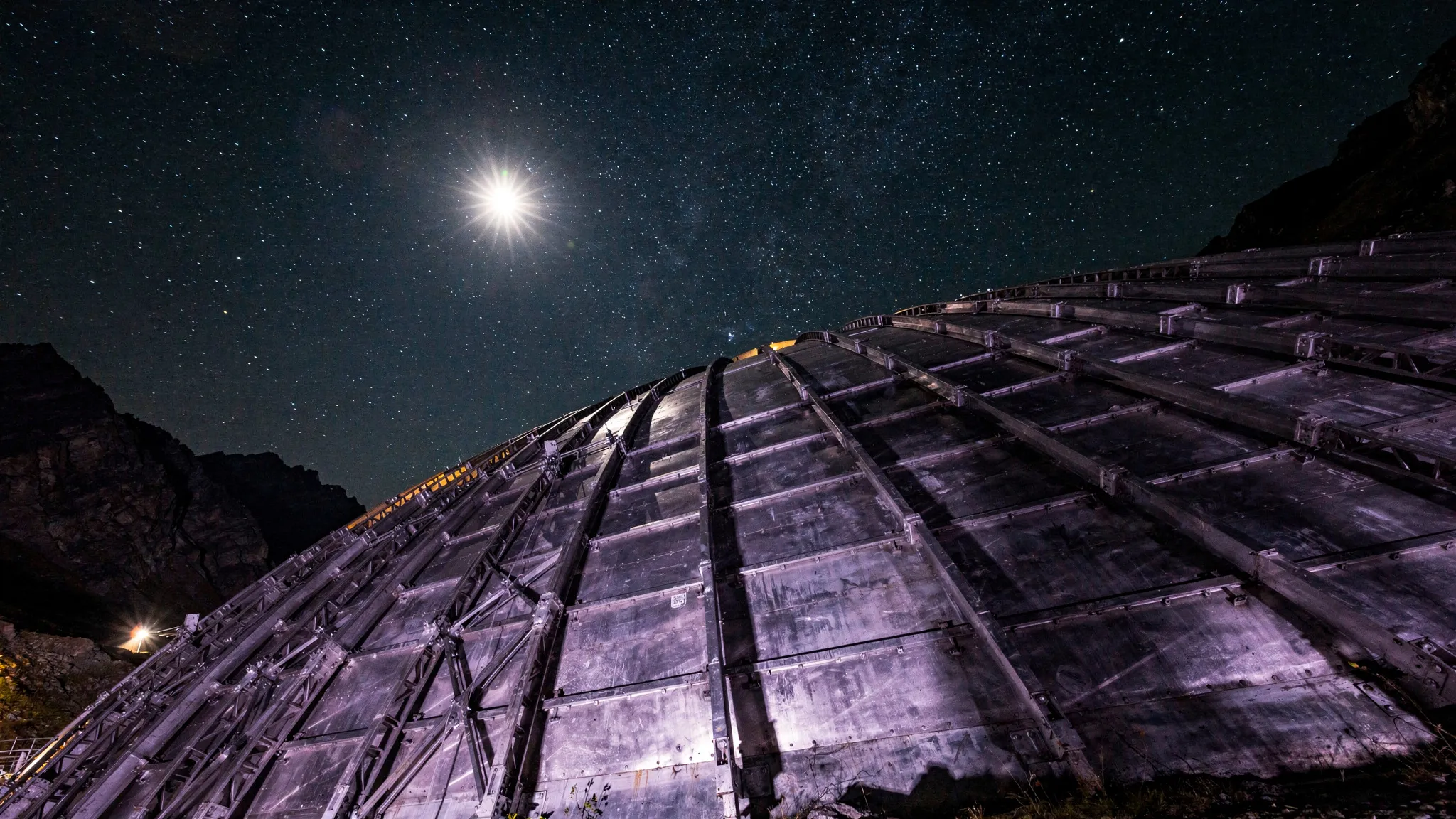
All nine bursts arrived while the source sat in a side lobe of CHIME’s beams — the less sensitive edge of its field of view, about a quarter as sensitive as the centre. Had the storm come a few minutes later, as the source crossed the centre of the field, the team estimates CHIME would have recorded at least 21 bursts, perhaps around 70.
How extreme is that? The team compared it with two of the most prolific repeaters known, followed by the giant Chinese radio telescope FAST. With FAST’s full sensitivity, they reach 46 and 23 bursts in a 106.5-second window. But keeping only bursts as bright as the faintest of the nine, their best windows hold just 6 and 8. According to the authors, FRB 20210601A shows the highest burst rate over minutes ever reported from a repeating source at comparable sensitivity — while the comparison remains rough, since the two telescopes listen at different frequencies and different rhythms.
An ordinary source with an odd timetable
Otherwise, the source looks typical. The bursts have the drawn-out, multi-part shapes common in repeaters, and the way their signal is spread and twisted by the gas they cross falls close to the average for CHIME repeaters. No host galaxy could be pinned down, and searches for gamma-ray, X-ray, optical or persistent radio counterparts found nothing.
The energy released was modest: about a millionth of the magnetic energy stored in a typical magnetar, a strongly magnetised neutron star, even taking the source’s distance at the maximum the data allow.
What could switch on and off like that?
The authors weigh several ideas, without a winner:
- Intermittent pulsars, which switch off for long stretches. One recently found in our Galaxy, PSR J2109+50, showed its bright mode only once in a month, for about 90 seconds — but it is far less luminous.
- Magnetar outbursts. In our Galaxy, the magnetar 1E 2259+586 fired more than 80 X-ray bursts in four hours after 5.6 calm years. Still, a two-minute storm is far more compressed than any known Galactic example.
- A companion star, whose wind or orbit would open a brief window of emission or visibility.
- Lensing, where a clump of matter briefly magnifies a source that is usually too faint.
A hidden population
If such episodic sources exist, CHIME is the best place to find them, thanks to its daily scans of a wide sky. A simple statistical model suggests about 9 of them within CHIME’s reach — with enormous uncertainty, from 1 to over 200 — and, at best, one to four more discoveries in the next decade. Some apparently one-off bursts might even be storms caught only in part. A sensitive telescope such as FAST, pointed at the source during its quiet years, could test the idea by catching fainter bursts.