IF BETELGEUSE SWALLOWS ITS COMPANION, THE SKY WILL FLASH
Betelgeuse, the red supergiant marking Orion’s shoulder, is one of the most studied stars in the sky, with a radius close to 800 times the Sun’s. For decades, astronomers argued over whether it hides a partner: its speed along our line of sight wobbles oddly, its brightness has a long secondary cycle, and it spins unexpectedly fast.
Recent analyses explain all three with a low-mass companion star circling inside Betelgeuse’s extended outer atmosphere, once every six years or so, at about 8.6 times the Earth–Sun distance. It now has a name: α Orionis B, or Siwarha, “her bracelet” in Arabic. Two telescopes have probably glimpsed it directly, though the detections remain tentative and the mass estimates depend on models.
A companion on a slow death spiral
That orbit is not stable. Tides in Betelgeuse’s huge, churning outer envelope trade spin with the orbit and make it shrink. Meanwhile the giant keeps swelling. Eventually its surface reaches the companion, and the smaller star is engulfed. Astronomers call the phase that follows a common envelope: two stars sharing one gaseous body.
Such swallowings power a known kind of outburst, the luminous red nova. Our Galaxy produces roughly one per decade, but most happen much farther away and are spotted only after they erupt. Betelgeuse would be a rare case: a nearby, well-measured star caught before the event.
Naunet Leonhardes-Barboza and colleagues at the University of California, Santa Cruz, the Flatiron Institute’s Center for Computational Astrophysics in New York and the Center for Astrophysics | Harvard & Smithsonian evolved Betelgeuse with companions of 0.7, 1.0 and 2.0 solar masses — to cover the uncertain mass of the real one — up to the moment of engulfment. Depending on the mass, that moment arrives in 7,262, 5,702 or 4,293 years in their models. The authors treat these dates as orders of magnitude only: how tides act in a turbulent envelope is uncertain tenfold or more.
Torn apart near the core
Once swallowed, the companion spirals inward ever faster, dumping orbital energy into the gas, until the giant’s gravity rips it apart a few solar radii from the centre. In the two lighter cases the companion is still a young star, not yet on its main, stable phase, with a puffy, low-density envelope; the 2-solar-mass one is more compact.
The team fed this energy into one-dimensional simulations of gas and radiation, which treat the star as perfectly round and follow only what changes with distance from the centre. In total, 6.3 to 13.9 × 10⁴⁸ ergs (the erg is a tiny unit of energy) are released deep inside, below the base of the star’s churning hydrogen envelope, where hot gas rises and sinks like boiling water — far too deep for the light to escape straight away. Instead, the energy launches a pressure wave that steepens into a shock and travels outward from a few solar radii to the surface, about 820 solar radii from the centre. In the 1.0-solar-mass model, it takes about 28 days to reach the surface.
Brighter than Venus, bluer than Sirius
When the shock breaks out, Betelgeuse flares. The peak reaches 2.4 to 6.2 × 10⁴¹ ergs per second — of the order of a hundred million times the Sun’s output (figure 4 plots it near 10⁸ solar luminosities), roughly 600 to 1,600 times Betelgeuse’s own output today. The bright phase is short: 1.5 to 2 days, counted between the moments when it shines at half its peak.
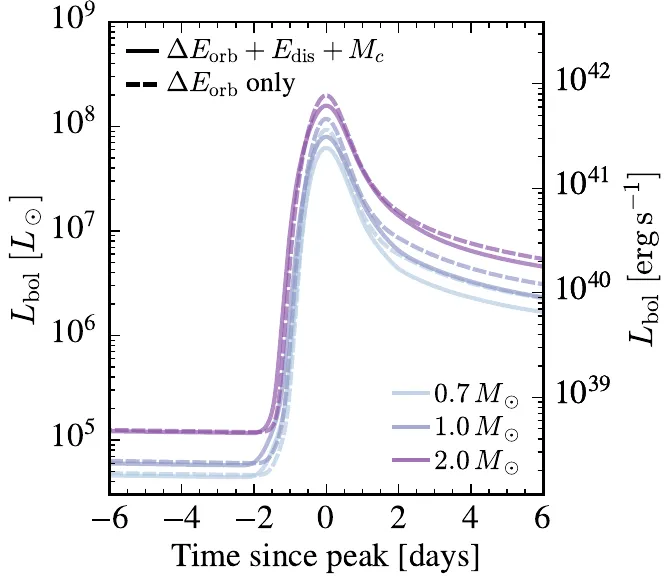
The predicted flash for companions of 0.7, 1.0 and 2.0 solar masses, centred on the peak. Solid lines include the torn-apart companion’s mass and energy; dashed lines count only the energy of the inward spiral. — Figure 4, Leonhardes-Barboza et al. (2026), arXiv:2610.31755.
Seen from Earth, the authors write, the outburst would be several times brighter than Venus, while staying fainter than the full Moon, and would far outshine Sirius, the brightest star in today’s night sky. Its colour would change dramatically: red while the shock is still buried, then suddenly bluer than Sirius as hot gas reaches the surface, then reddening again as the ejected gas expands and cools.
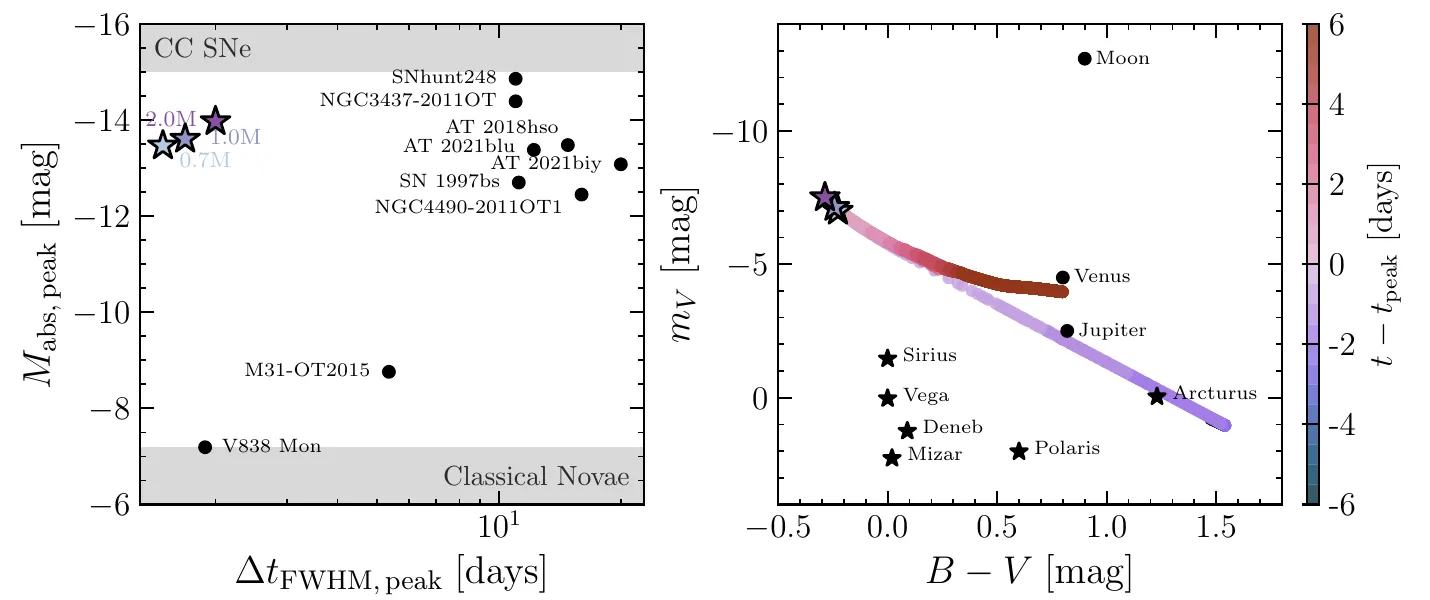
Left: the Betelgeuse models (coloured stars) sit among the brightest and shortest early peaks of observed red novae. Right: the predicted track of the 1.0-solar-mass model in the night sky, compared with the Moon, Venus, Jupiter and bright stars; the colour scale counts days from the peak. — Figure 5, Leonhardes-Barboza et al. (2026), arXiv:2610.31755.
A flash that remembers its victim
The heavier the companion, the brighter the flash: peak luminosity grows roughly as the companion mass to the power 0.93, a factor of about 2.5 between the lightest and heaviest models. The duration barely moves, by about 35%. So the early blue flash carries a measurable memory of the star that was swallowed.
The shredding of the companion matters too. It adds energy, but also mass to the expelled gas, so each gram gets less energy: in the simulations, including it slightly lowers the peak compared with the energy of the inward spiral alone.
Six to eleven Suns’ worth of gas
The merger also blows away 6.15 to 11.19 solar masses of hydrogen-rich gas at around 200 kilometres per second — a large share of Betelgeuse’s envelope. A classic energy-budget formula says the lightest companion should eject nothing; the simulation still throws out over six solar masses, because shocks push the outer layers in ways such a budget misses.
Betelgeuse is expected to end as a supernova, probably within the next 100,000 years. If the merger comes first, that explosion would go off inside the gas the merger left behind.
An older scar, dust and lopsided gas
Not everyone reads Betelgeuse’s past the same way. Some researchers see its fast spin and unusual surface composition as traces of an earlier merger, rather than signs of a companion. If both readings were right, Betelgeuse would need a more complex history, possibly within a system of several stars; the authors stick to the Betelgeuse–Siwarha pair.
The model is also one-dimensional, whereas a real merger is lopsided and turbulent, and it ignores the gas and dust Betelgeuse has already shed. Collisions with that material would broaden the flash and dim its peak, so the predicted brightness is an approximate upper limit and the durations lower limits. Thick dust could make the outburst redder and fainter in visible light, glowing in the infrared instead. Under one earlier estimate cited by the authors, though, the dust would leave the flash only slightly reddened, not hidden.