DOES A NEWBORN BLACK HOLE CHOOSE MAXIMUM ENTROPY?
When two black holes spiral into each other, they leave a single spinning black hole behind. Computer simulations of Einstein’s equations — numerical relativity — predict its properties with remarkable precision. Take two black holes of equal mass, not spinning, on a near-circular orbit: they leave a black hole with about 95.16% of their total mass and a spin of about 0.69 on a scale where 1 is the fastest possible. The rest leaves as gravitational waves.
The simulations give the answer. What they do not give is a reason — a simple physical principle that would explain why this particular final state is chosen.
A rule borrowed from thermodynamics
A team of physicists recently proposed one, called the maximum-entropy conjecture. Follow the pair as it loses energy and angular momentum to gravitational waves. At every step, imagine a hypothetical black hole that would form at once with the pair’s current mass and angular momentum. Such a black hole has an entropy — in thermodynamics, the quantity that never decreases and settles at its maximum when a system reaches equilibrium; for a black hole, it is proportional to the area of its horizon.
As the pair spirals in, the entropy of this imaginary candidate first rises and reaches a peak; if the calculation is pushed past that point, it falls again. The conjecture says the real remnant is the candidate at the peak. It is a construction, not the true entropy of the pair, for which there is no agreed definition during a merger. Yet with a detailed description of the inspiral, to fourth order in the post-Newtonian approximation (Newton’s gravity with Einstein’s corrections added one order at a time), the peak lands within a few per cent of what the simulations predict.
That is a striking coincidence — or a hint of a deeper link between orbital motion and black-hole thermodynamics. Only observation can tell, and Yang Jiang and Qing-Guo Huang, at the University of Chinese Academy of Sciences and the Institute of Theoretical Physics in Beijing, set out to provide one.
One signal, cut in two
They used GW250114, recorded by the two LIGO detectors with an exceptionally strong signal: a signal-to-noise ratio — how far the signal stands out from the detectors’ noise — of 78.6. It came from two black holes of nearly equal mass, with small spins and no measurable elongation of the orbit — close to the ideal case the conjecture was built for.
The key was to split the signal so that the conjecture never shaped the measurement:
- Before the merger, the inspiral reveals the masses of the two black holes. From them, the team computed the curve of the candidates’ entropy and found its peak: that is the prediction.
- After the merger, the new black hole “rings” like a struck bell, in waves that quickly fade. Their pitch and how fast they die out depend only on its mass and spin: that is the measurement.
Prediction against measurement
The maximum-entropy rule predicts a final black hole of 70.0 solar masses with a spin of 0.70. The ringing gives 72.3 solar masses (give or take about 3.6) and a spin of 0.74 (+0.05 / −0.07).
The prediction is far sharper than the measurement: the inspiral contains many orbits, while the ringing is brief and weaker. The predicted spin also has a hard ceiling near 0.70 — in this version of the rule, the spin depends only on how equal the two masses are, and two equal masses give the maximum.
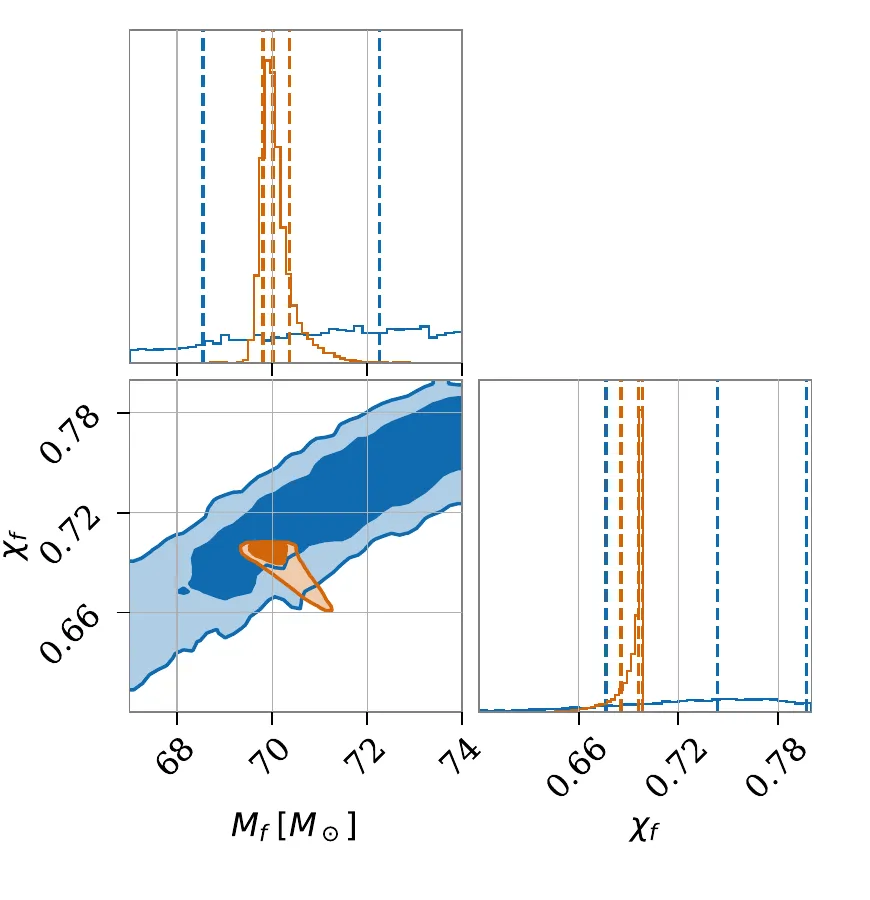
Mass and spin of the final black hole: predicted by the maximum-entropy rule from the inspiral (orange), and measured from the ringing (blue). Dark and light shading: 68% and 95% credible regions. — Figure 1, Jiang & Huang (2026), arXiv:2611.05718.
The team measured the gap as relative deviations — prediction minus measurement, divided by the measurement, so −0.03 means a prediction 3% too low. For mass, −0.03 ± 0.05; for spin, −0.07 (+0.09 / −0.06); for entropy, a median of −0.03 with a 68% range — the range that has a 68% chance of holding the true value — from about −0.09 to 0.04. Zero — perfect agreement — lies within the 68% range.
They then varied where they cut the signal, when they started reading the ringing, and whether they included a second ringing tone. The prediction barely moved; the measurement shifted somewhat, and adding the second tone nudged the entropy gap upward. In every case, zero stayed within the 95% range.
Agreement, not proof
The authors are careful: the result does not confirm the conjecture. The precision is limited by the ringing, and their version of the rule assumes the two black holes were not spinning, when their spins were small but not known to be exactly zero.
Louder signals, a version of the rule that includes spin, and many events combined could settle the question: whether maximum entropy is only a remarkable shortcut to what supercomputers compute, or a principle that nature actually follows when two black holes become one.