THE PROOF GALOIS NEVER WROTE DOWN
The “testamentary letter” that Évariste Galois wrote on the eve of his fatal duel is packed with mathematics. Its first part summarises his theory of when polynomial equations can be solved, the subject of a memoir he had submitted to the French Academy of Sciences on 16 January 1831. But almost a quarter of the letter deals with something else: the symmetries of the “modular equation”, which comes from the theory of elliptic functions.
In modern language, those symmetries form a group that shuffles p + 1 objects — the numbers 0, 1, …, p − 1 plus a point called “infinity” — where p is a prime number. Each shuffle is a fraction x ↦ (ax + b)/(cx + d), computed with whole numbers modulo p — that is, keeping only the remainder after dividing by p. Inside this group, Galois singled out a half, now called PSL(2, p).
A claim with three exceptions
About this group, Galois made two claims without proof. The first — that the group cannot be broken into smaller pieces — he called easy, and the author of the new paper, Péter P. Pálfy of the Alfréd Rényi Institute of Mathematics in Budapest, admits: “We have no clue what kind of easy proof he had in mind.”
The second is the one Pálfy has always admired Galois for. PSL(2, p) has a subgroup of index p — a subgroup p times smaller than the whole group, which would let the equation be reduced to one of degree p — only when p is 5, 7 or 11. After giving the three examples, Galois wrote: “In all rigour this reduction is not possible in the higher cases.”
That “in all rigour” hides a correction. In a short announcement published in April 1830, Galois had claimed the reduction was impossible for every p above 5. In the letter, he quietly fixed it and insisted: “all that I have written here has been in my head for almost a year and it is not in my interest to make a mistake so that one could suspect me of having announced theorems of which I did not have the complete proof.” The proof itself, Pálfy notes, was apparently never written down.
The proofs that came after
Enrico Betti published the first proof in 1853, but it was incomplete. The first correct one appeared in Camille Jordan’s treatise of 1870, using linear algebra; his general argument needed p above 13, so he had to treat 13 separately. In 1881, Joseph Gierster, a student of Felix Klein, listed all subgroups of PSL(2, p), and Galois’s claim followed at once. Today it is seen as a corollary of that classification — built on group theory developed long after Galois.
How, then, could Galois have known? Pálfy’s clue is a word. Among Galois’s surviving fragments, on a torn piece of paper kept at the library of the French Academy, is his handwritten definition of an “imprimitive” group: one that moves its objects around in fixed blocks.
Sorting the objects into pairs
Pálfy’s reconstruction uses only that idea and simple counting. The whole group has (p + 1) × p × (p − 1) / 2 elements, so a subgroup of index p must have (p + 1)(p − 1)/2. From there, the paper shows that such a subgroup must sort the p + 1 objects into pairs that it always keeps together — Galois’s own “linked letters” — and the labels can be chosen so that infinity is paired with 0.
Call M the partner of 1. Two cases remain:
- If M is a square modulo p — the remainder, after dividing by p, of some whole number multiplied by itself — it must be −1, and an equation of the form x² + 1 = 0 would have to hold for almost every number. It has at most two solutions, so p ≤ 5.
- Otherwise, every square modulo p other than 0 and 1 must solve one of two quadratic equations. Each has at most two solutions, so there can be at most five non-zero squares. Since exactly half of the non-zero numbers modulo p, (p − 1)/2 of them, are squares, that forces p ≤ 11.
Beyond 11, the pairs simply cannot be made to fit.
Three Platonic solids
For p = 5, 7 and 11, Galois even wrote down the pairings that work: for p = 7, for instance, ∞ with 0, 1 with 3, 2 with 6, and 4 with 5. Pálfy shows that, up to symmetry, they are the only ones.
To check that they really give subgroups, Pálfy takes a deliberately anachronistic shortcut, since for Galois a group was always a set of permutations of roots. The three subgroups have 12, 24 and 60 elements: exactly the numbers of rotations of the tetrahedron, the cube and the icosahedron. Label the six edge midpoints of the tetrahedron, the eight corners of the cube or the twelve corners of the icosahedron with 0, 1, …, p − 1 and infinity in the right way, and each rotation of the solid becomes one of Galois’s fractions.
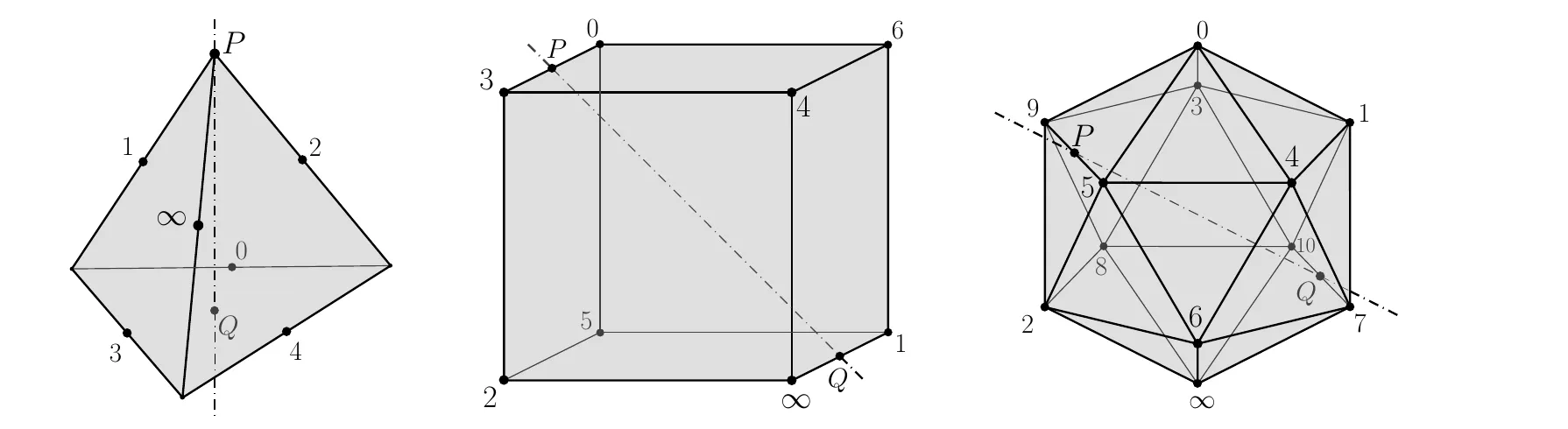
The tetrahedron (p = 5), cube (p = 7) and icosahedron (p = 11), with their points labelled 0, 1, …, p − 1 and ∞ so that rotations act like Galois’s fractions; dashed lines: rotation axes. — Figure in Section 4, Pálfy (2026), arXiv:2611.06054.
The paper is dedicated to the memory of Peter M. Neumann, editor of Galois’s mathematical writings, with whom Pálfy exchanged emails on the question in 2020. Whether Galois’s own argument looked like this one, nobody can say. But it offers a proof built only from tools he had — a sign that the result was within his reach.