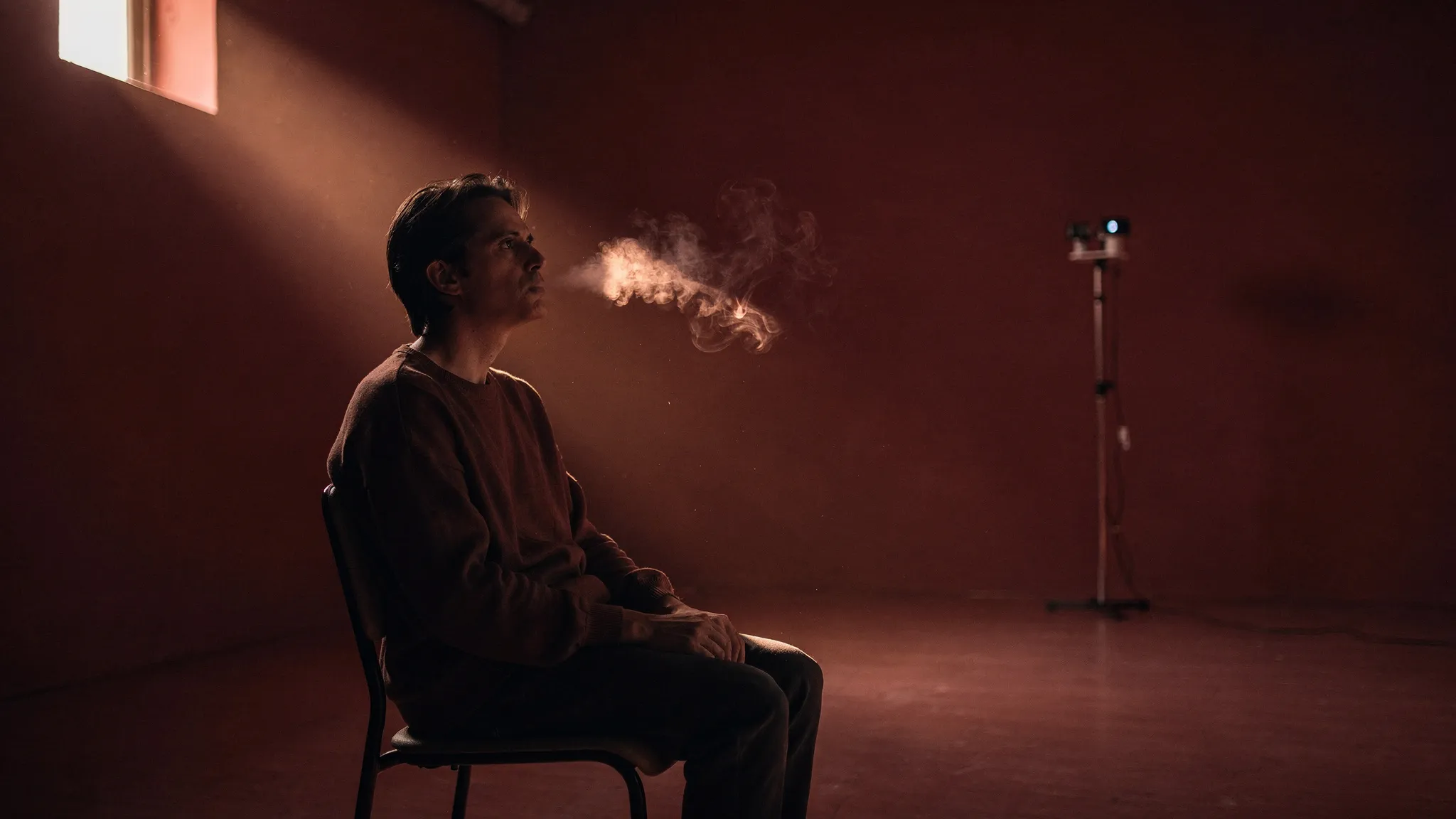
YOUR BREATH CROSSES THE ROOM
Sit someone in a closed room, and the air they breathe out will soon reach the far wall. How fast, and by what route? For airborne infections, the answer decides who is exposed. Lars Natusch and Roland Netz, physicists at the Free University of Berlin, combined measurements and computer simulations to find out, using carbon dioxide as a tracer. CO₂ is produced automatically by every person, it is far easier to measure than aerosols, and it moves like small micron-sized droplets, which take much longer to settle than the times that matter here.
Thirty minutes on a chair
The room measured 5.75 by 2.85 metres, with a ceiling at 2.55 metres, a window, and no ventilation. A test person walked in, sat down and breathed calmly, without talking, for 30 minutes. Three CO₂ sensors stood 3 metres away, on the other side of the room, at heights of 0.3, 0.8 and 1.8 metres. The experiment was repeated five times.
The CO₂ level, about 455 ppm (parts per million) at the start, then rose steadily by 0.1314 ppm per second. Multiplied by the room’s volume, that gives a production of 0.00549 litres of CO₂ per second, close to the 0.0052 litres per second reported for an average-sized adult.
Far too fast for diffusion
The striking number is the delay. The CO₂ needed 150 seconds to reach the top sensor, 170 for the middle one and 280 for the bottom one.
If molecules simply drifted at random, by diffusion, distance and time would be linked by L² = 2Dτ, where L is the distance, τ the delay and D the diffusion coefficient, which says how fast molecules spread by random motion alone. Plugging in 3 metres and these delays gives an effective coefficient of 0.016 to 0.030 square metres per second, about three orders of magnitude — roughly a thousand times — above the real value for CO₂ in air, 0.000016 m²/s.
The simulations confirm it. With diffusion alone, the coefficient has to be inflated 500 to 1,000 times to match even the bottom sensor. With the real value, the CO₂ barely leaves the person’s surroundings, even after 25 minutes.
Heat helps, but arrives late
The team then added the person’s body heat, between 70 and 110 watts released through the skin and 10 watts through breathing, and the measured temperatures of the walls and window. The air warmed by the body rises to the ceiling with the CO₂, spreads out, cools along the walls and sinks towards the floor.
That brings the simulation much closer to reality. But the middle and lower sensors still see the CO₂ too late, and the top sensor shows large swings in concentration that the real sensors never recorded: the CO₂ stays mostly in the upper part of the room.
Breathing out is not breathing in
The third model adds breathing: 0.8 litres every 4 seconds through the nose, at 0.96 metres per second, split into thirds of breathing in, breathing out and pause. Now the delays at all three sensors match the measurements closely, the swings fade, and the concentration rises steadily as in the experiment. Only with breathing can the delays be reproduced everywhere.
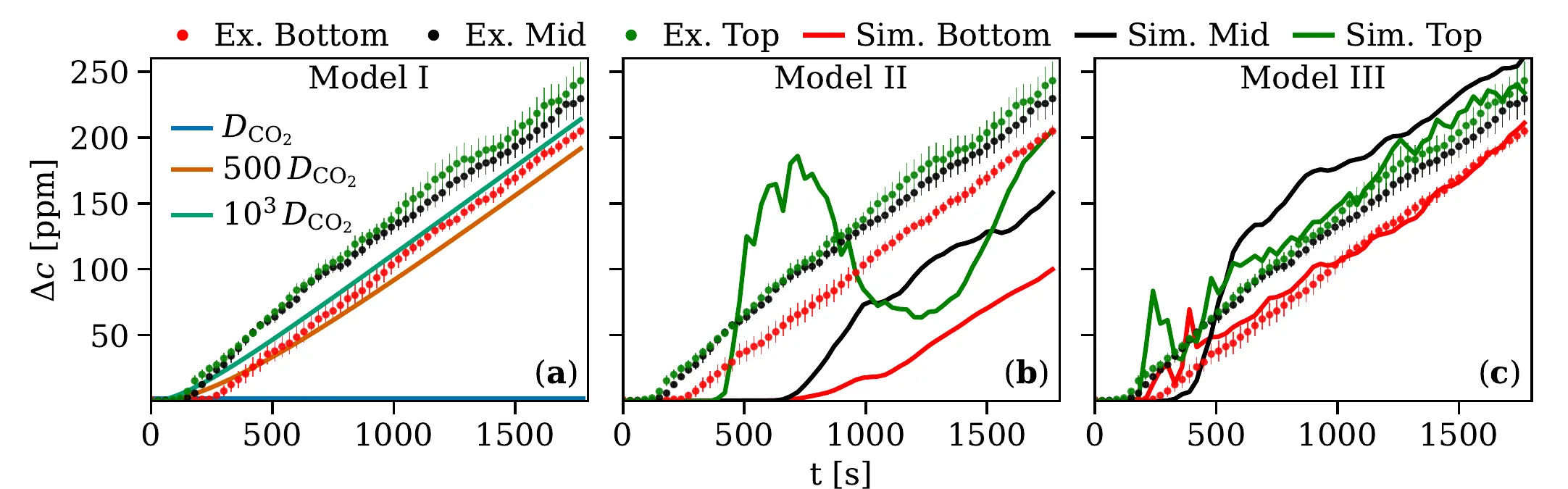
CO₂ increase measured (dots) and simulated (lines) at the three sensors over 30 minutes: diffusion alone (Model I, three diffusion coefficients), with heat (Model II), with heat and breathing (Model III). — Figure 2, Natusch & Netz (2026), arXiv:2611.15791.
Why does breathing matter so much, when air goes out and comes back in by the same amount? Because the two halves are not mirror images. Breathing out launches a jet that reaches far into the room. Breathing in only draws air from the immediate vicinity of the face. Only a thin layer of CO₂ next to the nose is inhaled again; the rest stays in the room, carried farther by the moving air.

Horizontal air speed in front of the face during one breath: the red jet of exhalation (snapshot at 2 s) travels far, while inhalation (snapshot at 5 s) only moves air near the nose (blue). Room air at 20 °C (a) or 33 °C (b), breath at 33 °C. — Figure 4 (a–b), Natusch & Netz (2026), arXiv:2611.15791.
The authors trace this asymmetry to a classic exact solution of the equations of fluid flow, the Landau–Squire jet: the exact flow created by a small force pushing on a fluid is lopsided, front and back. Their simulations reproduce it, and the lopsidedness grows with the Reynolds number, which grows with the flow’s speed and shrinks with the air’s viscosity, its internal friction. For breathing, this number reaches about 1,600, well above the values of 20 and 70 in these tests, so the lopsidedness should be even stronger.
Masks, voices and crowded rooms
The authors draw a few consequences. Small droplets 1 micrometre in radius stay airborne for about five hours when released at a height of 2 metres. Speaking produces more aerosols but, according to earlier work they cite, barely changes the long-distance flow, so the results should hold for someone who talks. And masks may protect at a distance not only by filtering, but also by slowing down the jet that carries the aerosols.
The study covers one person in one unventilated room. The next step is a room with several people, where breathing jets, rising plumes of warm air and ventilation could combine in ways that a single seated person cannot reveal.