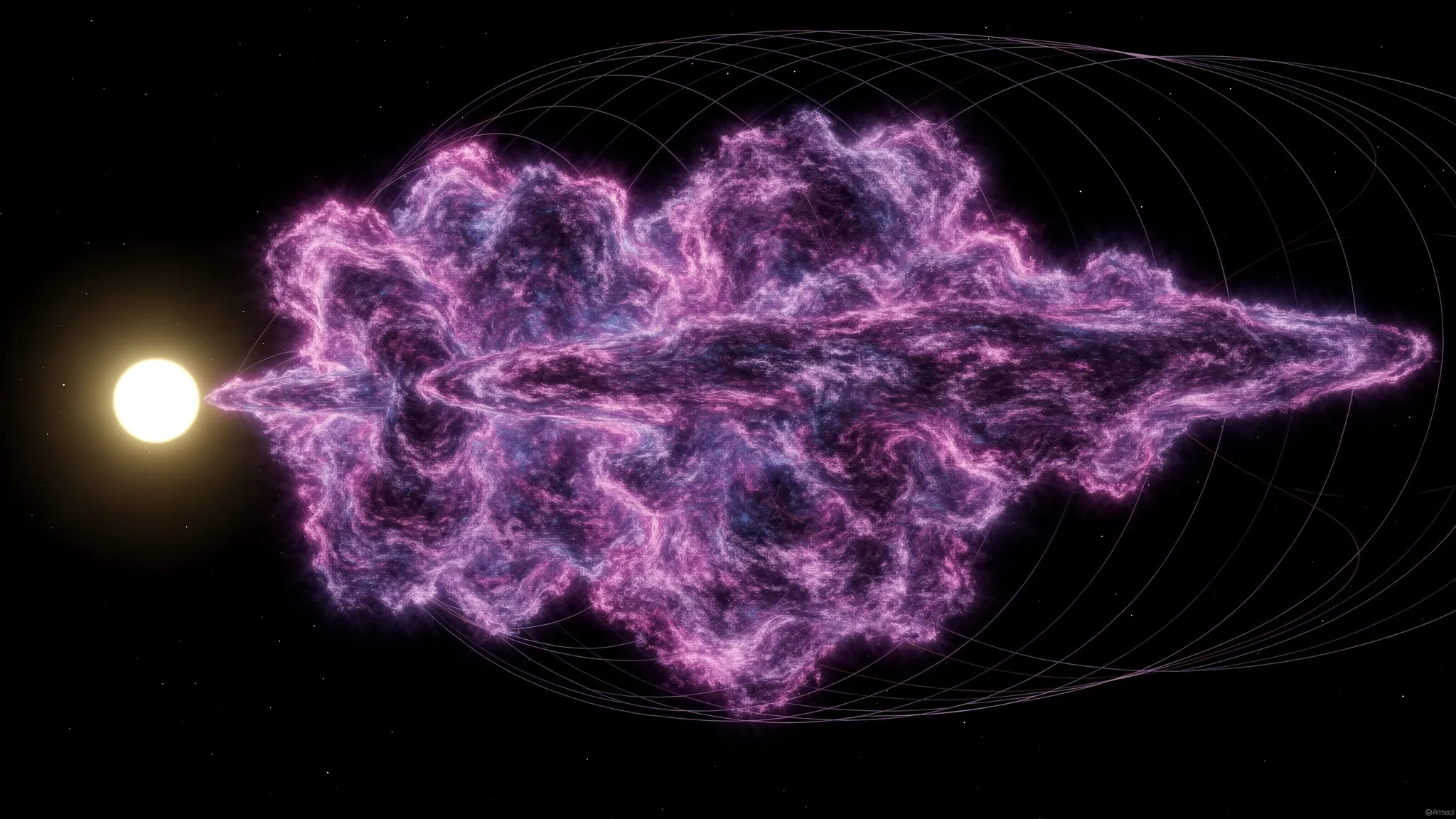
THE SOLAR PANCAKE BEHIND THE MAY 2024 STORM
Now and then, the Sun throws a coronal mass ejection (CME) into space: a cloud of magnetized plasma weighing some 10¹² to 10¹³ kilograms, carrying 10²³ to 10²⁵ joules. When such a cloud heads for Earth with a magnetic field pointing south, it can trigger a severe geomagnetic storm, able to disrupt communications, navigation, power grids and activities in space.
Clouds launched one after the other can collide on the way. Several iconic superstorms — the 1859 Carrington event, the 1989 Quebec event, the 2003 Halloween event and the May 2024 storm — have all been tied to such encounters between several CMEs. Interacting clouds often carry an unusually strong southward field. The question is why.
The usual suspect: a shock
The classic explanation is a shock. A fast cloud drives a shock wave ahead of it; when that shock runs into a slower cloud in front, it compresses its magnetic field. Simulations show this can amplify the southward field by a factor of two or more. But on its own, a shock seems unable to explain why, in many extreme storms, the strong field lasts so long. Two other processes are on the table: clouds squeezing each other, and clouds merging when their magnetic fields reconnect.
May 2024: a chase across space
On 8 May 2024, solar active region AR 13664 produced a string of eruptions. Three of its clouds — CME1, CME2 and CME3, born from the same region in the same direction — set off towards Earth one after the other. Their pile-up produced the strongest geomagnetic storm since 2003.
Ziwei Wang, Liping Yang, Xueshang Feng and colleagues, at Chinese institutions including the National Space Science Center of the Chinese Academy of Sciences and Peking University, followed the clouds with images from several spacecraft, from the solar surface to beyond Earth, and with measurements taken near Earth by the WIND spacecraft. They then rebuilt the event in a three-dimensional model of the solar wind, from the Sun’s surface out to 250 solar radii.
From a bulky cloud to a pancake
The images tell the first part of the story. Close to the Sun, CME1 and CME2 are clearly separate. Farther out, in the outer of the two heliospheric imagers aboard the STEREO-A probe — cameras that watch the space between the Sun and Earth — their fronts merge into a single large, bright front, and the clouds change shape: from a bulky cloud to a flattened “pancake”.
The simulation fills in the rest. Eight hours into the simulation, CME1 travels at about 1,000 kilometres per second. CME2, faster, then catches up with it. By the twentieth hour, the two clouds move at almost the same speed, separated by a hot interface. CME1 is squashed to a very thin layer. A cloud normally expands as it travels and its field weakens; squeezed, CME1 cannot expand, and its southward field stays above 60 nanoteslas inside. After about 27 hours, its front reaches Earth.
Three virtual experiments
To isolate the squeezing, the team ran three versions of the event. In the first, all clouds have the same magnetic twist, as in reality; where they touch, their fields point in opposite directions, so they tend to merge. In the second, CME2’s twist is reversed; the touching fields point the same way, and the clouds mostly squeeze each other. In the third, CME1 travels alone.
Both interacting versions give a peak southward field near Earth of about 60 nanoteslas. The lone cloud gives only about 30. The interaction doubles the field, and the simulated Dst index, the standard gauge of a geomagnetic storm’s strength, drops to about −400 nanoteslas, close to the −412 recorded during the real storm. Since squeezing alone does the job, the authors conclude that it, rather than merging, is the main driver. And the harder the squeeze, the stronger the field.
Three kinds of pressure
The squeeze works in stages. At first contact, around the ninth hour, the momentum of CME2 crashing into CME1 dominates, and CME1 thins rapidly. From about 12 to 20 hours, the magnetic pressure of the interface between the clouds takes over and strengthens CME1’s field. After that, the heat of the interface keeps CME1 compressed. In the end, its field stays about twice as strong as that of a lone cloud. This also explains a puzzle of the event: no shock was detected inside the clouds, yet the field stayed strong.
A single storm, for now
The study covers one event, and only the twist of CME2 was varied. The simulated clouds reach Earth too early — the model had to be shifted by about 11 hours to match the measurements, a common problem in forecasting. The paper has been accepted by The Astrophysical Journal Letters. Since one cloud catching another always squeezes it, the authors see in this mechanism a physical basis for forecasting how hard the next interacting clouds will hit.