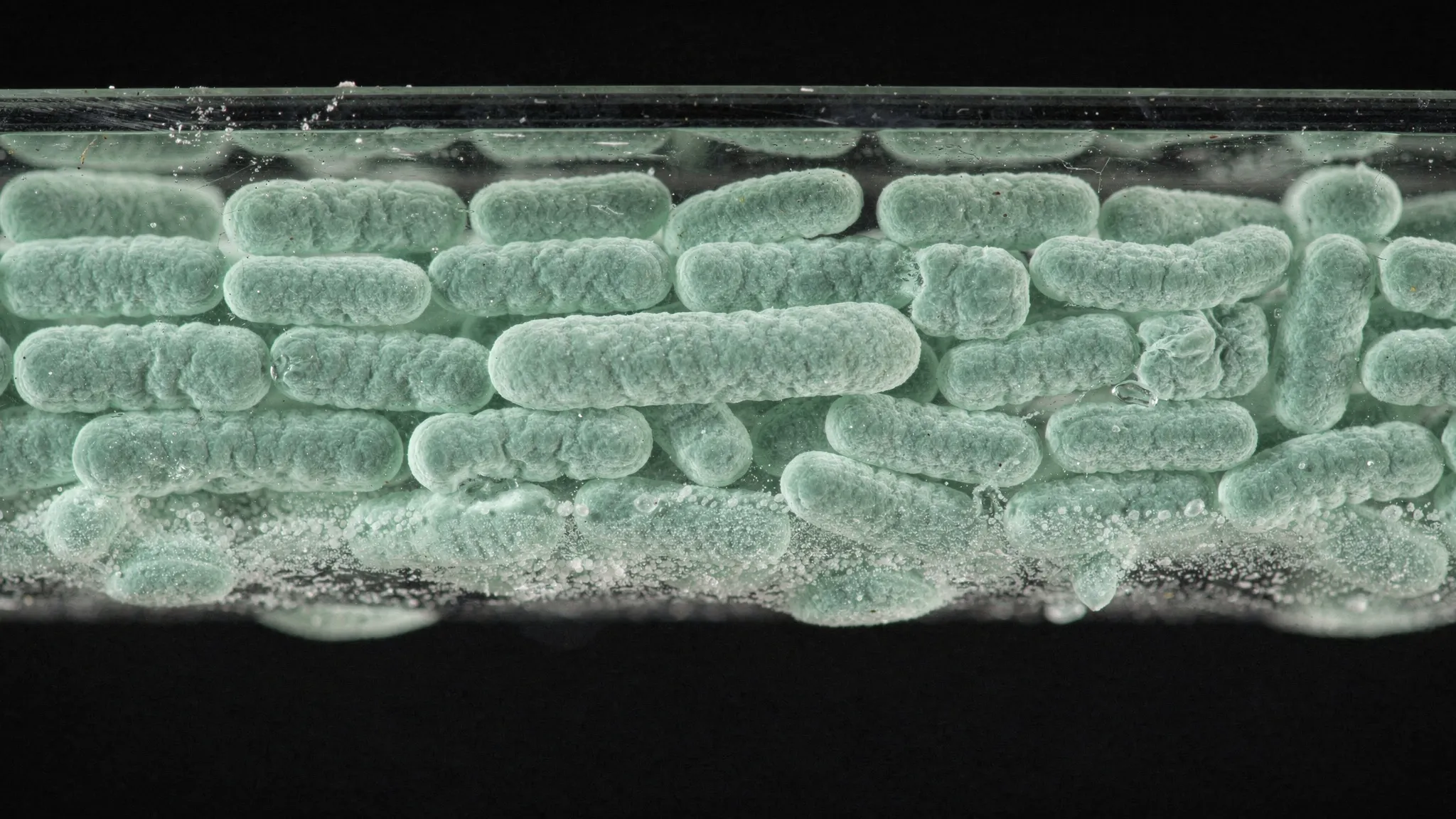
SQUEEZED BACTERIA SLOW DOWN, THEN ADAPT
Bacteria often live in tight spots. In soils, in host tissues and mucus, in sediments, they are pressed, stuck to surfaces and crowded. Mechanical stress is known to change how they grow and divide, and strong confinement can deform cells, delay division or kill them. But most studies look at cells that have already adapted to their confined life. What happens in the hours right after the switch has remained largely unexplored.
Chenyu Jin, Anupam Sengupta and colleagues, at the University of Luxembourg, Heinrich Heine University Düsseldorf and other institutions, filmed that switch cell by cell.
From broth to glass and gel
The team took Escherichia coli cells growing freely in a liquid culture medium and moved them into three settings of increasing mechanical strength: stuck to glass in the same liquid; pressed between glass and a soft gel (1.5% agarose); and pressed between glass and a stiff gel (6% agarose). At 30 °C, a microscope photographed the growing colonies every 2 minutes for 3 to 7 hours, and software followed each cell, its length, its birth and its division, generation after generation.
An immediate slowdown
In liquid culture, cells lengthened at about 0.032 per minute — a rate that measures what fraction of its own length a cell gains each minute. In generation 0 — the cells already present when filming began — that rate fell to 0.019 for cells stuck to glass, 0.018 under the soft gel and 0.013 under the stiff gel — about 2.5 times slower. The cells kept growing, but the switch alone was enough to trigger a marked response, even without any gel. Placing bacteria on glass or under gel, often seen as a mere imaging condition, is in fact a physical perturbation.
The cells then recovered, roughly exponentially, over several generations, mostly within the first three or four. Stronger confinement meant a deeper initial drop and a lower final speed. From the second generation, about 7% of the cells (counted as a share of the colony’s area) failed to divide on time and kept lengthening into filaments, a known sign of stress.
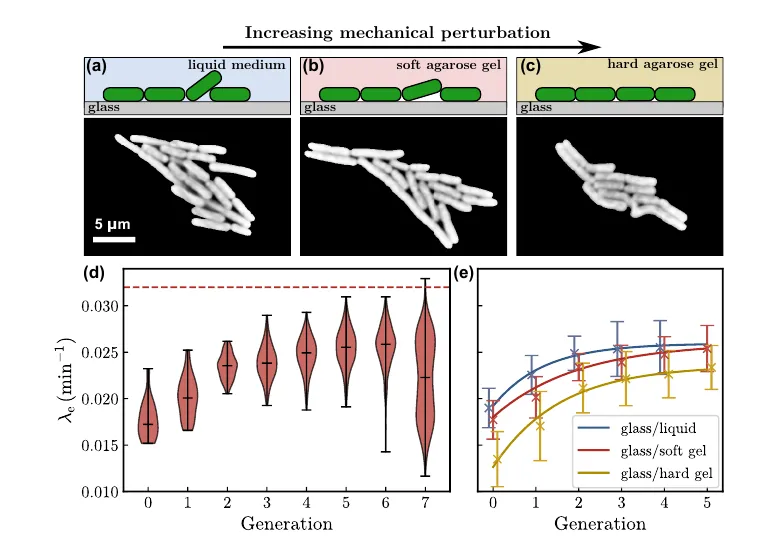
Growth after the switch: colonies in the three settings (top), elongation rate per generation under soft gel, with the liquid-culture value as a dashed line (d), and recovery curves for the three settings (e). — Figure 2, Jin et al. (2026), arXiv:2611.18273.
Three ways to decide when to divide
How does a bacterium know when to split? Researchers describe three idealized rules. A sizer divides on reaching a set size. A timer divides after a set time. An adder adds a roughly constant length between birth and division, whatever its size at birth. In steady growth, many bacterial species behave like adders.
Each rule leaves its own signature in the data. With an adder, the length a cell adds does not depend on its length at birth. With a timer, cells born bigger add more. The team built a computer model of dividing cells, with noise and a growth rate that recovers as measured, to read these signatures reliably.
A brief switch to a timer
Stuck to glass in liquid, the cells behaved like adders throughout. Under the soft gel, the first generation looked like a timer: cells born longer added more length. Plotted against birth length, the added length rose with a slope of 1.61. That estimate is uncertain enough to be compatible with a timer’s slope of about one, and clearly different from an adder’s zero. Under the stiff gel, this timer-like phase appeared to last two generations. Adder-like control was in place from the first generation on glass, and came back at the second under the soft gel and at the third under the stiff gel.
Could the slow recovery of growth alone produce these signatures? The simulations say no: with any of the three rules held fixed, growth recovery cannot reproduce the data. Of the switches tested, only a switch from timer-like to adder-like control matches the measured signatures.
Size held steady
Despite this reshuffling, newborn cells kept roughly the same mean size from one generation to the next. Their sizes spread out a little more for a while, but the distribution kept the same shape and stayed bounded. Simulations show why: a timer phase lasting only a few generations widens sizes briefly without letting them run away.
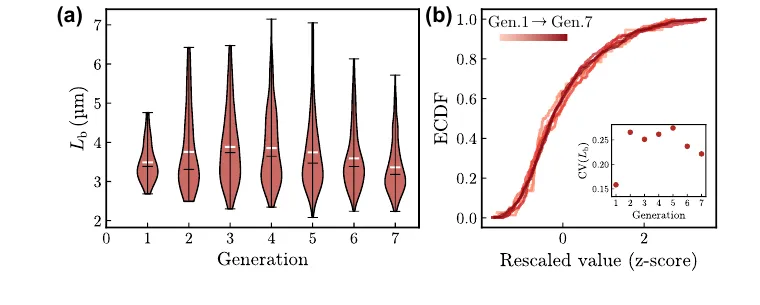
Birth length per generation under soft gel (a) and the rescaled distributions of generations 1 to 7, collapsing onto one curve (b). — Figure 3, Jin et al. (2026), arXiv:2611.18273.
Two clocks
The most striking detail is the timing. Adder-like control returns before growth has fully recovered: the way cells decide to divide and the speed at which they grow relax on two different timescales. The study covers a single species and only the first generations after the switch, before colonies pile up into several layers; it is a preprint. For the authors, it shows that a bacterium’s size control is not a fixed setting but a process that can bend under pressure, then snap back.