THE SUN'S CORE, TAKEN AT 15.6 MILLION KELVIN
The Sun runs on fusion. Its main chain of reactions, the proton-proton chain, provides 99% of its power by fusing four hydrogen nuclei into one helium nucleus. Most of that fusion happens in the very centre, the solar core. Fusion also releases neutrinos, particles that fly straight out of the core, and catching them is direct evidence that fusion is going on in there right now.
The Super-Kamiokande collaboration has turned those neutrinos into two measuring tools: a thermometer and a ruler.
A thermometer made of boron
A side branch of the fusion chain produces boron-8. When a boron-8 nucleus decays, it emits a neutrino that Super-Kamiokande can detect. Making boron-8 is extremely sensitive to temperature. The authors rely on a known power law linking the temperature at the centre of the Sun to the total number of boron-8 neutrinos, with an exponent of 24 (they test values from 19 to 29): the number of boron-8 neutrinos climbs extremely steeply as the centre gets hotter. For the neutrinos of the main proton-proton chain, the exponent is −1.1: their number hardly depends on temperature. Count the boron-8 neutrinos precisely, and you can read the temperature of the core.
A ruler made of flavour changes
Neutrinos come in several types, or “flavours”, and can switch from one to another. Inside the Sun, this switching — the MSW effect — depends on the density of electrons at the spot where the neutrino is born, and on its energy. Because that density drops roughly exponentially from the centre outwards, the share of neutrinos that change flavour, and the way the mix of their energies is distorted, both depend on how spread out the production zone is.
The team defines the core as the region where 90% of all solar neutrinos are produced. They then stretched or squeezed the core of their solar models by a scale factor, shifted the density towards or away from the centre, predicted what Super-Kamiokande should see in each case, and compared with what it actually saw.
5,805 days in a tank of water
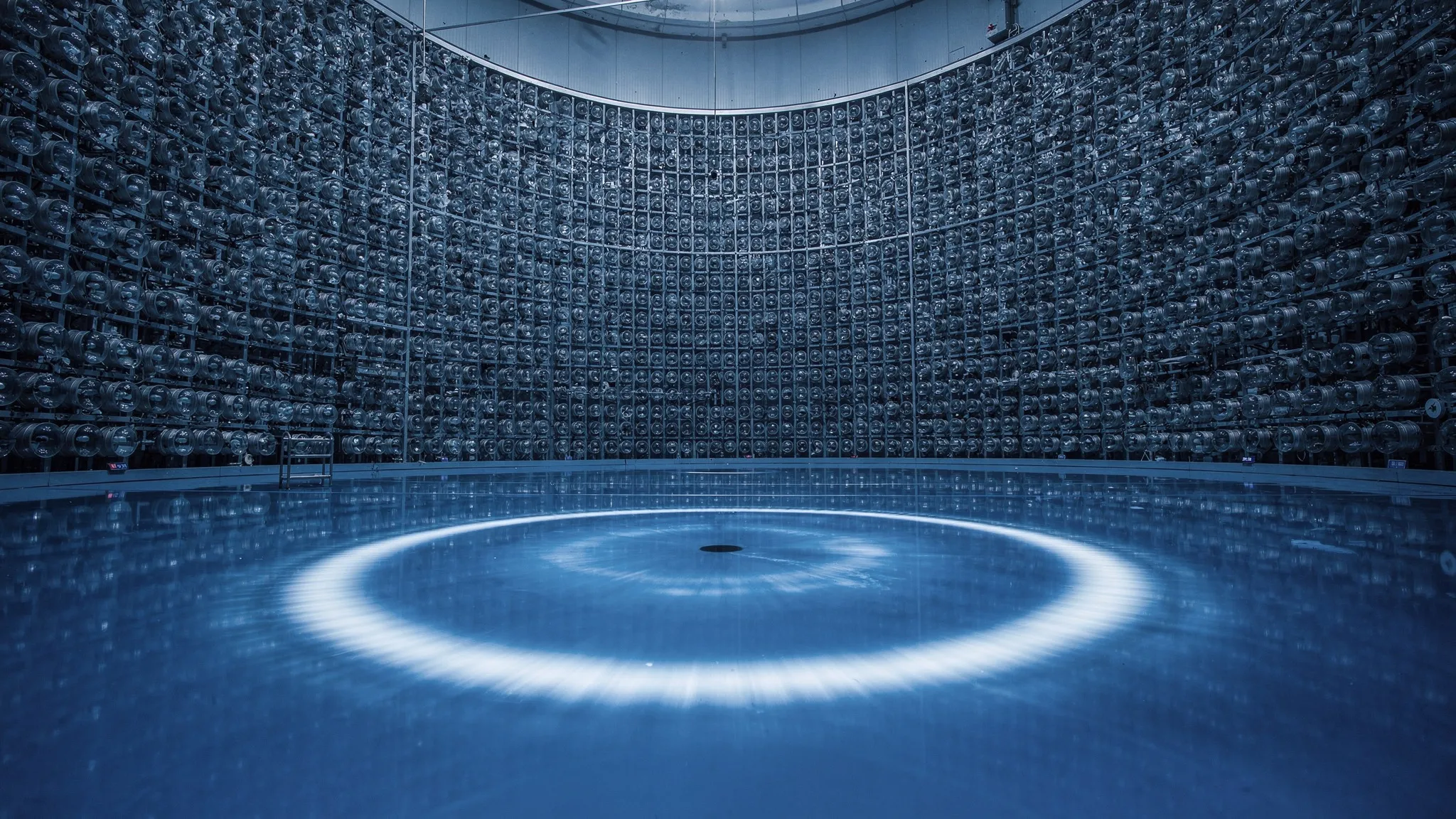
Super-Kamiokande is a tank of 50,000 tonnes of water — the paper says 50 kilotonnes — buried 1,000 metres underground in Kamioka, Japan. Its inner walls carry 11,129 light sensors (photomultiplier tubes) 20 inches across. When a neutrino strikes an electron in the water, the electron, if fast enough, emits a faint flash of Cherenkov light. From that flash, the detector reconstructs the electron’s energy and direction.
The analysis combines four running periods: 1,496, 791, 548 and 2,970 days, or 5,805 days of data in all. It also accounts for the slight difference between day and night counts — at night, neutrinos cross the Earth before reaching the tank. And it adds results from two other experiments: the SNO neutrino detector and the JUNO reactor experiment, which pins down how neutrinos switch flavour.
What the neutrinos say
Size. With Super-Kamiokande alone, the core cannot be larger than 0.499 solar radius — about half the Sun’s radius — at 90% confidence, in the standard solar model B16+GS98. That model comes in two versions that differ in the assumed chemical make-up of the Sun; this is the “high-metallicity” one. In a model that includes the young Sun’s accretion of matter (K2-A09-MZvar-12), the limit is 0.381. Adding the SNO data tightens these limits to 0.268 and 0.215 solar radius. The best fit even shows a slight preference for a core of real size — 0.092 solar radius in the standard model — rather than a single point.
Density. The density in the core agrees with the solar models, with a slight preference for a little more matter at the centre.
Temperature. For a core of the expected size and density, in the high-metallicity standard model, the temperature at the centre of the Sun comes out at 15.599 million kelvin, with a stated uncertainty of about 0.0016 million kelvin.
The fine print
That tiny uncertainty only holds inside the chosen assumptions. The same analysis with the low-metallicity version of the model gives 15.441 million kelvin. And the temperature depends on the core size assumed: it drops as the core is taken larger. For a core half the expected size, the best fit of the combined analysis, it reaches 15.608 million kelvin.
The size of the core, for its part, is only an upper bound, and it moves with the solar model chosen. The authors also set aside small temperature swings caused by internal motions of the Sun, expected to be weak. The paper is a preprint.
What the measurement does fix is this: wherever 90% of the Sun’s neutrinos are made, the radius of that furnace is at most half the Sun’s — and, once SNO is added, barely more than a quarter of it.