
FEEBLE RADIO WAVES THROW BIRDS OFF COURSE
A northern wheatear weighs about 25 grams. It migrates the length of Asia, from Alaska to East Africa and back, a round trip of some 29,000 kilometres. Like many migratory songbirds, it relies in part on the Earth’s magnetic field — a field a hundred times weaker than a small fridge magnet. Evidence for this magnetic compass dates back to the 1960s. More than sixty years later, how it works is still largely unresolved.
In a perspective article, P. J. Hore, a chemist at the University of Oxford, takes stock of a puzzle that the field has learned to live with: radio waves far weaker than the Earth’s field can switch the compass off.
A compass made of quantum chemistry
The leading hypothesis places the sensor in the eye, in a light-sensitive protein called cryptochrome (most likely the form called CRY4a). When blue light hits it, an electron hops along a chain of four small building blocks of the protein, leaving behind a radical pair: two molecules, each with one unpaired electron.
Each of the two electrons carries a spin, a tiny magnetic property that makes the pair sensitive to magnetic fields. The two spins rock back and forth between two combined states, a “quantum beat” with frequencies up to about 100 megahertz. The Earth’s magnetic field nudges this rocking, so the amount of signal the protein finally produces depends on the direction of the field. The energy of the Earth’s field acting on the pair is millions of times smaller than that of a chemical bond, which seems to rule out any effect on chemistry; radical pairs, short-lived and sensitive to magnetic fields, escape that argument.
Radio waves that scramble it
In 2004, European robins placed in orientation cages could no longer find their migratory direction under radio waves at 7 megahertz, or spread from 100 kilohertz to 10 megahertz — fields at least a hundred times weaker than the Earth’s.
The effect has since been reproduced by three independent groups, in Frankfurt, Oldenburg and St Petersburg, in four species: European robin, garden warbler, Eurasian blackcap and pied flycatcher. Radio waves whose magnetic field measures 1 to 100 nanotesla, at frequencies of 0.1 to 100 megahertz, are enough. For comparison, the Earth’s field is 25 to 65 microtesla — and one microtesla is a thousand nanotesla, so these radio fields are hundreds to tens of thousands of times weaker.
The right frequencies…
Radical-pair theory makes a sharp prediction. Radio waves can only disturb the pair if they match one of its internal rhythms. For the pair found in cryptochrome, the fastest rhythm sets a ceiling at about 116 megahertz; above it, radio waves should have no effect.
Blackcaps behaved exactly as predicted. Bands of radio noise centred on 5 and 80 megahertz disoriented them; bands of similar strength centred on 140 and 240 megahertz did not. Between 110 and 120 megahertz, right at the predicted limit, their behaviour was ambiguous. For Hore, this is arguably the strongest evidence yet that the compass relies on this radical pair — and a rare case of quantum mechanics predicting an animal’s behaviour.
…but far too strong an effect
The same theory fails on strength. In Hore’s calculation for a simplified radical pair, a 100-nanotesla radio wave tuned to the right frequency changes the signal about 5,000 times less than turning the Earth’s field by 90 degrees. At 1 nanotesla, the effect is about 50 million times smaller. Yet the birds lose their compass altogether.
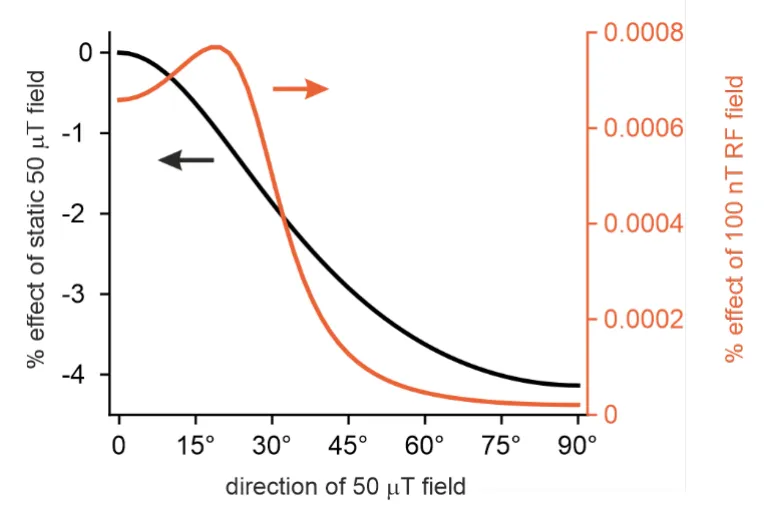
Calculated change in the signal of a simplified radical pair as the Earth-strength field turns (black, left scale, in percent) and the extra change caused by a 100-nanotesla radio wave (red, right scale: thousands of times smaller). — Figure 4, Hore (2026), arXiv:2611.21293.
For a radio wave of 100 nanotesla to matter, the spins would have to stay in step for more than about 200 microseconds. At body temperature, simulations of cryptochrome suggest around a microsecond at most. Hore reviews the possible escape routes — an exquisitely sensitive nervous system, a theory missing something big — and finds none convincing. Researchers in the field, Hore included, have responded by “suspending disbelief” or ignoring “the elephant in the room”.
A separate radio sensor?
Another idea, revived in 2026, is that birds have a distinct sense for radio waves, based on electromagnetic induction: a changing magnetic field generates a voltage. One team has proposed that the semicircular canals of the inner ear, usually linked to balance, could act as such detectors. Because induction grows with how fast the field changes, it would respond far more to radio waves than to the slow changes caused by head movements.
Such a sensor might warn birds of lightning storms or of space weather that makes the magnetic compass unreliable. But these induction-based ideas rest on untested assumptions, and they explain the strength of the effect better than its frequency limits. None of this, Hore stresses, argues against cryptochrome as the compass itself.
Robins in shielded huts
The question is not only academic. At the University of Oldenburg, robins tested in wooden huts on campus could not use their magnetic compass. Lining the huts with grounded aluminium sheets, which cut the electrical noise about a hundredfold, restored their orientation; removing the grounding, or adding artificial noise, took it away again. At a rural site, the birds oriented normally without any shielding.
Whether such noise changes the routes or survival of wild birds remains unknown: in the open sky they also have the stars and other cues. To settle the debate, Hore suggests swapping some atoms of cryptochrome for other isotopes, so that the frequencies it responds to shift. If the birds’ sensitivity shifts too, the radio waves act on the compass itself; if it stays put, a separate radio sense becomes the better bet.