ATLAS HUNTS FOR JUMPS BETWEEN VACUUMS
The Standard Model of particle physics is, in the words of the ATLAS collaboration, “one of the most precisely tested theories in science”. Yet some of its predictions remain “largely unexplored”: those tied to the topological structure of the fields that carry the forces. Among them are instantons. In quantum chromodynamics (QCD), the theory of the strong force, they are solutions of the field equations that describe quantum tunnelling between topologically distinct states of the vacuum. This multi-vacuum structure gives rise to a puzzle known as the “strong CP problem”. Instantons should also leave visible marks in collisions — but despite decades of theoretical and experimental work, none has been confirmed.
A jump with no favourite direction
An instanton is not a particle. It is an extended configuration of the field, with a size written ρ. According to the theory, it must create one quark–antiquark pair of each available flavour at once. At the LHC, the reference calculation describes two gluons turning into up, down, strange and charm quarks with their antiquarks, plus several gluons: on average 5.5 to 6.8 gluons for instanton masses between 20 and 50 GeV.
Because an instanton has no preferred orientation, its products should fly out roughly evenly in all directions in the frame of the collision. That isotropy is the signature ATLAS looked for. The difficulty is that ordinary, “soft” collisions between protons also produce messy sprays of particles, especially when several pairs of quarks and gluons interact at once inside the same collision. And the predicted rate is very uncertain: it falls steeply with mass, and the calculation becomes unreliable below about 20 GeV. Earlier searches had been carried out in electron–proton collisions, at the HERA collider.
Rare collisions, on purpose
The team used 1.6 inverse nanobarns of proton–proton collisions at 13 TeV, recorded in 2015 under very unusual conditions: the LHC ran at such low intensity that a bunch crossing produced, on average, only 0.028 collisions. That keeps unrelated collisions from piling up on top of each other.
In each event, the ATLAS inner tracker reconstructs the paths of charged particles. Five quantities summarise the shape of the event: the number of tracks, their total transverse momentum, their average direction along the beam, how spread out they are along the beam, and how evenly they share out around it. The analysis keeps events with a total transverse momentum between 10 and 20 GeV, a window that retains 7.4% of the simulated instantons and 27% of the background. Instanton events there carry fewer tracks, packed in a narrower band along the beam.
Two classifiers that must not agree
The background cannot simply be taken from simulations: three different generators (Epos LHC, Pythia 8 and Sherpa 3) each describe soft collisions in their own way. So the team trained a neural network with two outputs, X and Y, each designed to separate instantons from background — with an extra constraint: for background events, X and Y must stay statistically independent.
That independence makes a classic counting trick possible. Cut the X–Y plane into cells. In a cell where both classifiers score high, the expected background can be predicted from three others: the strips where only one of them scores high, and the corner where both score low, with A = (B × C)/D. The background is thus estimated from the data themselves, and the simulations serve to correct it and measure the uncertainties. The signal region stayed blind until the strategy was fixed on simulation.
An excess of round events
Once opened, the signal region held 32,789 events. The fit attributes about 28,800 to background and 3,900 to an instanton-like signal, with an observed significance of 3.5 sigma against background alone — where only 1.5 sigma was expected. The fitted signal is 2.3 ± 0.6 times the predicted one, a visible cross-section of 2.4 ± 0.7 microbarns.
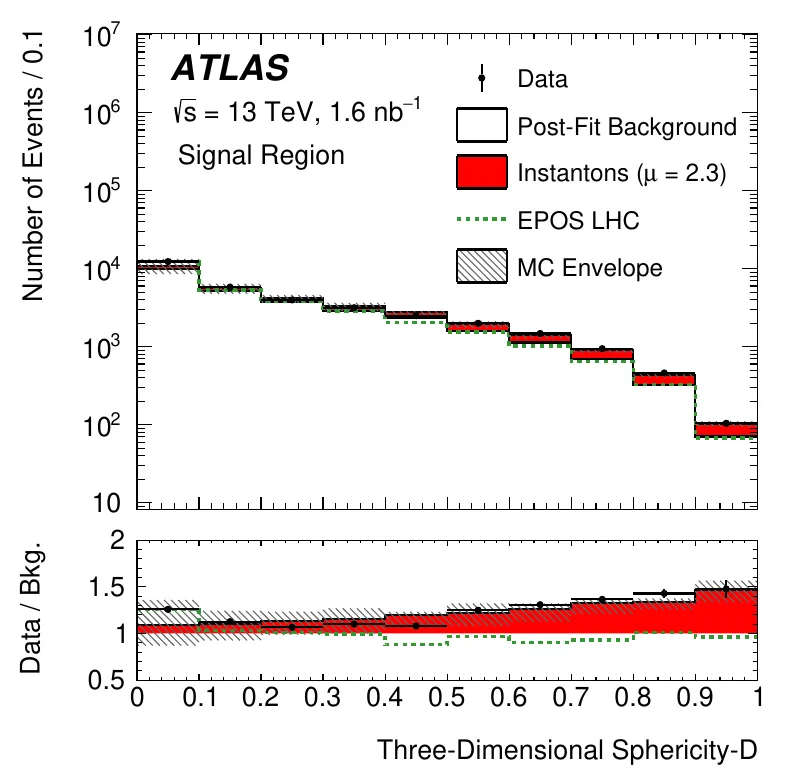
Events in the signal region sorted by sphericity, from elongated (0) to fully round (1). The red band is the fitted instanton signal; in the lower panel, the data rise above the background towards the most isotropic events. — Figure 2, ATLAS Collaboration (2026), arXiv:2611.22092.
Several checks support the result. In two windows of higher transverse momentum, where the share of instantons should be at least 30 times smaller, the same fit finds a signal compatible with zero. An alternative correction of the background still gives 3.0 sigma. And on a shape variable the network never saw — sphericity, which measures how round an event is — the excess sits where it should: among the most isotropic events.
Not a discovery yet
The authors are careful. “No background-only model can fully describe the data,” they write, and the interpretation of the excess “is limited by the modeling of the background”. The theoretical rate itself can rise about 24-fold or drop about 20-fold depending on choices made in the calculation. To confirm instantons, the next step is to look for their fingerprints: the strange and charm quarks they must produce, and the spectrum of their masses. For now, this Letter, submitted to Physical Review Letters, is the first direct look at the LHC at a corner of the Standard Model that has stayed in the dark.