A RUNAWAY BLACK HOLE NEEDS A WIND TO MAKE WAVES
Supermassive black holes usually sit at the heart of their galaxies. But theory has long predicted that some get thrown out — flung by a gravitational slingshot between three bodies, or kicked by the recoil of gravitational waves after two black holes merge. Direct evidence is scarce. The strongest case so far is RBH-1, spotted with the Hubble Space Telescope by van Dokkum and colleagues and later confirmed with JWST.
A shock far from home
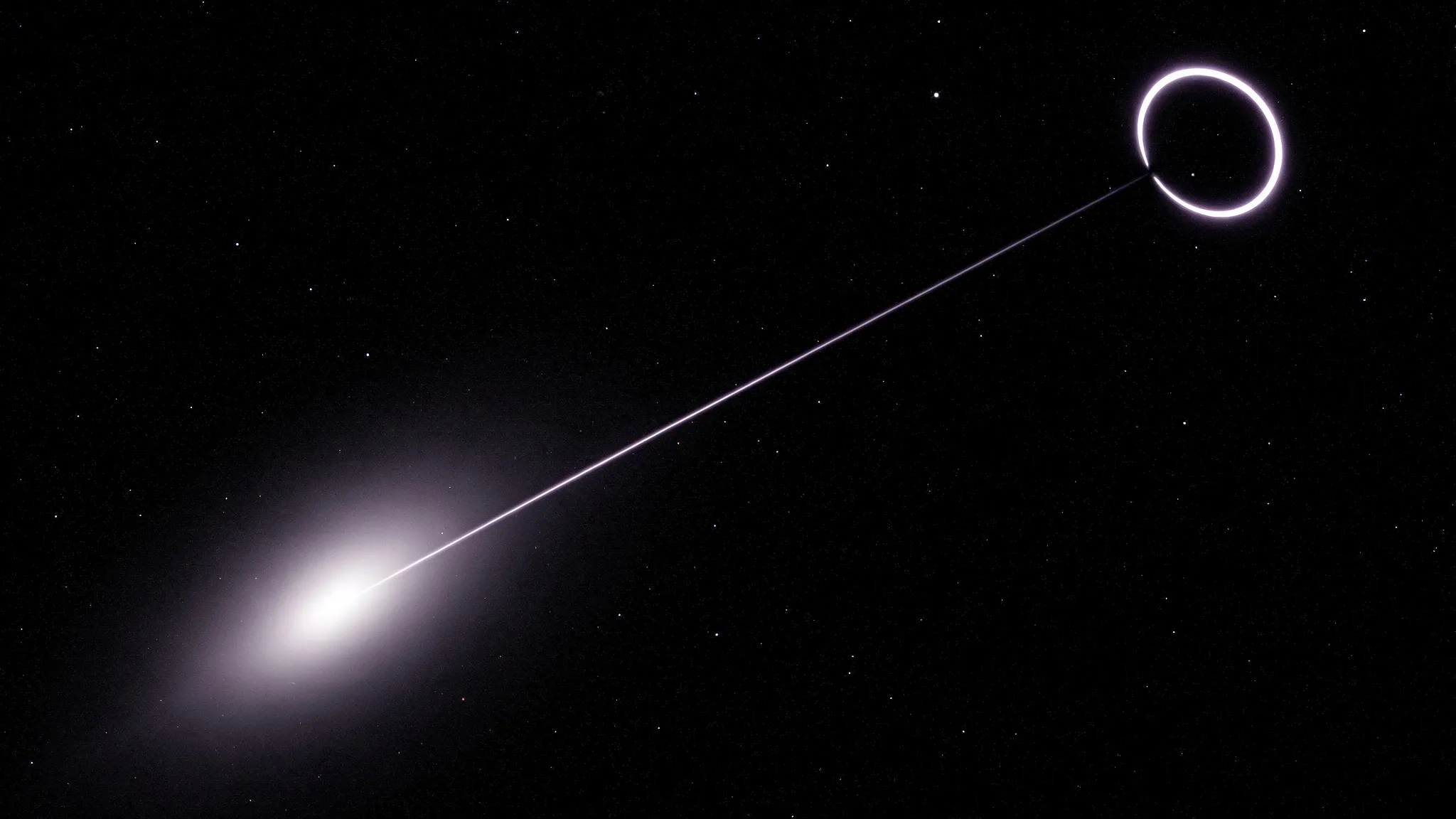
RBH-1 lies in the halo of diffuse gas — the circumgalactic medium — around a galaxy at redshift 0.96. What the telescopes show is striking: an arc-shaped shock front about 1 to 2 kiloparsecs wide, some 60 kiloparsecs from the host galaxy, and a straight trail linking the two. The object at the tip is thought to be a black hole of about 20 million solar masses moving at roughly 1,000 km/s.
Earlier explanations attributed the shock to the black hole itself plowing through the gas, without any outflow. Kung-Yi Su and Claude-André Faucher-Giguère, at Northwestern University in Illinois, put that idea to the test with controlled simulations.
Gravity is not enough
The setup is deliberately simple: a box of uniform gas 200 kiloparsecs on a side, at about a million kelvin, with a black hole of 20 million solar masses crossing it at 1,000 km/s. With no outflow at all, the gas is barely disturbed. In such hot gas, and against such a strong headwind, the region where the black hole’s gravity really matters is tiny compared with the observed shock. “An ongoing wind is absolutely necessary to reproduce the bow shock,” the authors write in a figure caption.
So they gave the black hole a wind — gas blown outwards, travelling with it — and varied its speed, strength and history. A bubble of hot gas then inflates around the black hole, pushing ambient gas into a thin dense shell whose front is the shock. Ahead, the bubble stops growing where its push balances the headwind; behind, it stretches into a trail.
A wind that must still blow
The runs reveal simple rules. At a given push, a faster wind makes a hotter, less dense bubble; at a given speed, a stronger push makes a wider shock. If the wind is faster than the black hole itself, a second shock appears behind it, on the far side.
Crucially, the shock does not survive long without its engine. Three million years after the wind is switched off, the front has gone diffuse; seven to nine million years after, the black hole has overtaken its own shock. To match RBH-1, the wind must be blowing now, or have stopped less than about 3 million years ago.
The best matches use a wind of 3,000 km/s that stays weak for the first 57 million years, then reaches full strength: a push of 6 × 10³² dynes and 0.03 solar masses of gas per year, if the surrounding gas holds one particle per thousand cubic centimetres. They reproduce a shock about 2 kiloparsecs across and a thin trail. By the time the black hole reaches its observed distance, after about 63 million years, the wind has expelled some 350,000 solar masses of gas. In a halo ten times less dense, the push, the gas flow and the total expelled all drop tenfold.
The black hole, or a cluster of stars?
What could power such a wind? The first candidate is the black hole itself, fed by a disc of gas it carried along. Swallowing matter at 1% of its Eddington limit — the theoretical ceiling set by its own radiation — it would shine at about 2.8 × 10⁴³ ergs per second, while the wind needs only 10⁴⁰ to 10⁴¹: less than one per cent of that power would do. No X-rays were detected, but the authors estimate that fewer than three X-ray photons would be expected in the existing Chandra observation, so such a source could have slipped through. Hubble has also seen a compact ultraviolet source at the expected position, a tentative hint that remains to be confirmed.
The alternative is a cluster of stars dragged along by the black hole, its supernovae blowing the wind. A cluster of 30,000 to 300,000 solar masses could provide a comparable push. But more than 60 million years after the ejection, supernovae have become at least ten times rarer than in a cluster’s first ten million years. The authors judge this scenario “difficult to reconcile” with a standard population of stars. A jet fired from the host galaxy, without any runaway, fits the shape of the trail less well.
A calm halo, measured by a straight line
There is a bonus. Gas around galaxies is notoriously hard to observe, and its motions even harder. When the team stirred the simulated gas, the trail became strongly disturbed. Keeping it as straight as RBH-1’s requires a calm medium: random motions below about 30 km/s, or a Mach number below 0.18 for gas at a million kelvin. Runaway black holes, the authors suggest, could become a new way to probe turbulence in these halos.
What the simulations leave out
The study does not reproduce the emission lines seen by Hubble and JWST, and it cannot resolve the cold gas inside the trail, which probably produces most of that light. The medium starts uniform, without magnetic fields or cosmic rays, and neither the accretion disc nor the star cluster is modelled directly. Those are the next steps — along with mock images to set side by side with the real RBH-1, a first-of-its-kind candidate that already tells a story about the gas it crosses.