NEUTRON WAVES BENT INTO CONES MAKE BESSEL BEAMS
An ordinary beam, of light or of particles, spreads as it travels. A Bessel beam does not, at least for a while: its cross-section, a bright central spot ringed by fainter circles, keeps the same shape as it moves forward. It can even rebuild itself after hitting a small obstacle. Since their first experimental demonstration in 1987, such beams have served for imaging, moving tiny particles with light, and processing materials with lasers. They have also been made with matter waves, the waves of massive particles: electrons and atomic Bose–Einstein condensates.
Neutrons were the missing case. Several theoretical studies had imagined neutron Bessel beams, for scattering experiments or to study how a neutron decays. But neutron beams are faint, each neutron’s wave stays in step with itself only across a tiny width, comparable to the size of the etched patterns described below, and detectors see them with coarse pixels.
Millions of tiny cones in silicon
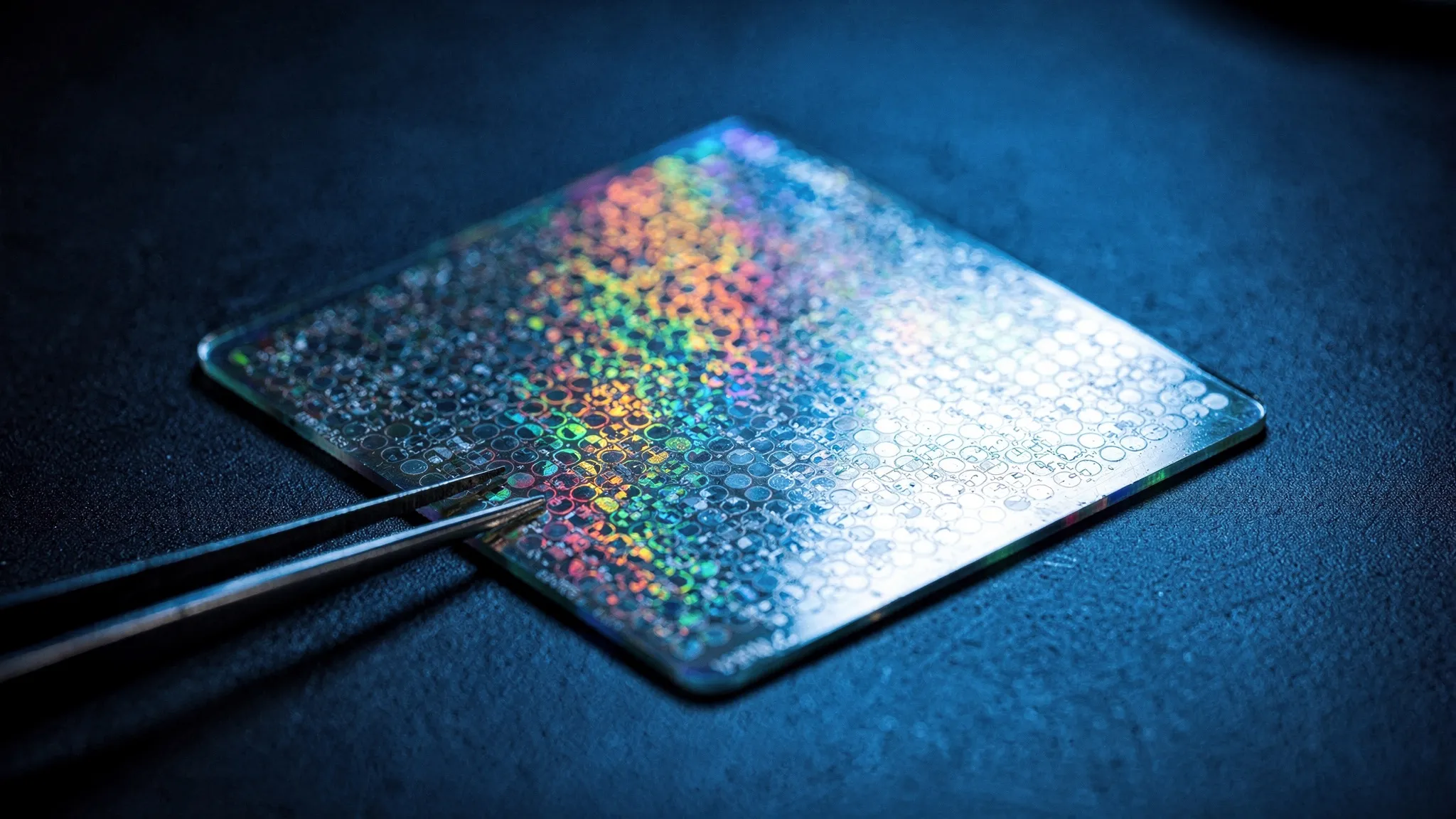
Owen Lailey, Dmitry Pushin and their colleagues at the University of Waterloo, with partners in the United States, Australia and the United Kingdom, used a trick their group had already applied to other neutron beams. They etched phase gratings into silicon wafers: tiny patterns of curved ridges set 480 nanometres apart, each pattern 0.6 micrometres in radius, repeated millions of times. As a neutron wave passes through, each pattern delays it a little more or less at each point, so that the wave leaves along a cone. Waves arriving from all around a cone interfere into a Bessel beam.
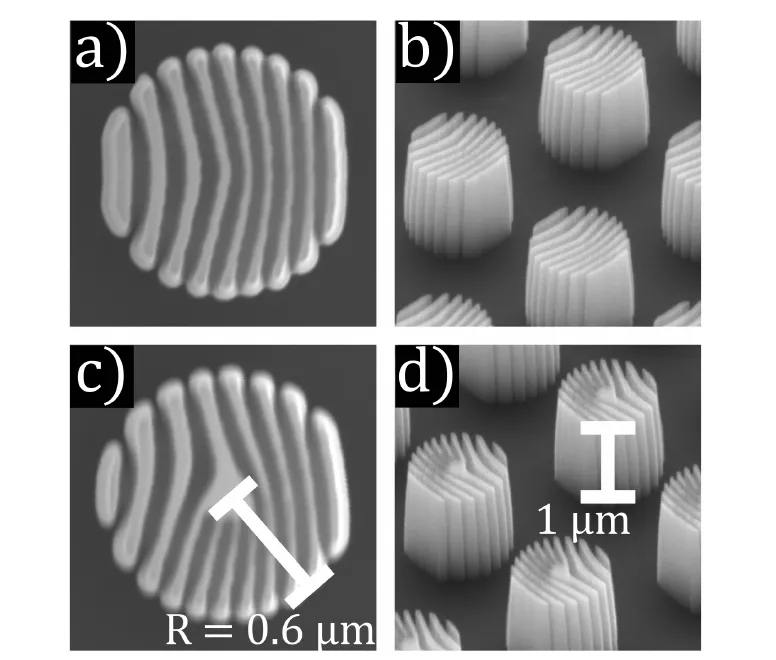
The silicon gratings seen with an electron microscope: one element from above (a, c) and the arrays at a 45° angle (b, d). Top row: the pattern for the zeroth-order beam; bottom row: the pattern with a twist, for the third order. Each element has a radius of 0.6 µm. — Figure 2, Lailey et al. (2026), arXiv:2611.24655, CC BY 4.0.
Adding a twist to the pattern gives the beam orbital angular momentum: the wave winds around its axis like a corkscrew. With a twist of three, the grating sends neutrons off in several directions: the nearest ones form beams of order 3, the next ones beams of order 6. An untwisted grating, stacked at right angles in the same beam, gave the plain order-0 beam.
What the detectors saw
The gratings were tested on two neutron instruments: ZOOM, at the ISIS neutron source in the United Kingdom, and Bilby, at the Australian Centre for Neutron Scattering.
- The order-0 beam produced a central spot 7.8 mm wide on the detector, 9.6 metres from the grating, against 15.5 mm for an ordinary beam under the same conditions — about two times narrower.
- The twisted beams showed a dark centre, as expected: on the axis of a wave that winds around itself, the intensity drops to zero.
- The quality of the interference rings, measured by their contrast, exceeded 60% for orders 3 and 6.
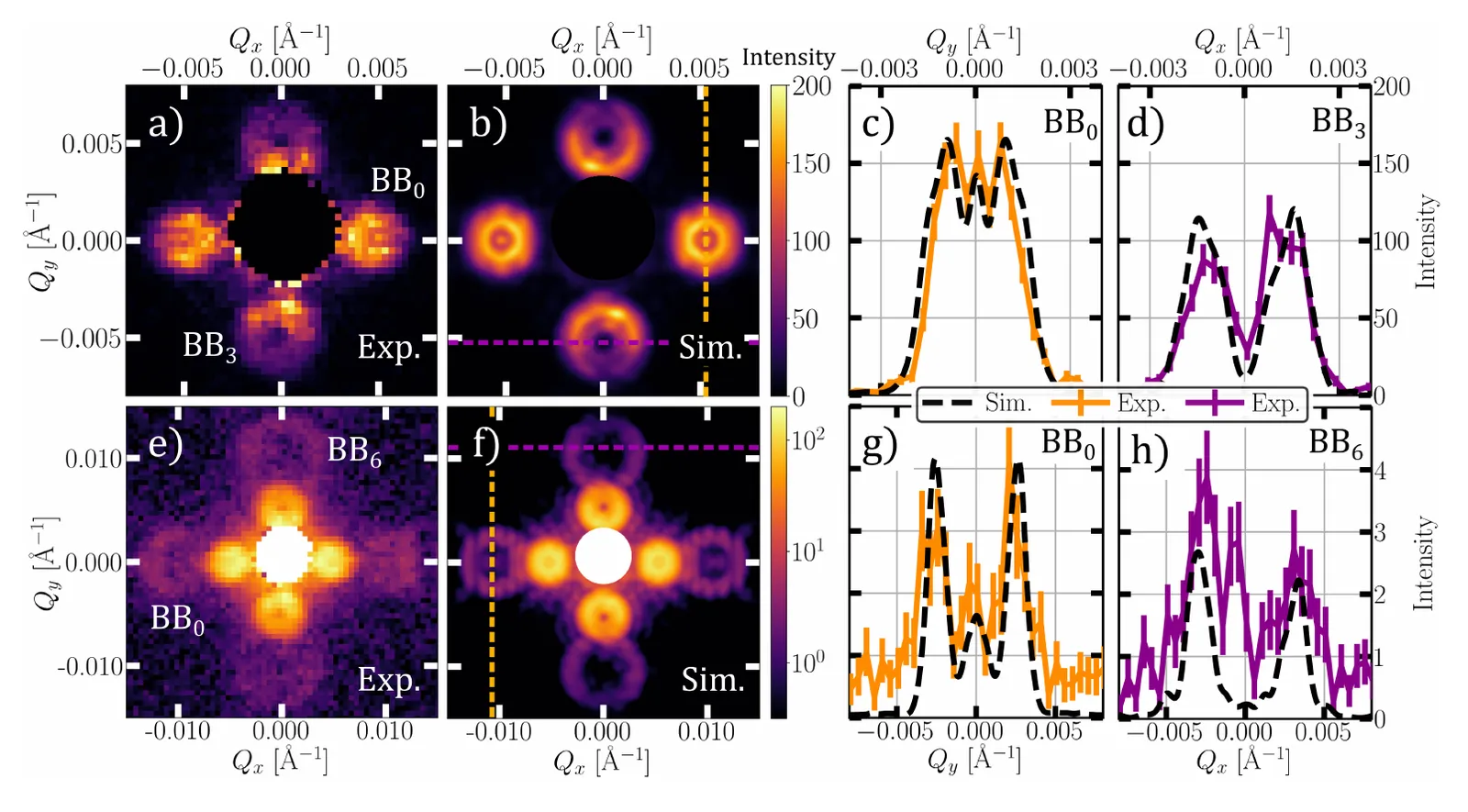
Measured (Exp.) and simulated (Sim.) patterns on the detector: the order-0 beam (BB₀) has a bright centre, while the twisted order-3 and order-6 beams (BB₃, BB₆) have dark cores. Cuts through the spots (c, d, g, h) match the simulations. — Figure 3, Lailey et al. (2026), arXiv:2611.24655, CC BY 4.0.
The authors call this the first experimental realization of neutron Bessel beams. With the “vortex” and “Airy” neutron beams made earlier, it completes the three basic families of shaped neutron waves.
A lens that is not a lens
Focusing neutrons is hard: in common materials, their refractive index differs from 1 by only about 10⁻⁵ to 10⁻⁶, so lenses are weak and must be stacked. A Bessel grating focuses by diffraction instead, into a stretched line whose sharp core is set by the etching. For now, though, the beams keep their shape over only about 0.24 mm after the grating.
The team also proposes a new measurement. Squeezing a wave sideways makes its phase advance a little more slowly along the beam, a consequence of the uncertainty principle. A Bessel beam is squeezed into its cone, so it slowly falls behind: this lag is the Gouy phase, about 16 radians per millimetre for their settings. Gratings etched on both faces of a wafer 320 micrometres thick would make an interference pattern of four petals that turns when this phase changes: bringing the ridges closer, from 480 to 380 nanometres apart, would shift this phase by π and visibly turn the petals. That device exists only in simulation so far.