TILT THE DISH AND BACTERIA SPREAD DOWNHILL
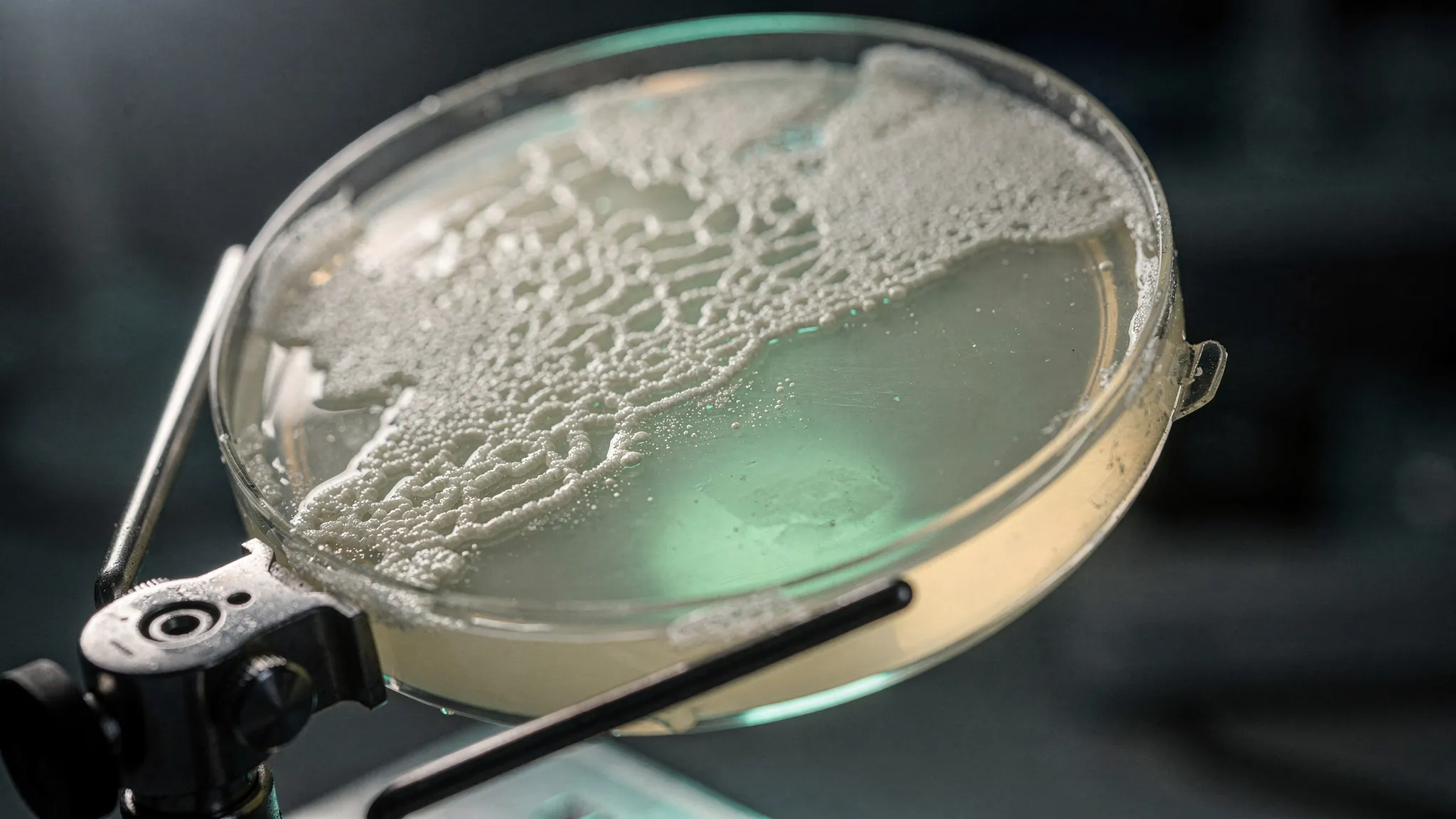
Swarming is a way some bacteria travel together: dense crowds of moving cells spread across a soft, moist surface, inside a thin layer of liquid, forming clusters, swirls and collective flows. In the lab, swarms grow into circles, branching shapes or tendrils.
Their physical surroundings matter — how much water the gel supplies, the surface tension of the liquid film. But one factor has been largely ignored, the paper notes: gravity. Standard experiments use horizontal dishes, where gravity is a fixed, neutral background. An older study, cited by the authors, showed that the direction of gravity changed the shape of colonies of staphylococci grown in soft gel.
Eight angles, from flat to upside down
Pengxi Gu, Zijie Qu and colleagues at the Global College of Shanghai Jiao Tong University, with co-authors at the Georgia Institute of Technology, Johns Hopkins University and Fudan University, worked with Enterobacter sp. SM3, a swarming bacterium originally isolated from the mouse gut — an environment where surfaces are curved and rarely horizontal. On a flat dish, SM3 forms an almost round colony, a clean reference.
They placed a droplet of bacteria at the centre of soft gel plates, let the swarm start for three hours on a flat surface, then set the plates at eight orientations: flat (0°), tilted face-up at 30°, 45° and 75°, tilted face-down at 105°, 135° and 150°, and flat upside down (180°). They photographed the colonies every hour up to nine hours — 15 independent colonies per angle — and filmed the moving cells at five points along each colony’s edge under a microscope.
The middle angles win
The differences built up over time. By the end, swarm growth depended on the tilt in a non-monotonic way: colonies grew most at intermediate inclinations, with the largest at 75° and 45°, and least on plates that were nearly or fully upside down (150° and 180°). Plates tilted only slightly, at 30°, grew a little less than flat ones.
Which side faced up also mattered. Pairs of plates with the same tilt, one facing up and one facing down — 30° and 150°, 45° and 135°, 75° and 105° — gave different results: the face-up configuration tended to produce larger colonies in every pair.
Shapes pulled downhill
Flat colonies stayed nearly circular. Tilted ones became lopsided, extended toward the downhill side:
- A measure of shape asymmetry stayed around 0.1 on flat plates and reached 0.90 at 75°.
- The downhill side extended about 1.46 to 1.52 times as far as the uphill side between 75° and 135°.
- Some colonies grew a comet-like tail: at 75°, the downhill tip advanced about 2.2 times as fast as its two neighbouring flanks.
Under the microscope, the picture was subtler. Cells generally moved more slowly on tilted plates than on flat ones, and slower at the downhill tip than at the top of the colony. Swirls at the tip were slightly smaller and more numerous. So the front that advanced fastest was the one where cells moved slowest — a sign, the authors write, that local cell speed alone cannot explain how the edge progresses.
A film of water, pulled two ways
To interpret these trends, the team extended an existing model of swarms as a thin, two-layer film of cells and water, adding gravity split into two parts. The part along the surface pushes the film downhill. The part across the surface changes the pressure in the film, and with it how quickly water seeps in from the gel underneath.
The model, which was not tuned to the experiments’ real sizes or times, reproduced the main patterns, including the best angle, 75°. Switching off one part at a time clarified the roles: gravity along the surface produced the downhill stretching, while gravity across it was needed to tell face-up plates from face-down ones.
A stuck edge that breaks free?
The study used one bacterial strain, in controlled lab conditions, and the model is a simplified description. The authors suggest that at the downhill tip, liquid and cells may pile up behind a stuck edge until it suddenly breaks free, again and again, which would also break up the larger swirls — but they flag this mechanism as hypothetical, to be tested with synchronised measurements of the front and the flow. Their broader message is simpler: in swarming experiments, the orientation of the surface is not a neutral detail.