TWO MICROSWIMMERS, ONE PRISONER'S DILEMMA
Microorganisms rarely swim alone. Bacteria, amoeba-like cells, sperm and algae move in groups and colonies. At their scale, viscosity dominates inertia: the flow set up by each stroke appears instantly, fades only slowly with distance, and is felt by the cells nearby. Swimmers with fixed strokes are already known to attract, repel and fall into step through these flows.
Albert Alonso, of Aalborg University in Copenhagen, asked a further question. If the best way for one cell to swim depends on how its neighbours swim, then swimming together becomes a game. In such a game, natural selection favours a Nash equilibrium — a situation where no cell can do better by changing only its own stroke. But a Nash equilibrium can be worse for everyone than what the cells could achieve together.
Learning to swim from scratch
Alonso simulated soft, two-dimensional cells whose membrane can bend but not stretch, with 10% more membrane than a circle of the same area — the slack that lets a cell change shape at all. Each cell is scored by how far it travels minus the energy it spends.
To avoid building the answer into the model, Alonso gave the cells random shape changes to start with, then improved them step by step, using a fluid simulation written so that it can compute, for any small change of a stroke, how each cell’s score would respond.
Alone, every random start converged on the same stroke: a wave of deformation running from front to back on both sides at once, pushing the cell forward by nearly three quarters of its radius every cycle. It matches the travelling wave long known to be optimal for small deformations, and resembles the chevrons seen on swimming Dictyostelium amoebae.
A lopsided game
Alonso then placed two cells 5 to 20 cell radii apart, one behind the other or side by side, and measured two things.
- The influence: how much a cell’s stroke changes its neighbour’s score.
- The incentive: how much a cell could gain for itself by adapting its stroke to its neighbour.
For cells in line, influence far outweighs incentive. A swimmer drags fluid along, and its neighbour is simply carried by that flow, an effect that fades as 1/ℓ with the distance ℓ. But a flow that carries the whole body along does not change the best stroke; only the way the flow varies across the body does, and that fades as 1/ℓ². In the simulations, the influence beats the incentive by a factor of 6 at 5 radii and 33 at 20 radii. More than 98% of the influence comes from being carried along.
Worse off for trying
So what happens when each cell adapts its stroke for itself? Each one responds only to the weak incentive, and misses the large gain set by the influence.
At a distance of 5 radii, in line, the numbers tell the story. Two cells that keep their solo strokes and only fall into the right rhythm do 17% better than two lone cells. Two selfish cells, each optimising its own stroke, do only 14% better. Two cooperating cells, optimising their joint score, do 29% better. Each selfish cell improves its own lot given the other’s stroke, yet together they end up worse off than if neither had changed shape — “much as in a prisoner’s dilemma”, the paper notes.
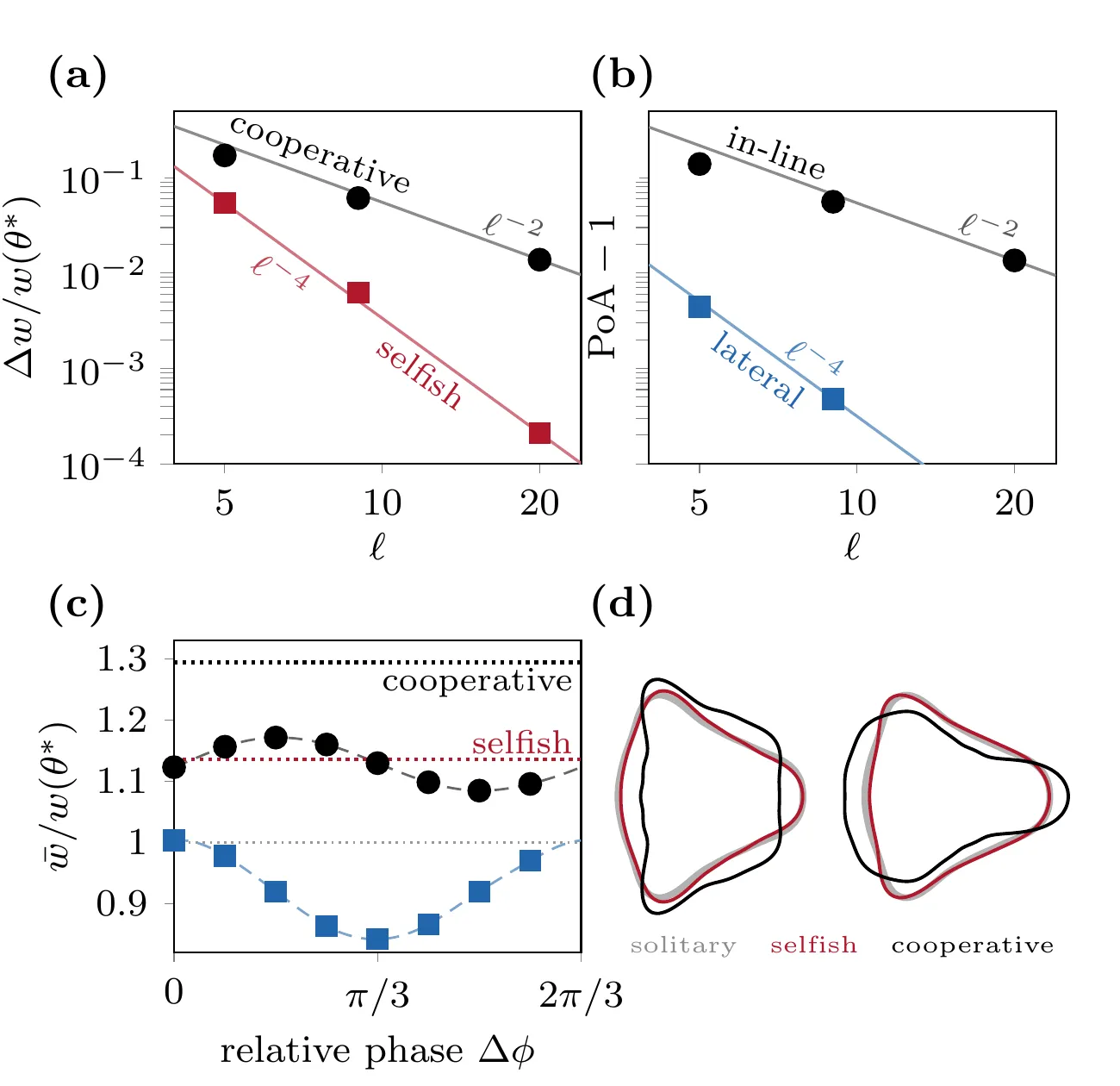
(a) Gain per cell from adapting the stroke, for cooperative and selfish cells; (b) how much better cooperation does, in line and side by side; (c) payoff of two cells with solo strokes against their timing, with the selfish and cooperative levels; (d) shapes of the back and front cells. — Figure 3, Alonso (2026), arXiv:2610.41965.
The adaptations differ too. A selfish leader changes its stroke by only 5% and its follower, swimming in its wake, by 12%. Cooperating cells both change by about 27%: the leader now adapts to shape the flow its follower swims in. The advantage of cooperating over selfishness shrinks with distance — cooperating pairs do 14% better than selfish ones at 5 radii in line, 1.4% at 20 — and for cells side by side it is only 0.4% even at 5 radii.
Clones and rivals
Cells in a clone share their genes, and evolution then favours their joint success. Alonso let each cell value its neighbour’s score with a weight ρ, its relatedness: 1 for clones, 0 for strangers, negative for rivals that gain when their neighbour loses. The pair’s gain over two selfish cells then follows a simple law: (2ρ − ρ²) times the full gain of cooperation. The first term is the help a cell receives; the second, what it gives up to help in return.
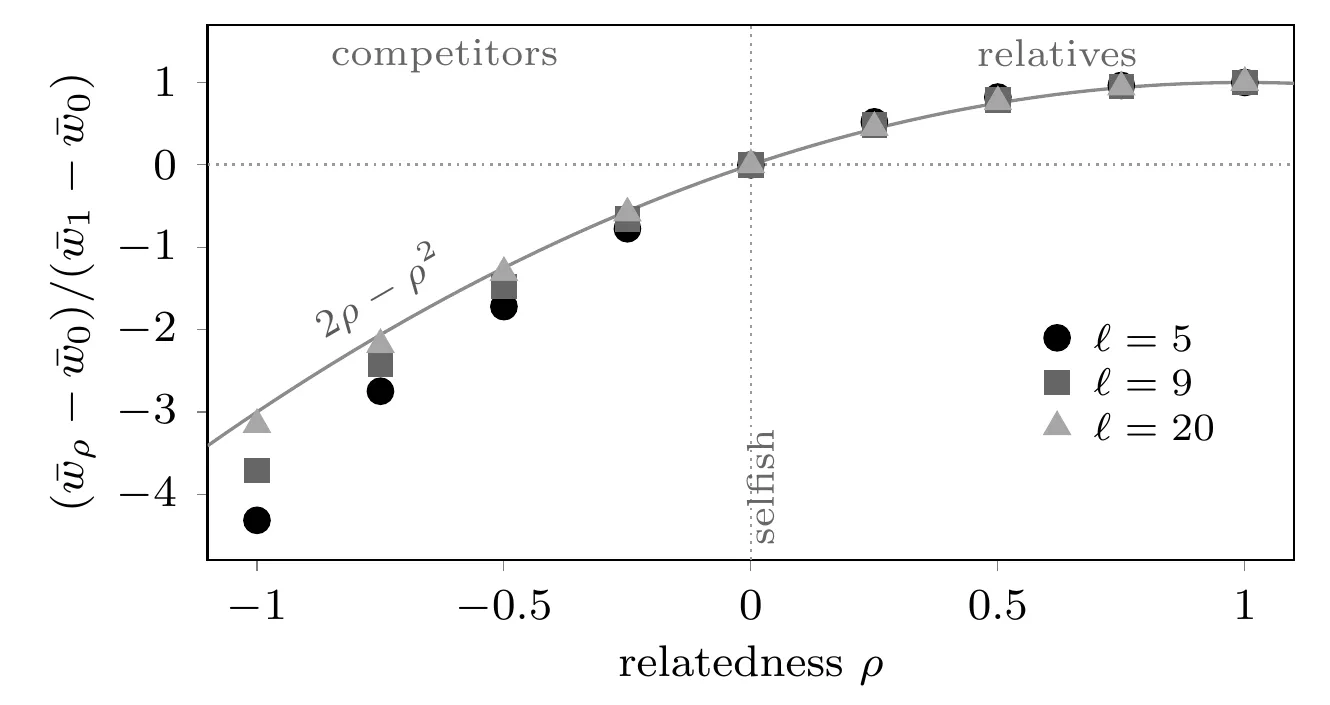
Payoff of a pair of cells in line against their relatedness ρ, measured from a selfish pair in units of the cooperative gain, at three distances. The line is the prediction 2ρ − ρ². — Figure 4, Alonso (2026), arXiv:2610.41965.
Clones recover the whole gain that selfish cells forgo. Rivals pay to hinder each other: when ρ = −1, the law predicts that each loses three times the cooperative gain. The paper points to the sperm of deer mice, which swim faster in groups with sperm from the same male while competing with that of other males.
From flat to real
The study is two-dimensional, with the cells’ positions held fixed. In three dimensions the flow fades faster, as 1/ℓ², which should confine the dilemma to close neighbours — and in bacterial swarms, cells sit closer than 5 radii. Alonso predicts a test: two unrelated swimmers in line should adapt unequally, the follower changing its stroke more than twice as much as the leader. The paper adds that microrobots trained only on their own reward should fall into the same selfish trap unless they share it. “Even without any signal or contact,” it concludes, “the fluid alone makes swimming a social act.”