A SHEET ONE MOLECULE THICK THAT GASES POUR THROUGH
From breathing to dialysis, from purifying natural gas to desalinating water, membranes are everywhere, and separating chemicals is one of the largest consumers of energy in industry. One rule dominates: the thinner the membrane, the faster things cross it.
The thinnest membrane imaginable is a single layer of atoms, such as graphene. But graphene is essentially impervious even to the lightest gases. To use it, holes must be made in it from the top down — with ion beams, ultraviolet etching or electrical breakdown. That approach struggles twice: it is hard to make enough holes, and the holes come out in a spread of sizes and shapes, which spoils the sorting.
A crystal with its holes built in
The alternative is to build the holes into the material from the start. Poly(carboxyfantrip) is such a material: a synthetic two-dimensional polymer crystal, grown in Benjamin King’s laboratory at the University of Nevada, Reno. Star-shaped molecules first arrange themselves into a honeycomb layer on water; ultraviolet light then links them into a single sheet.
The result is about 1.3 nanometres thick, one molecule. Every pore is identical, with an effective diameter of about 1.2 nm, and there are 3.2 × 10¹⁷ of them per square metre — a rough estimate from the size of the atoms puts the open area at 30% of the surface.
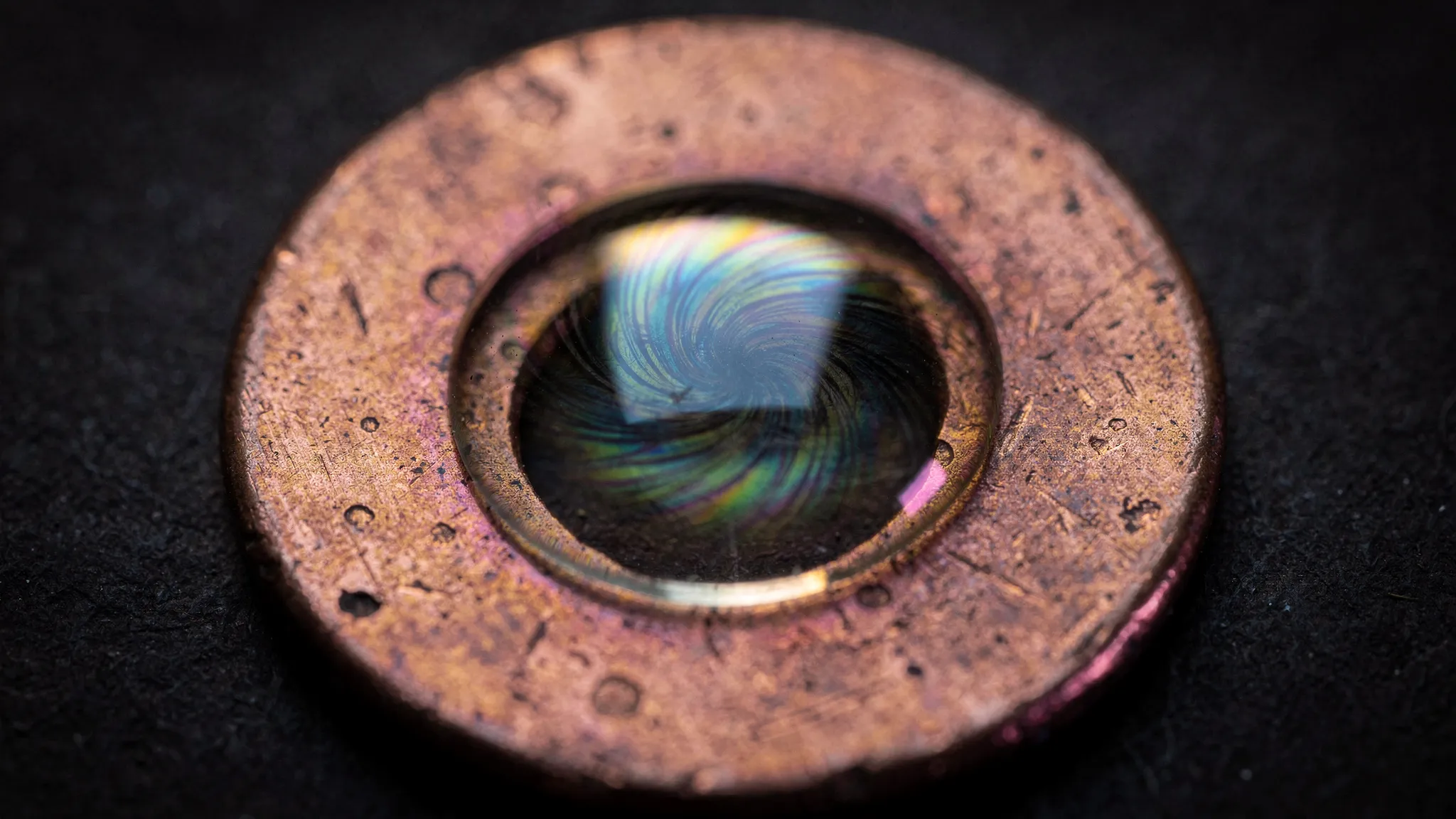
Making a free-standing sheet is delicate: only about one attempt in twenty produced an intact film spanning a single 50-micrometre hole in a copper grid. The team then pushed gas through it with a pressure difference of just 374 pascals and timed a soap film sliding along a glass micropipette, which takes 40 to 350 seconds depending on the gas.
Graham’s law, at full speed
Five gases were tested: hydrogen, helium, nitrogen, carbon dioxide and sulphur hexafluoride (SF₆), spanning a factor of nearly 100 in molecular mass. All five obeyed Graham’s law of effusion — the passage of a gas, molecule by molecule, through tiny holes: the flow scales as one over the square root of the molecular mass. Hydrogen, the lightest, crosses fastest.
More striking is the size of the flow. In an ideal gas, the fastest possible transport through a thin porous sheet is set by how often molecules hit the open pores. The measurements sit close to that limit, with an open fraction — the share of the sheet that behaves as open hole, deduced from the measured flows — of 23%. Measured as permeance — the flow per unit area and per unit of pressure difference — in the field’s gas permeation units (GPU), it ranges from about 130 million GPU for hydrogen to 16 million GPU for SF₆ — three to four orders of magnitude above most atomically thin membranes that sort gases by pore size, which reach about a thousand to ten thousand GPU. Until now, flows of this magnitude had only been reached with graphene drilled with nearly a million much larger holes, about 10 nm wide, cut one by one with an ion beam.
Adrian Del Maestro’s group at the University of Tennessee reproduced the measurements with atom-by-atom simulations, within the experimental uncertainty. The simulations show that nitrogen and carbon dioxide are strongly attracted to the sheet and its pores, lingering on it before crossing.
The molecule that should not have fit
The surprise came from SF₆. Its kinetic diameter — the size a molecule effectively presents in collisions — is about 0.55 nm. That is less than the 1.2 nm quoted for the pores, but the authors estimated the opening of a rigid, motionless pore to be narrower than SF₆, so it was not expected to pass easily. It does, and on the same Graham’s-law line as the small gases. Interactions between gas and pore, a flexible pore rim or rare wider passages could explain it; the authors cannot yet tell which.
The flip side is that this sheet sorts gases only by their mass, not by their size: it is a very fast door, not yet a sieve. The next challenge, the authors write, is to add selectivity — by chemical modification, stacking or distorting the lattice — without losing the huge open area, and to test mixtures of gases. Further out, they mention separating helium-3 from helium-4 through several sheets, and arrays of nanometre pores for superfluid helium sensors.