حالے ترجمہ نئیں ہویا: اصل انگریزی لکھت۔
AMMONIA MOLECULES THAT FLIP LIKE UMBRELLAS
Water and liquid silicon owe many of their oddities to an open network of directional bonds. Simple liquids, by contrast, are just densely packed. Liquid ammonia sits in between. Each NH₃ molecule has three hydrogen atoms that can donate a hydrogen bond but only one site that can accept one, so its bonds are sparse and fleeting — roughly one accepted bond per molecule, lasting about a tenth of a picosecond, according to the studies the paper cites.
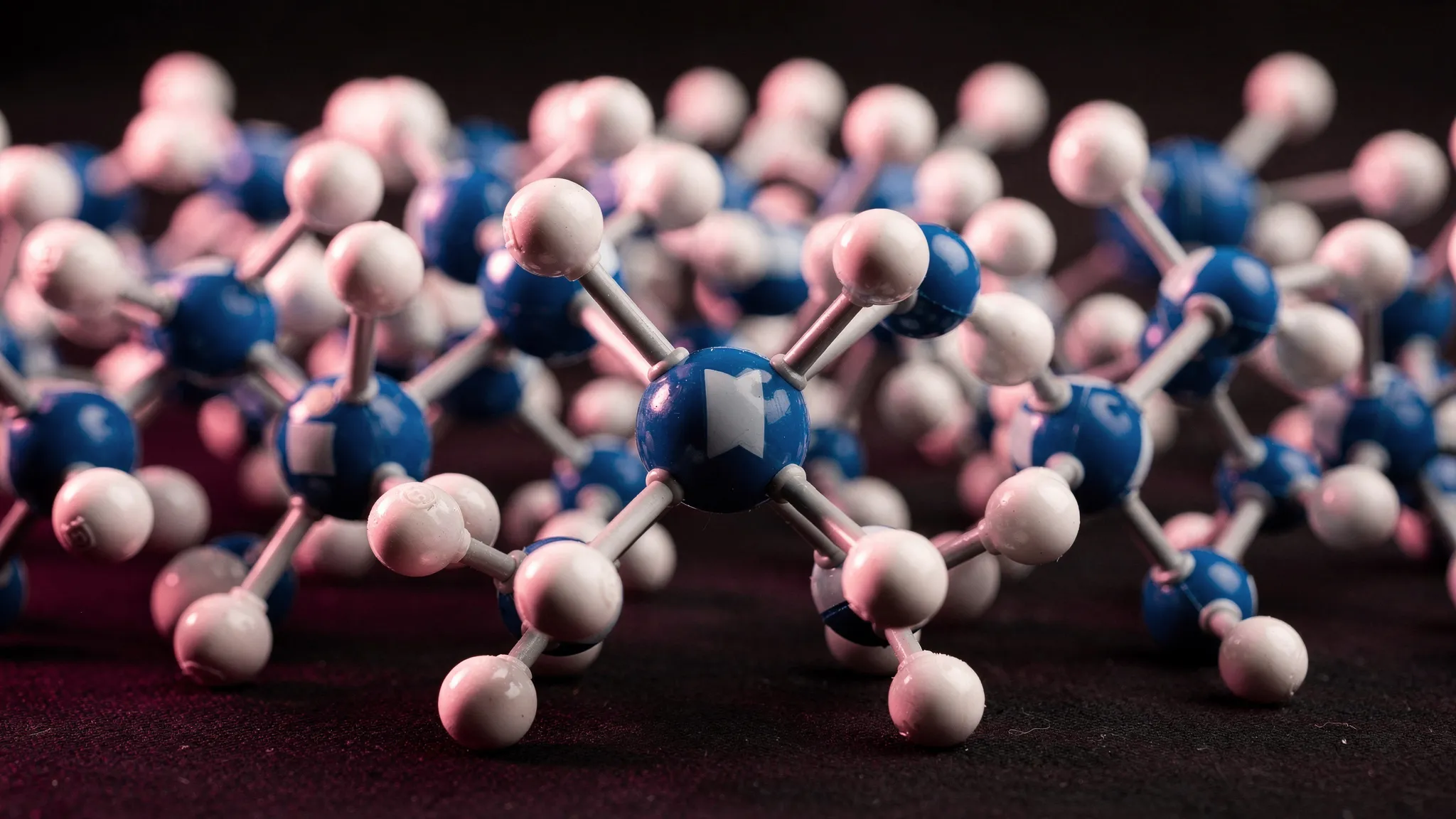
Ammonia also has a party trick. The molecule is a small pyramid, and its nitrogen atom can slip through the plane of the three hydrogens to the other side, turning the pyramid inside out like an umbrella in a gust. This pyramidal inversion is sensitive to quantum effects: in the gas, the molecule flips by tunnelling. Minwoo Kim, Ji Woong Yu, Won Bo Lee and colleagues at Seoul National University and Ajou University asked whether, in the liquid, these flips could affect something as ordinary as how fast molecules wander about.
Most models cannot even flip
The first obstacle was the model. Among five standard force fields tested, four produced no flips at all: two treat the molecule as rigid, and two hold its angles with springs that never let it reach the flat, 120-degree shape the flip requires. The team instead used a machine-learned force field, trained on quantum-chemistry calculations in earlier work, which reproduced the liquid’s structure, density, viscosity and diffusion as well as the best standard models — while still allowing spontaneous flips.
To include the quantum nature of the nuclei, they used ring-polymer molecular dynamics: each nucleus is represented by 32 copies linked by springs, which reproduces its quantum statistics. Classical and quantum runs shared exactly the same energy landscape, for 512 molecules between 170 and 250 kelvins, a range that reaches into the supercooled liquid, below the melting point.
Flips that shake the neighbourhood
- With quantum nuclei, the liquid is less dense, its viscosity matches experiment more closely, and it holds slightly fewer hydrogen bonds.
- The apparent energy barrier of the flip drops from 0.272 electronvolts (classical) to 0.213 (quantum), so flips become relatively more frequent as the liquid cools.
- Holding all neighbours frozen, the flipped molecule sits 0.277 electronvolts higher than before: the surroundings are badly suited to the inverted shape, so the flip and the rearrangement of neighbours go together.
- Around each flip, the molecule loses hydrogen bonds and its local density dips for about a picosecond either side. Neighbours within 5 ångströms — its first shell — lose about 2% of their bonds and 1% of their density; beyond that, nothing.
Escaping the cage
In the warmer liquid, quantum nuclei change diffusion by only −5% to +2%. But below about 210 kelvins, the effect turns positive and reaches +18% at 170 kelvins.
The explanation lies in caging. As the liquid cools, each molecule is increasingly trapped by its neighbours, as in a glass, and must break out to travel. The probability of escaping the cage is higher with quantum nuclei — about 20% higher at 170 kelvins — and rises in step with the diffusion boost. In the authors’ picture, each quantum-assisted flip is a small local “structure breaker” that loosens the cage just when cages start to matter.
The authors are careful: classical and quantum liquids are compared at their own densities, so the flip’s role is not fully separated from the density change, and the correlation between cage escape and diffusion does not prove the mechanism on its own. Their central point is that a quantum effect on a motion inside a molecule can, once coupled to its surroundings, reach all the way to how the whole liquid flows.