WHY HOSPITAL INSULIN DOSES MAY DO NOTHING
When a hospital patient’s blood sugar runs high, the most common response is sliding-scale insulin: glucose is measured every few hours, and a nurse injects insulin in proportion to how far the reading sits above a target. Current guidelines already discourage using it alone. But, the authors point out, the evidence comes almost entirely from adults with type 2 diabetes, and the arithmetic behind the dose was designed for people whose body makes no insulin.
Many inpatients do not fit that picture: their pancreas works, but steroids or intravenous feeding push their sugar up. In them, an injection does not act on a passive body. It acts on a system that already has a regulator — the pancreas, which cuts its own output whenever glucose falls.
One patient, read as a control system
Nir and Guy Regev, of Regev Labs in California, treat the sliding scale in control-engineering terms: a proportional controller that samples every four hours. They built a model of glucose and insulin in the body, calibrated on the record of one patient: a 17-year-old girl weighing 45 kg, 41 to 51 days after a stem cell transplant, fed entirely by drip and given high-dose methylprednisolone, a steroid. She was not diabetic before. Her chart holds 45 glucose checks over eleven days. Then they tested the conclusions on 4,995 virtual patients drawn from published physiological ranges.
They identify three failures and argue that none can be fixed by choosing a different dose factor.
The pancreas cancels the syringe
In the model, the patient’s own glucose loop settles in 11.5 minutes, whereas injected insulin takes 64 minutes to peak. As the injected insulin starts to bite, her pancreas simply secretes less. One unit per hour lowers glucose by 23 mg/dL, which cuts her own secretion by 0.7 units per hour: 70% of the dose is replaced rather than added.
Simulating the rule as prescribed over nine days, it delivered under one unit a day and moved her mean glucose by less than 1.5 mg/dL. Her chart shows the same thing: one night a reading of 173 mg/dL went uncorrected, and glucose fell by 57 mg/dL over the next 7.4 hours on its own. Across the virtual population, the pancreas supplied a median 53% of the correction, and the prescribed rule was too weak to matter in every virtual patient.
Strong enough is too strong
The second problem is that one unit of insulin does not always do the same thing. In the model, it lowers glucose by 11.6 mg/dL at 110 mg/dL, but only 5.8 at 190. A dose factor strong enough to correct a high reading therefore overshoots when glucose is near normal; one that never overshoots does nothing at high glucose. In 99.5% of virtual patients, no single factor can do both. The size of the gap varies: twofold for this patient, about 30% for a pancreas behaving like isolated human islets measured in the lab. As the authors put it, the prescribed scale is safe because it does nothing.
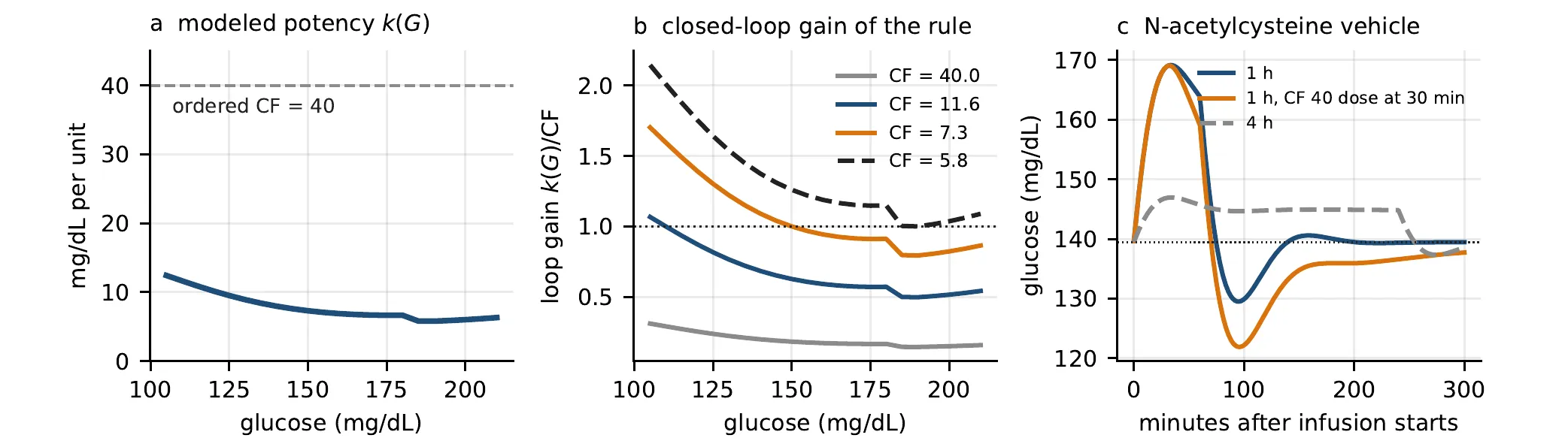
Left: modelled glucose drop per unit of insulin, far below the prescribed factor of 40. Centre: above the dotted line, each correction overshoots its target. Right: modelled glucose after a one-hour infusion of a drug diluted in dextrose. — Figure 1, Regev & Regev (2026), arXiv:2610.08730.
Four hours is too slow
The steroid is given twice a day, and the checks hint — on few data points — at a 12-hour rhythm in glucose. Checks every four hours are far too sparse to follow it, so consecutive readings are essentially unrelated: each dose answers a value that has already moved on. The model also flags hidden sugar: N-acetylcysteine and the antibiotic levofloxacin were diluted in dextrose and infused over an hour, adding a modelled spike of 30 to 47 mg/dL that the routine checks almost never catch. A reading taken on that spike, combined with an “effective” dose factor, could send glucose dangerously low in the model. Simply running that infusion over two to four hours would blunt the spike — a prediction the authors note one extra fingerstick could test.
An untested alternative, and its caveats
The authors propose replacing correction doses with a continuous insulin drip mixed into the dextrose, so it stops whenever feeding stops, adjusted once a day on the previous day’s average glucose, with rescue only below 70 mg/dL. They know of no published protocol like it, and state that it is untested. They also note that the patient’s average, 145 mg/dL, already sat within usual hospital targets.
The limits are substantial, and the authors list them: one patient; every number is a model output; her insulin sensitivity was never measured; and a drug she received can make some glucose test strips read falsely high — the strip type was not checked, so the whole record might be biased upwards.
Conflicts of interest. The two authors are family members of the patient. They own Regev Labs, LLC, which holds a provisional US patent application on patient-specific glucose models and insulin correction rules, and a second one on insulin infusion scheduling. No ethics committee review was sought; the patient’s parents gave written consent for publication and the patient gave written assent. This article describes a model, not medical advice.