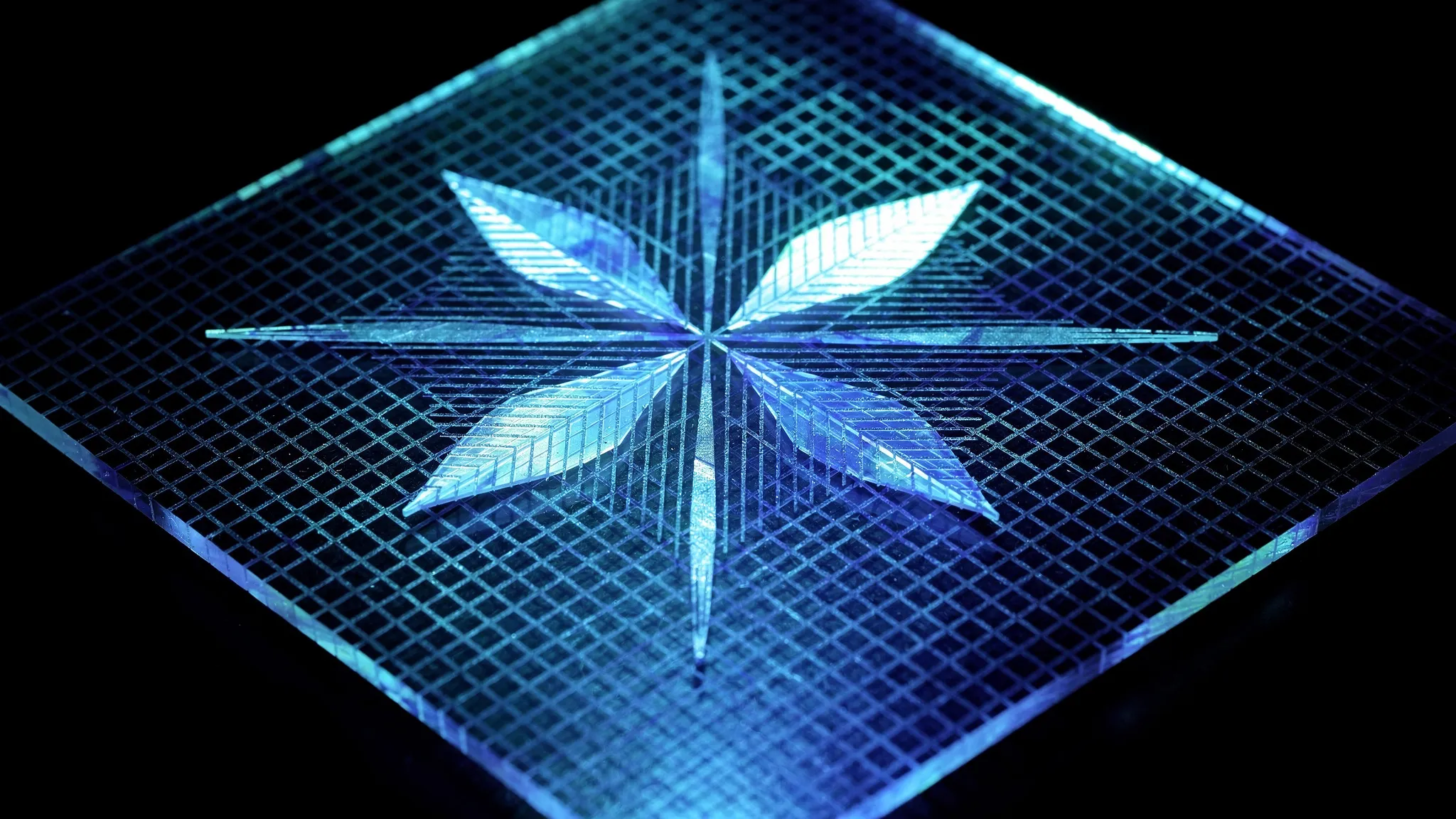
A QUASICRYSTAL MADE BY TWISTING TWO CRYSTAL SHEETS 45°
A crystal is a pattern that repeats: shift it by one step and it lands on itself. Quasicrystals broke that rule. As the paper recalls, they showed that long-range order can exist without any repetition. Their atoms follow a strict, deterministic arrangement that gives sharp diffraction patterns — but with rotational symmetries, such as five-, eight-, ten- or twelve-fold, that are impossible in a repeating crystal. Such order has been linked to unusual electronic, optical and mechanical behaviour.
The catch is that most quasicrystals have been found in particular metal alloys, or as ultrathin layers on specific surfaces. That leaves little control over their symmetry, their chemistry or how to build them into devices.
Twist instead of discover
The idea explored here is to make the twist angle itself the control knob. Twisted stacks of two-dimensional materials have already shown that forbidden symmetries can be imposed by geometry, but their layers are only weakly held together. Complex oxides are different: their surfaces can bond chemically when they touch, and change their electronic structure in the process.
Shivasheesh Varshney, Bharat Jalan, Richard D. James and a large team at the University of Minnesota, with partners including Caltech, MIT, the Technical University of Denmark and the University of Antwerp, worked with strontium titanate, an oxide whose atoms sit on a square grid 3.905 ångströms across. They grew thin single-crystal sheets on a sacrificial layer, released them, rotated them by chosen angles, stacked them on a support, then baked the stack at 900 °C in oxygen.
- Two sheets at 45° produce an eight-fold, octagonal pattern.
- Three sheets at successive 30° steps, with a thin middle sheet, produce a twelve-fold, dodecagonal pattern.
X-ray measurements show that the twist angles hit their targets within ±0.2 degrees, whatever the support.
Seeing the forbidden symmetry
Electron diffraction shows rings of eight equally spaced spots for the 45° stack and twelve for the triple stack, and the spots are sharp, a sign of long-range order. Atomic-resolution images match the textbook mathematical tilings of these quasicrystals: squares and 45° rhombi in the eight-fold case, with squares and rhombi in a ratio of 1 to √2; triangles, squares and 30° rhombi in the twelve-fold case.
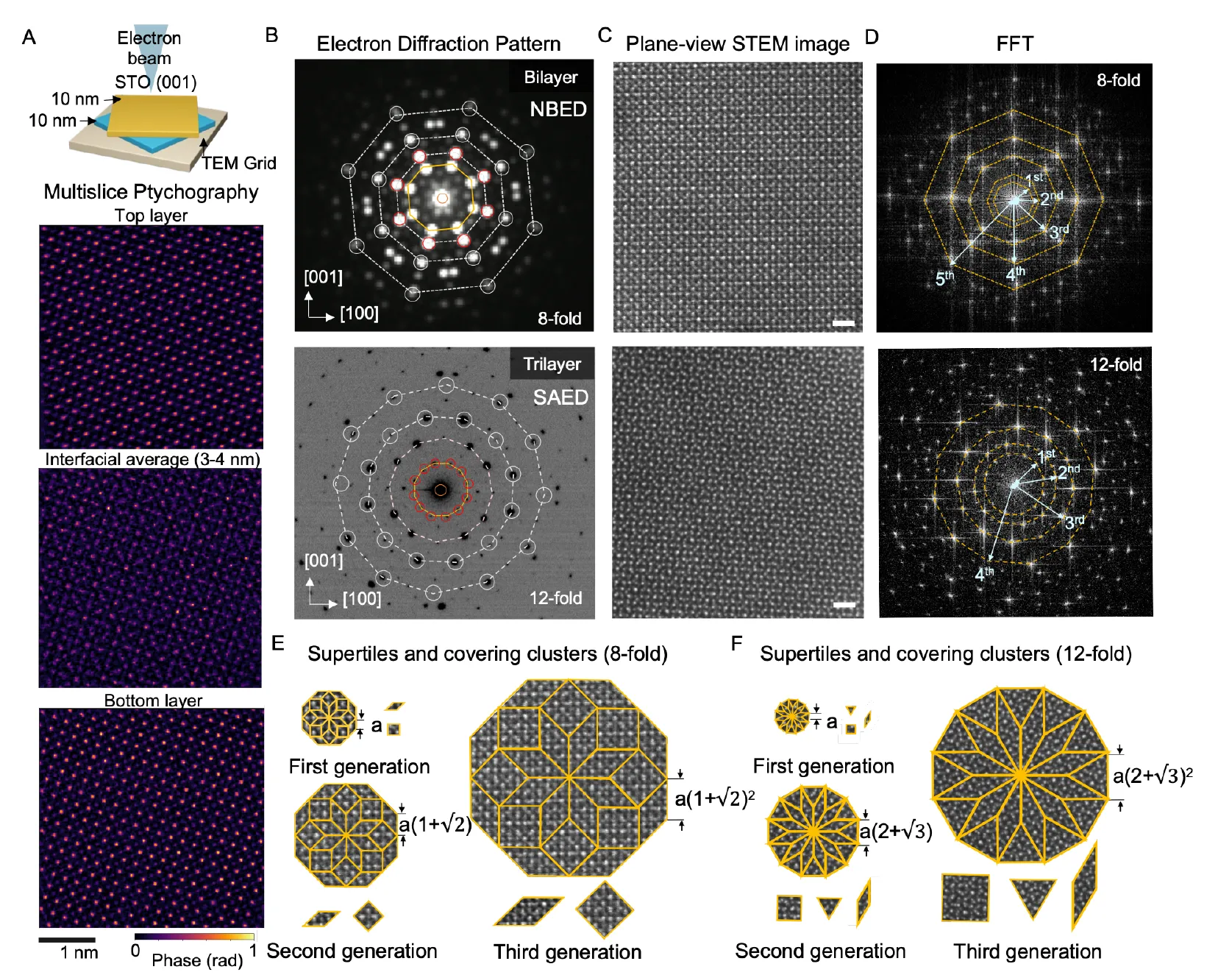
Eight-fold (45° bilayer) and twelve-fold (30°/30° trilayer) order seen by electron diffraction, atomic imaging and Fourier analysis, and the nested tilings whose sizes grow by 1 + √2 and 2 + √3. — Figure 2, Varshney et al. (2026), arXiv:2610.09222.
The patterns are also self-similar. Clusters of tiles reappear at larger and larger scales: in the eight-fold case, each generation is 1 + √2 ≈ 2.414 times larger than the last; in the twelve-fold case, 2 + √3 ≈ 3.732 times. Computer simulations using machine-learned atomic interactions show that the arrangement survives relaxation and room-temperature motion, and that a measure of quasicrystalline order reaches its maximum only at exactly 45°.
A bonded, not just stacked, interface
Baking matters. Before it, a residue layer 1 to 3 nanometres thick separates the sheets. After it, microscopy shows an interface that is abrupt to within about one atomic layer, with crystal planes continuing across it. Electron spectroscopy reveals titanium atoms in a different charge state (Ti³⁺) right at the boundary — a sign of real chemical bonding.
The boundary also reshapes the electronic structure. In sheets only 1.5 nanometres thick, X-ray absorption measured on neighbouring single-sheet and twisted two-sheet regions shows that the 45° interface redistributes the electrons’ orbitals and strengthens bonding across the boundary. Calculations point to a swirling pattern of tiny electric dipoles at the interface.
A special angle for light
Finally, the team pumped the stacks with an intense terahertz pulse and probed them with circularly polarised laser light. At intermediate twist angles, the interface adds its own signal. At exactly 45°, that interfacial signal cancels out and becomes indistinguishable from the substrate’s — and only after baking. The quasicrystalline angle stands out as a special point.
A new knob for materials design
In this approach, the authors argue, quasicrystalline order no longer has to be found in a special alloy: it can be dialled in with a twist, in oxides where electrons, spins and the crystal lattice are strongly coupled, and moved onto different supports. How the twelve-fold stacks reshape electronic structure is left for future work.