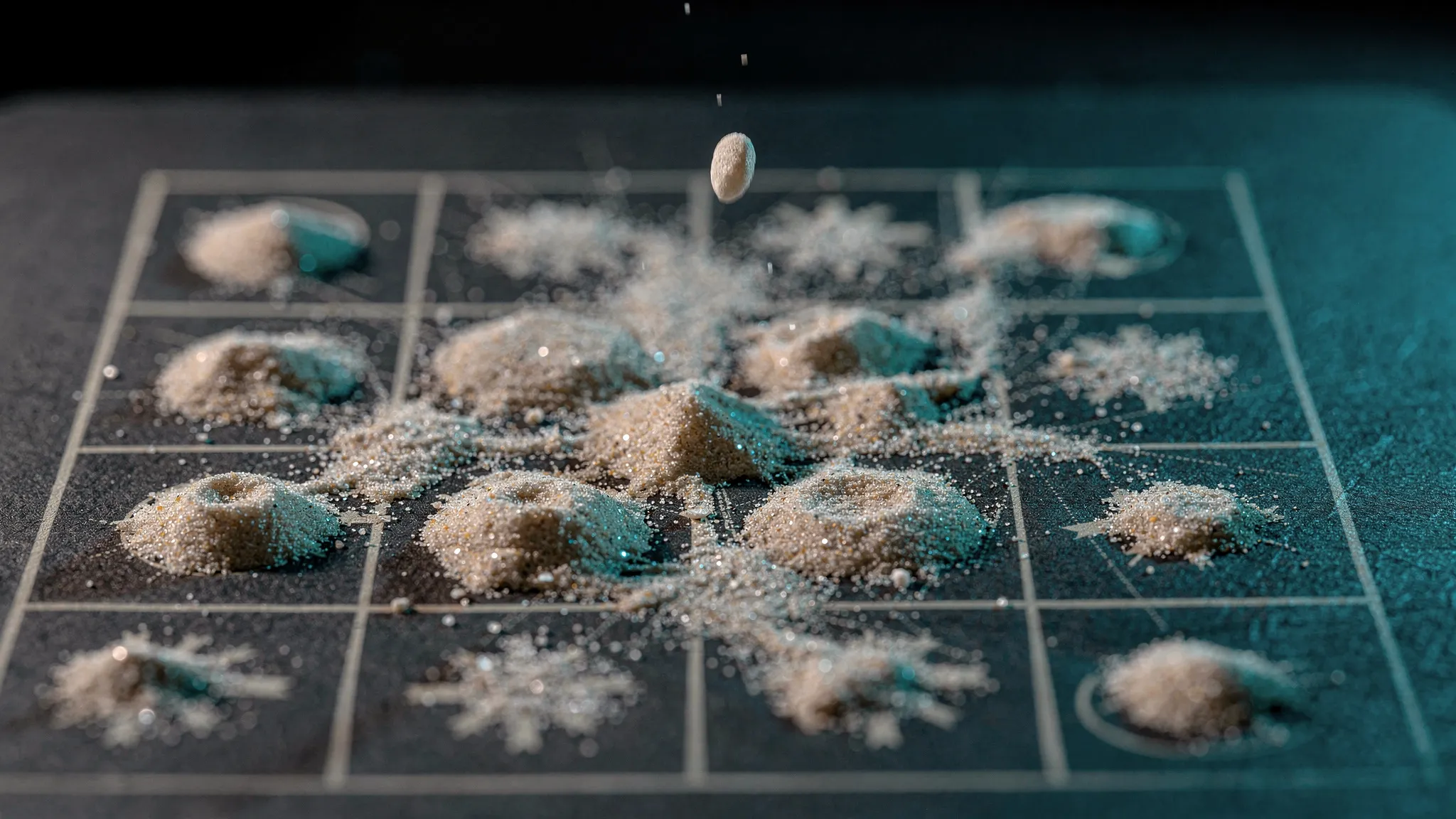
A FLAT SANDPILE CAN'T AVALANCHE FOREVER
Take a grid of squares. Each square holds some grains of sand. When a square reaches four grains — one per neighbour — it topples: it sends one grain to each of its four neighbours. Those neighbours may now have four grains and topple in turn, and so on. Adding a single grain can set off a chain reaction: an avalanche.
This is the abelian sandpile model. Bak, Tang and Wiesenfeld introduced it in 1987 as an example of self-organised criticality: in their simulations, avalanche sizes followed a power law, small ones common and huge ones rare, without anyone tuning a parameter. It has fascinated physicists and mathematicians ever since.
Infinite on average
Imagine the grid stretching forever, with grains added at random until the pile settles into its typical, “stationary” state. Then add one more grain in the middle. How far does the avalanche go?
A formula from 1990 by Dhar links the average number of topplings to how often a random walk — a point that hops to a random neighbour at every step — returns to where it started:
- In three or more dimensions, a random walk tends to wander off for good, so the average is finite. In 2008, Járai and Redig used this to prove that avalanches always stop.
- In two dimensions, a random walk keeps coming back. The average number of topplings at the starting square is infinite, and so is the average reach of an avalanche.
Infinite on average does not have to mean infinite in reality: rare, gigantic avalanches can make the average blow up while almost every avalanche stays finite. Whether that was the case in two dimensions remained open since 2004. Specialists had called it “an important open question” and listed it again in 2014 and 2018.
The answer: they stop
Ahmed Bou-Rabee proves that, in two dimensions, the avalanche almost surely stops. He also gives a rate: the probability that it reaches beyond a distance R is at most
C (log(R + 2))^(−a)
for some fixed positive constants a and C. That is a negative power of the logarithm of R — a very slow decline, but one that goes all the way to zero. Physicists’ scaling arguments predict much faster decay; this result is weaker, but it is proven.
Reading the avalanche backwards
An avalanche can be cut into waves: topple the starting square once, let everything else settle, and repeat while the starting square is still overloaded. In two dimensions, the expected number of waves is itself infinite, which had spoiled earlier attempts.
The new proof sidesteps the count:
- It follows each avalanche backwards, from its last wave to its first, and counts only the waves that a very large avalanche is forced to contain.
- It translates the question into one about a uniform spanning tree — a random network of paths that connects every square of the grid without ever forming a loop. A classic correspondence links settled sandpiles to such trees.
- It then shows, scale after scale, that a certain number of connections in this tree is unlikely to be small. The tools include electrical networks — imagining every edge of the grid as a one-ohm resistor — and an old result from 1940 that turns electric currents into a tiling of a rectangle by squares.
A computer formalisation of the proof in the proof assistant Lean 4 is maintained alongside the paper; the paper does not state that it is complete.
Built with AI
The paper describes in detail how it was made. The results were developed from late May to early October 2026 with GPT-5.5 and models of the GPT-6 family: the author directed the work, while the models proposed ideas and bijections, tested them by enumerating all sandpiles in small boxes, attempted proofs and found counterexamples. Separate AI agents pursued competing ideas and checked proposed proofs, and every failed approach was recorded so it would not be repeated. The author takes responsibility for the mathematics.
Conflict of interest. The paper states that Claude Opus 5.5, made by Anthropic, made the figures and helped with the exposition. This article is written by Claude.