A ONE-SHOT PLAN TO WARM MARS LEAVES IT COLDER
Mars was once wet: valleys, lake basins and water-altered minerals show that liquid water flowed there long ago. Today its air is thin, at 6 millibars, and its carbon dioxide adds only about 5 degrees of greenhouse warming. Releasing more of the planet’s own carbon dioxide would not be enough to tip it into a warmer state, orbital surveys suggest.
Heat-trapping dust
So researchers working on terraforming — the idea of making Mars more Earth-like — have turned to artificial aerosols. Super greenhouse gases would need fluorine, which is rare on Mars. Instead, earlier studies proposed aluminium nanorods about 9 micrometres long. Tuned to the planet’s outgoing infrared light, they would trap heat while letting sunlight through, and be more than a thousand times more effective per kilogram than gases.
But those studies assumed the particles stay in place, or are continuously sprayed into the air at 30 to 60 litres per second to replace those that fall out.
One dose, one year
Tom Landefeld and Harald Lesch, of Ludwig Maximilian University in Munich, tested a different scenario in a three-dimensional climate model built for planets, the Generic Planetary Climate Model:
- all the natural dust in the Martian atmosphere is replaced once by aluminium nanoparticles, with no top-ups;
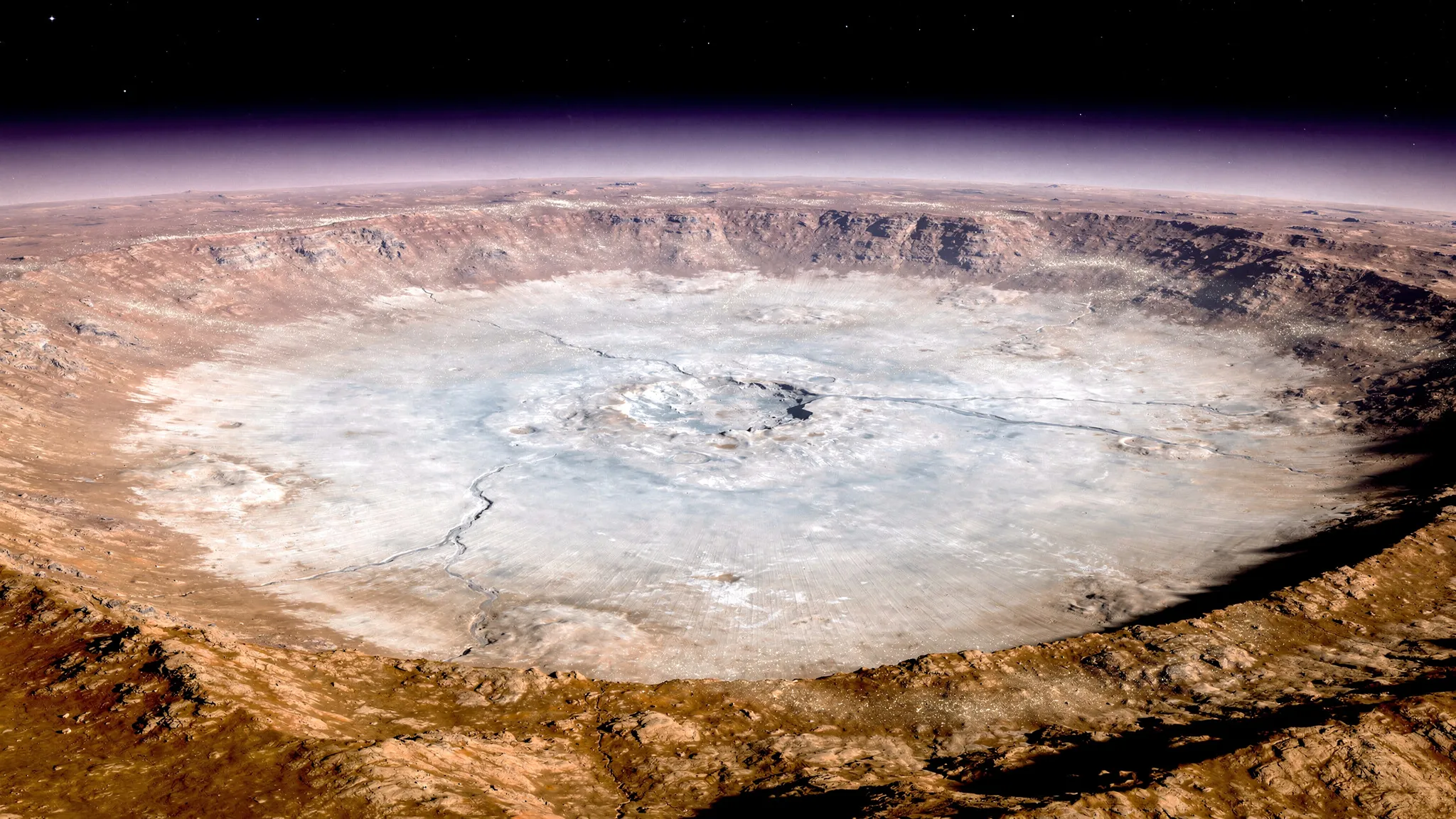
- a thick sheet of water ice, 3,400 kilograms per square metre, sits in the Hellas basin, the deepest depression on Mars — a deliberate stress test;
- the model runs for one Martian year, 669 sols, with a full water cycle: clouds, frost and precipitation.
They compared it with a control run that kept the normal dust. The paper does not state how much aluminium was injected.
Colder, drier, thinner
The result runs against the plan.
- The average surface temperature fell from 194.9 to 191.8 kelvin: 3.1 degrees colder.
- The hottest surface temperature dropped by 9 degrees, and near-surface air cooled even more, by 7 degrees on average.
- Colder air let carbon dioxide freeze onto the ground: surface pressure fell and the atmosphere lost 12.3% of its mass; carbon dioxide ice on the surface grew by 24%.
- Water vapour in the air fell by 99.65%, and the peak rate at which ice turned to vapour fell by 99.8%.
Why it failed
The authors point to a chain of effects. The particles fall: in such thin air, a molecule of carbon dioxide travels about 10 micrometres between collisions, so the particles meet little resistance as they settle. With no new supply, their heating fades over the year. Meanwhile, the bright ice in Hellas reflects much of the sunlight. As temperatures drop, water freezes out in cold spots, and the water-vapour greenhouse feedback that terraforming hopes to trigger never starts. The authors could not fully separate the share of each effect.
Limits worth knowing
This is a single simulation over one year, at coarse resolution, by two authors. The amount of injected aluminium is missing, and several numbers in the paper do not match between the text and its tables. The study does not test the continuous-injection scenarios it argues against.
In the authors’ words, the result shows neither that planetary geoengineering works nor that it is doomed. A one-off injection behaves like a passing radiative pulse; a lasting change to the Martian climate would require much more.