TRAPPING MOLECULES BETWEEN MIRRORS CHANGES NOTHING HERE
Ordinary solar cells waste part of the energy of each photon as heat. One proposed way around this limit is singlet fission: in certain organic materials, an excitation created by light (a “singlet”) splits into two lower-energy excitations (“triplets”). If both can be harvested, one photon gives two charges instead of one.
The catch, according to the paper, is that fission is very sensitive to the structure and packing of the molecules, which takes a lot of chemical work to optimise.
Mixing light and matter
An appealing shortcut is to change not the molecules but their light environment. Place a thin film between two closely spaced mirrors, and the light trapped inside can couple so strongly to the molecules that they form hybrid light–matter states, called polaritons. In theory, these could speed up, slow down or redirect processes such as fission without touching the chemistry.
Experiments have been contradictory. For one molecule, TIPS-pentacene, no change was found. For rubrene, a 2019 study using silver mirrors reported that fission was suppressed. The authors of the new paper point out a problem: the reported changes lasted picoseconds, while light only survives about a tenth of a picosecond between lossy silver mirrors. And the mirrors themselves act as a filter on the probing light, creating artefacts that can look like changes in the molecules.
Measuring where the mirrors are blind
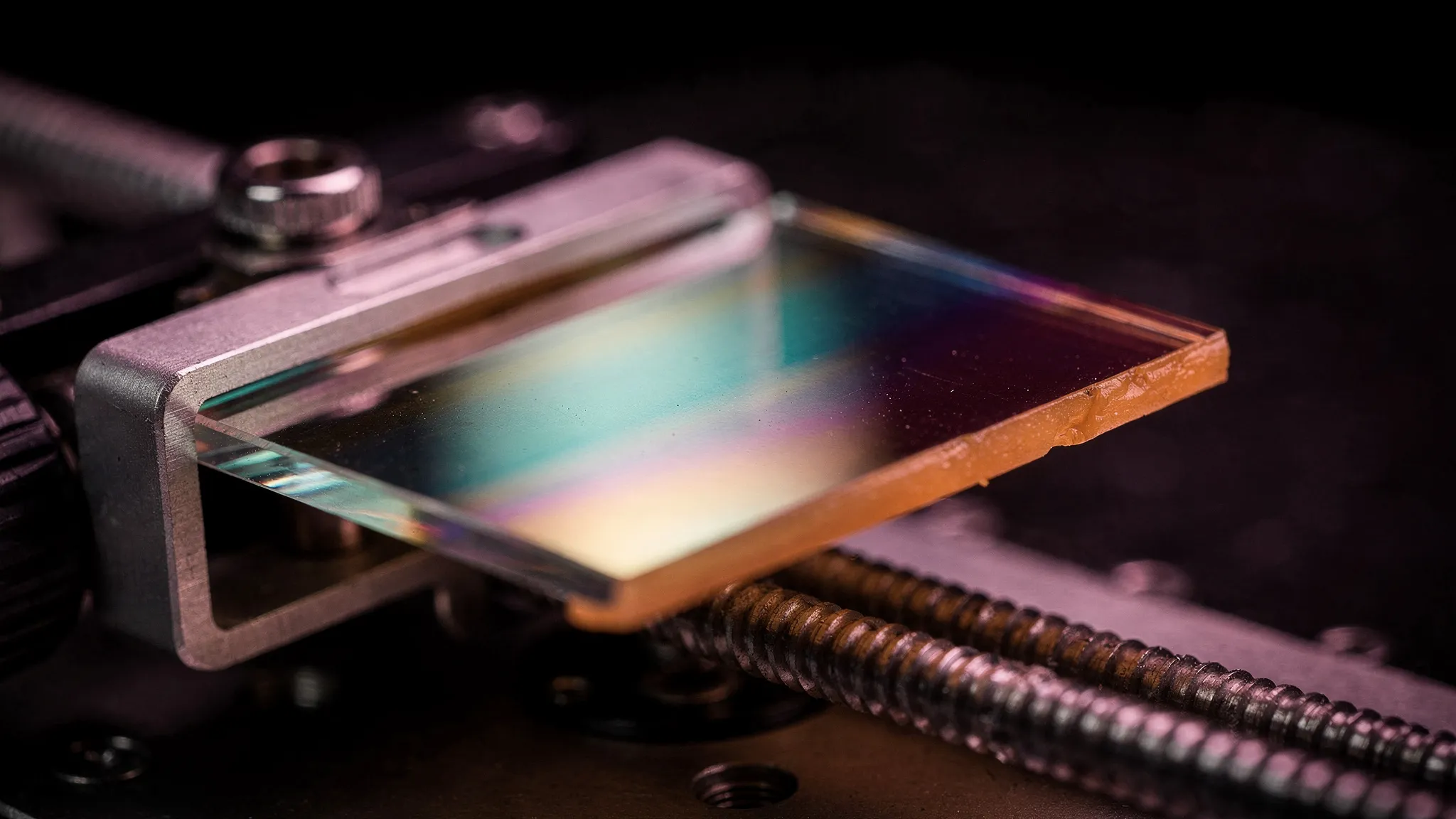
Jenny Clark (University of Sheffield) and colleagues from Sheffield, Oxford, Warwick and Bath built cavities from dielectric mirrors, stacks of silica and titanium dioxide layers that reflect strongly in the visible but let near-infrared light through. They then followed the fission in the near infrared, around 1,200 nanometres, outside the band the mirrors reflect, where the cavity cannot distort the signal. On a bare film, they checked that this infrared signal tracks the fission exactly as the visible one does.
They compared:
- a low-quality cavity, where light survives about 25 femtoseconds;
- a high-quality cavity, where it survives about 330 femtoseconds;
- cavities tuned to different energies, from +20 to −110 millielectronvolts, covering the conditions of the earlier report;
- a bare film and an “open cavity” with only the bottom mirror.
In all cavities, light and molecules were firmly in the strong-coupling regime, with a splitting of about 100 millielectronvolts.
Same fission, everywhere
In every case, the fission ran virtually unchanged. The same model with the same rates described the open cavity and both strongly coupled cavities: the first step of fission took place at 130 per nanosecond in all three. Changing the tuning made no difference either.
The team did see small changes in the spectra, but detailed optical simulations reproduced them as interference effects in the mirrors, not as altered photophysics. A third, independent technique, time-resolved electron paramagnetic resonance, probes the spins of the triplets through magnetism rather than light, and showed the same triplet signal with and without the cavity.
One detail illustrates how easy it is to be misled. Fission was about 20% faster in the cavities than in the bare film, but just as fast in the open cavity, which has no top mirror and no strong coupling. The authors attribute it to contact with the titanium dioxide layer of the bottom mirror.
What it means for cavity chemistry
The results “cast significant doubt” on the earlier report of polariton-modified fission in rubrene, the authors write, and agree with the TIPS-pentacene study: the huge reservoir of uncoupled molecular states dominates the dynamics. They suggest that earlier changes likely came from optical artefacts, surface effects or second-order processes in which excitations destroy each other, and that any future claim of cavity-controlled chemistry should rule these out first. Probing outside the mirrors’ reflection band, they argue, is a simple way to do that.