A ROPE THAT HOLDS WITHOUT FRICTION
What holds a rope together? Not glue: its fibres are not bonded to one another, only tangled, unable to pass through each other. The question is, according to the authors, among the oldest in materials science. The paper quotes Galileo: “the very act of twisting causes the threads to bind together”. The accepted picture since then combines three ingredients — the twisted geometry, a pull on the rope and friction between fibres. Remove one, and things fall apart: a cut rope frays at its free end.
Springs instead of straight threads
Benjamin Greenvall, Gregory Grason and colleagues at the University of Massachusetts Amherst, with Williams College, changed one thing: the shape of the strands at rest. Twisted bundles of straight strands unwind and separate once cut. Bundles of strands that are naturally helical, coiled like springs, stay locked after the cut — with no sleeve holding them.
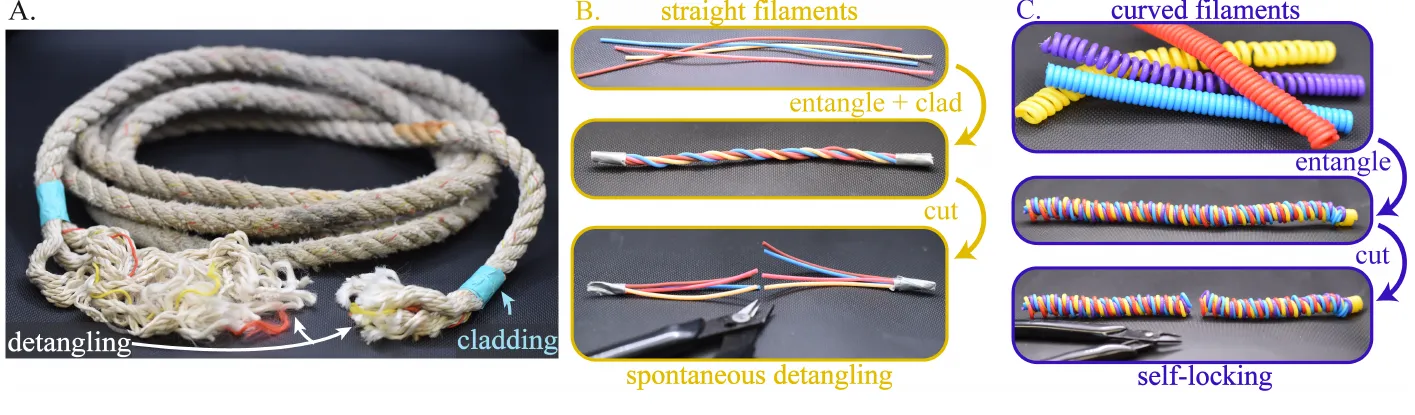
A cut rope frays (A); twisted straight strands separate when cut (B); naturally coiled strands stay locked (C). — Figure 1, Greenvall et al. (2026), arXiv:2610.36330.
Squeezed into place
In a tight bundle, each coiled strand cannot keep its preferred radius and pitch (the length of one full turn along the coil’s axis) without running into its neighbours. It is forced into a slightly different shape, and it pushes back. That stored elastic stress, held in check only by contacts that push and never grip, squeezes the bundle together. The authors call it “purely elastic cohesion”.
To prove that friction is not needed, they simulated elastic rods whose contacts are almost perfectly slippery. Bundles of two, three and four strands still lock — for the right shapes.
Locked or unzipped
Whether a bundle holds depends on how far its strands are pushed from their preferred shape, and on how many strands share the bundle. The line is sharp. For two strands with a pitch of four diameters, a preferred radius of 0.38 diameters locks; 0.375 unravels. Adding a third strand to the locked case makes it unravel too.
When a bundle fails, it does not fall apart all at once. An unravelling front forms at the free ends and travels along the bundle keeping the same shape and the same stored energy, like a solitary wave, until the strands are fully separated. The threshold does not depend on the bundle’s length: simulations from 40 to 320 strand diameters (about 6 to 48 turns) give the same answer. The authors describe the threshold like the cracking of a brittle solid: the bundle holds as long as opening the front costs more bending energy than the relaxation along it gives back. Their estimate: stability as long as the strands are forced outward by less than about 20% of the bundle’s packing radius — the tightest radius the strands can take without overlapping.
Where friction cannot help
The team also 3D-printed coiled strands 8 millimetres thick, from a rubbery plastic, and measured the torque needed to unwind pairs of them. Small mismatches locked, large ones unravelled, in agreement with the simulations and the theory.
Adding realistic friction (a friction coefficient — grip force divided by pressing force — of 0.6) widens the range of shapes that lock. But raising it further, even to an absurd value of 100, changes almost nothing beyond about 1. Some shapes cannot be locked by any amount of friction — including the classic case of straight strands twisted together, which always unwind once nothing holds them.
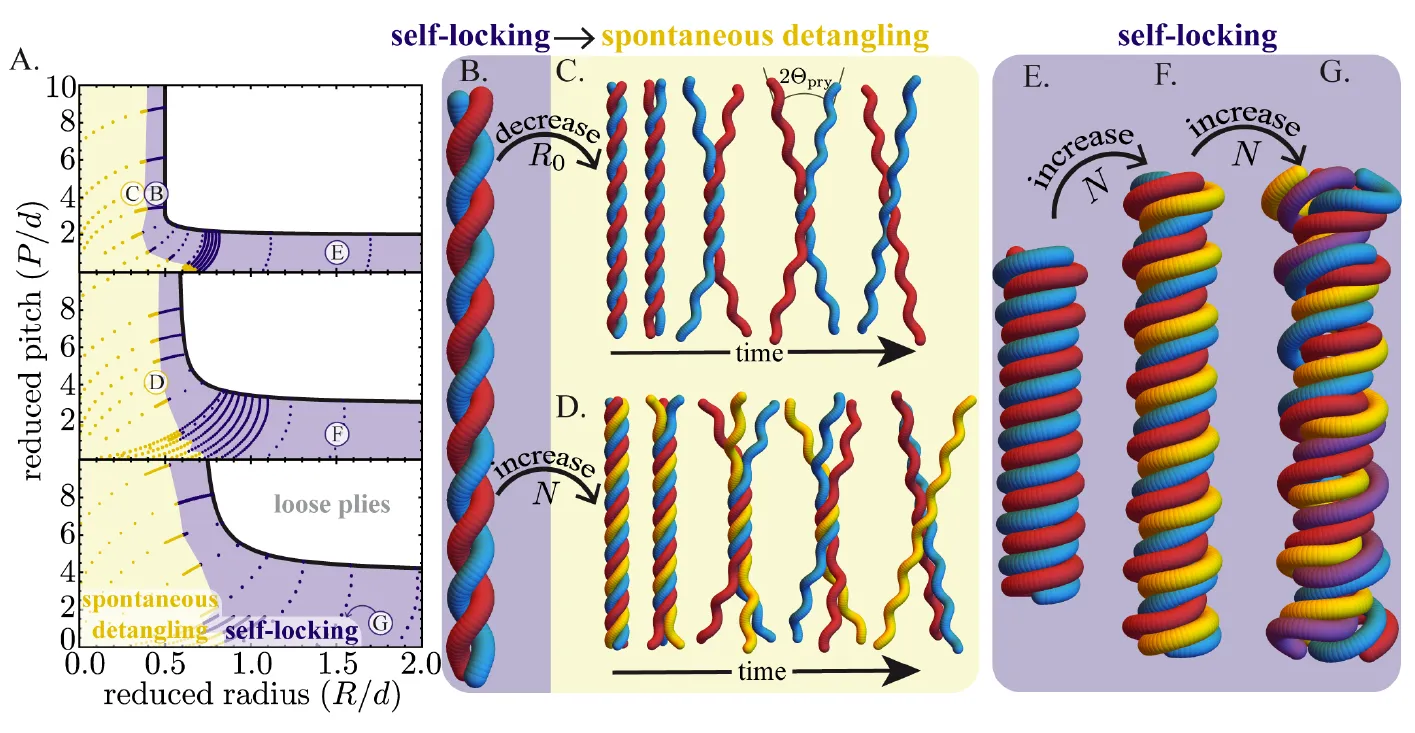
Which shapes lock and which unravel (A); a locked pair (B); bundles unzipping from their ends when the radius shrinks or a strand is added (C, D); locked bundles with more strands (E–G). — Figure 3, Greenvall et al. (2026), arXiv:2610.36330.
Coils of coils
When the problem is the pitch rather than the radius — the strands would like tighter coils than the bundle allows — the bundle stays locked but rearranges: each strand slides off the common axis and winds around a path that is itself a helix. These “superhelices” release 40 to 95% of the stored elastic energy and lock the bundle even more deeply.
Fibres that untie themselves
The authors suggest the mechanism may help explain how yarns of crimped fibres, such as sheep’s wool, hold together, and how some 3D-printed fabrics do. They also see a design rule for active materials: strands whose coil can be switched by heat or swelling, built close to the locking threshold, could form bundles that hold firmly and then, on command, unravel themselves.