
QUANTUM POPCORN: THE BUBBLES OF A CHANGING UNIVERSE ARE BORN LUMPY
Many extensions of the Standard Model of particle physics — grand unification, extra dimensions, supersymmetry, solutions to the “strong CP problem” — predict that the early Universe went through first-order phase transitions — abrupt changes of state, like water boiling, where the new state appears in bubbles. In the quantum version, the change starts with a rare event: by quantum tunnelling, a microscopic bubble of “true vacuum”, the new and more stable state, appears in a sea of “false vacuum”. Once born, it grows at or near the speed of light, converting vast regions until it rules. Collisions between such bubbles are considered a possible source of a background of gravitational waves.
The sphere of the textbooks
The tunnelling rate has been calculated since the work of Coleman, and of Callan and Coleman, in 1977. Their method rests on a solution called the bounce, which also gives the bubble’s profile at birth. The most probable configuration is thought to be spherical — which means, for instance, that the newborn bubble cannot emit gravitational waves. Because the most dramatic events come later, when bubbles expand and merge, the birth itself has drawn little attention, and its picture has stayed vague.
Kfir Blum and Omri Rosner, at the Weizmann Institute of Science in Israel, and Ipak Fadakar and Guilherme Pimentel, at the Scuola Normale Superiore and INFN in Pisa, decided to put “the microscope, so to speak, on the nascent bubble”.
One step beyond the sphere
The spherical bubble, they show, is only the leading term of the calculation. At the next order, the field is not a single shape but a Gaussian ensemble: a cloud of possible shapes, randomly fluctuating around the sphere, each with a computable probability. Any real bubble is one draw from that cloud — and almost none is exactly round.
The team derived the quantum state of the field at the moment of birth and showed that its fluctuations follow the same mathematics that Callan and Coleman used for the decay rate (the tunnelling rate), now given a clean probabilistic meaning.
How far from round?
To measure the lumpiness, they computed the bubble’s quadrupole moment — the part of its shape that makes it an ellipsoid rather than a sphere. The answer is strikingly simple: the typical relative deformation of the wall is
δR/R ∼ (ℏ/S_b)^½,
where S_b is the bounce action, the number that also controls how rare tunnelling is, and ℏ is the reduced Planck constant. For a thin wall, the factor in front is about 1.2; across the model families studied, it ranges from about 1.2 to 2.6.
For a cosmic transition to succeed, with bubbles appearing and filling space, S_b/ℏ must lie around 120 to 150, for transitions at temperatures between 100 GeV and 100 TeV. That gives a deformation of about 10% of the radius per mode — that is, for each elementary way of deforming the sphere, such as stretching it into an ellipsoid.
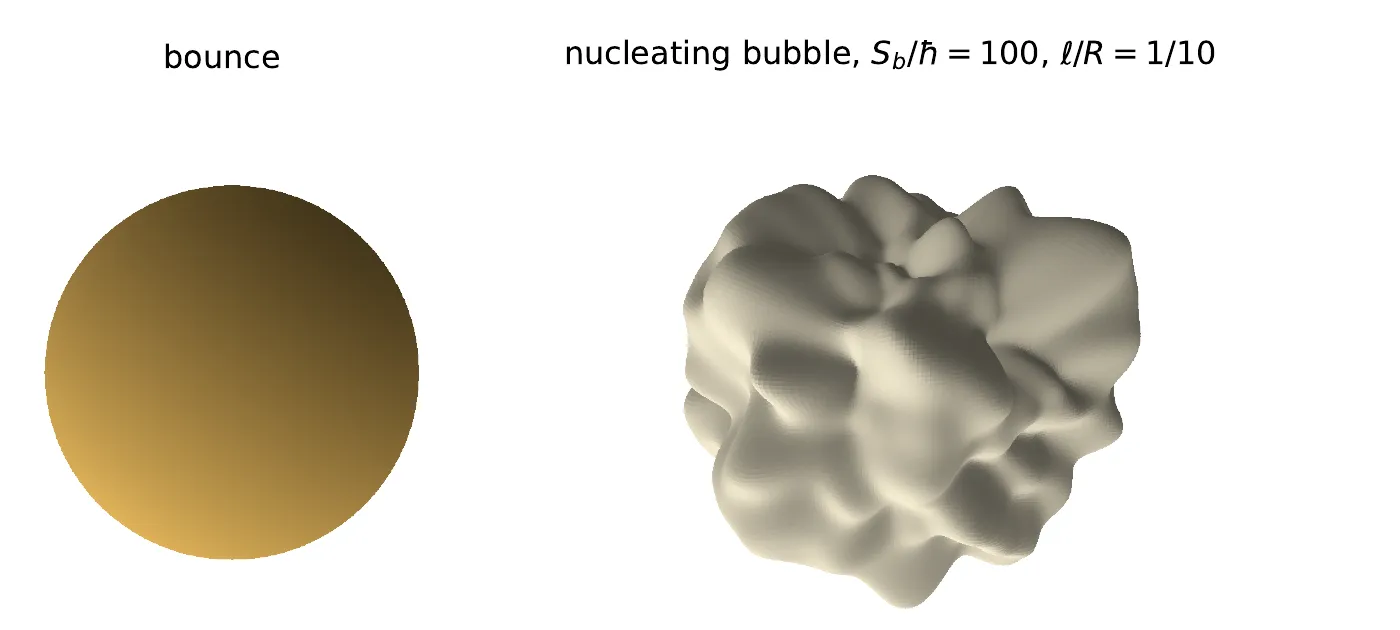
Left: the spherical bounce of the textbooks. Right: one bubble drawn at random from the quantum ensemble, for S_b/ℏ = 100, viewed at a resolution of a tenth of its radius; its wall is displaced by 17% of the radius, in root-mean-square terms. — Figure 1, Blum, Fadakar, Rosner & Pimentel (2026), arXiv:2610.41504.
The picture changes with resolution: looked at more finely, the wall turns out to be rough on every scale between its radius and its own thickness. The quadrupole, a single shape component, needs no such caveat.
Thick walls and light vacuums
The paper then checks how the result depends on the bubble’s structure. For thin walls, internal vibrations of the wall barely matter: they are suppressed by the cube of the ratio of wall thickness to radius. For thick walls, they contribute more, raising the factor up to about 2.6.
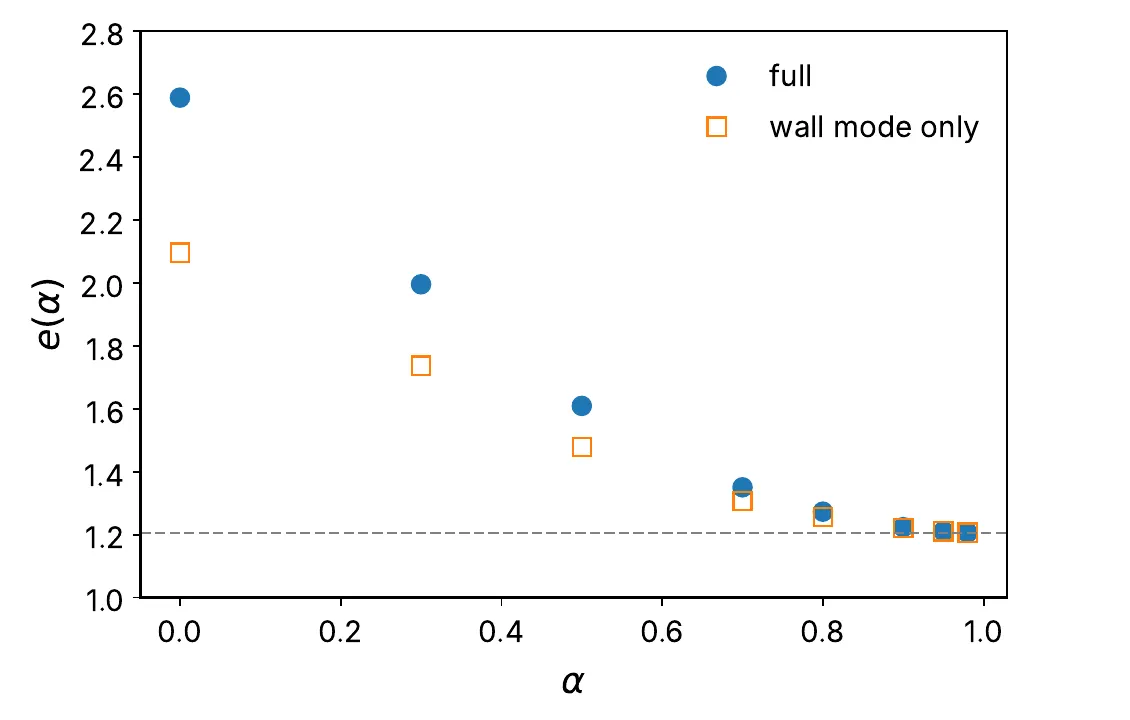
The relative deformation per mode, in units of (ℏ/S_b)^½, for a family of potentials from thick walls (left) to thin walls (right): full result (circles) and wall displacement alone (squares). The dashed line is the thin-wall limit, 1.206. — Figure 2, Blum, Fadakar, Rosner & Pimentel (2026), arXiv:2610.41504.
When the false vacuum is “light” — its particles so light that their natural range is much larger than the bubble — the bubble has a long tail, and fluctuations along that tail dominate, boosting the result by a logarithm of that mass ratio. The paper names the Standard Model’s own Higgs potential, at very large field values, as the canonical example of this case.
Popcorn and gravitational waves
A bubble that is not round could radiate. An earlier study by Blum and Mirbabayi computed gravitational waves from the quantum fluctuations of an expanding bubble; the new calculation recovers its starting state and extends it to the full field. Following the waves back to the very moment of birth is left for future work.
The paper’s appendix explains how the lumpy bubble of Figure 1 was drawn, under the title “Making popcorn”. Its last line: “Don’t forget to add butter and salt.”