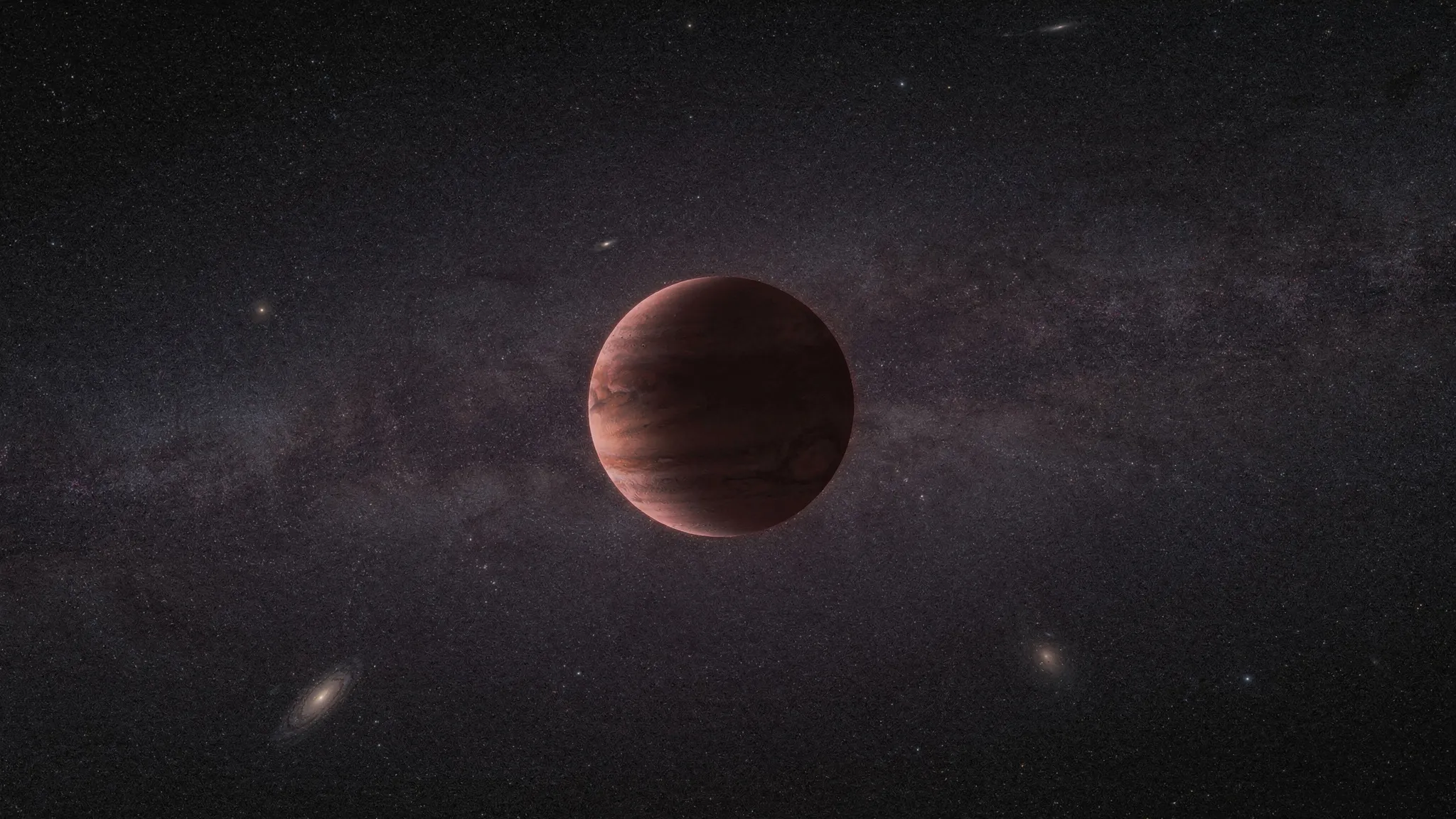
A LONE COLD WORLD, 64 PARSECS AWAY
Brown dwarfs are bodies too light to burn hydrogen steadily like stars. They never settle into steady burning and spend their lives cooling down. The coldest of them, the Y dwarfs, have surfaces at a few hundred kelvin and glow mostly in the infrared, around 4 to 5 micrometres. They are so faint that only about fifty are known, all within 20 parsecs of the Sun, and the coldest end of the class rests largely on a single object, WISE 0855, just over 2 parsecs away.
To understand them, astronomers need distances. Without one, a dim Y dwarf could be a small nearby object or a bigger, warmer one farther away. The only distance measurement that does not depend on models is the parallax: as Earth orbits the Sun, a nearby object seems to shift back and forth against the distant background, and the smaller the shift, the farther away it is. Astronomers count these distances in parsecs, a unit built on this shift: the distance in parsecs is one divided by the parallax measured in arcseconds, a tiny unit of angle.
Found among galaxies
The deepest surveys of the James Webb Space Telescope were designed to study galaxies in the young universe. But faint brown dwarfs of our own Galaxy also turn up in them — and can masquerade as very distant galaxies. Until now, none of these deep-field brown dwarfs had a measured parallax.
Feng-Yuan Frey Liu and colleagues at the University of Edinburgh studied JADES-GS-BD-5, found in the JADES survey’s southern field. It had been imaged by seven different programmes over two years, in five sets of dates, including fifty images in a single infrared filter. The team realigned every image using 850 reference sources, and tied the result to the sky using five stars measured by the Gaia satellite and 149 distant galaxies, whose apparent motion should be zero.
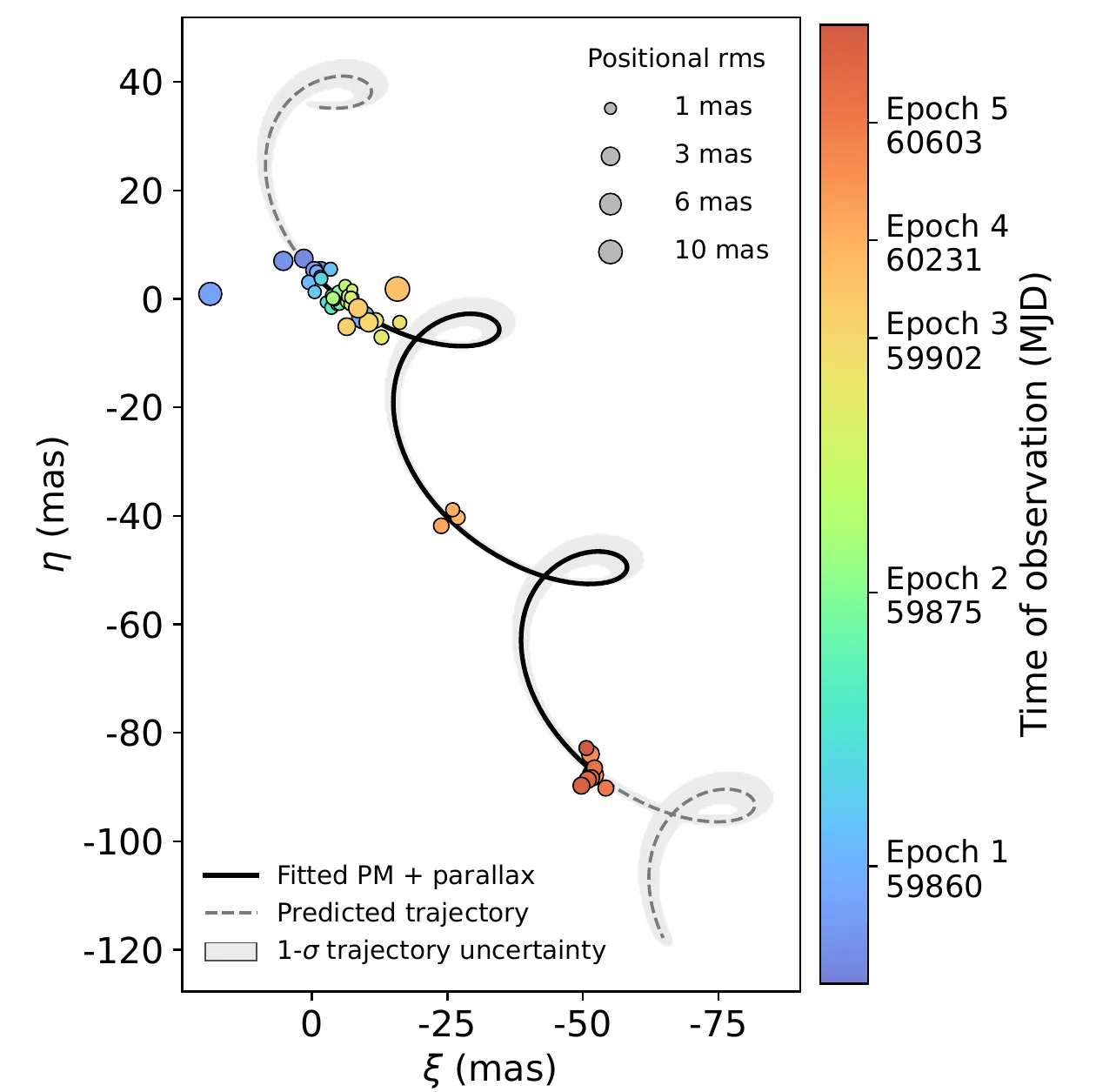
The position of JADES-GS-BD-5 in 50 images over two years (dots, coloured by date) and the fitted trajectory (black curve): a steady drift across the sky combined with a yearly loop, the parallax. Positions are in thousandths of an arcsecond. — Figure 3 (right panel), Liu et al. (2026), arXiv:2611.08346.
The object drifts across the sky by 49.8 thousandths of an arcsecond per year, but not in a straight line: on top of that drift, it traces a small yearly loop. Its parallax is 15.7 thousandths of an arcsecond, detected with high confidence, which puts it at about 64 parsecs. That is roughly three times farther than the most distant Y dwarfs whose distances were previously measured this way.
A planet without a star
With the distance known, the team could convert brightness into total power. JADES-GS-BD-5 emits about a ten-millionth of the Sun’s luminosity. Models of how such bodies cool then give a temperature of about 300 kelvin, a radius close to Jupiter’s and a mass of about 8 Jupiter masses. More than 90% of the possible masses lie below 13 Jupiter masses, the threshold the authors adopt for planetary masses.
The team searched for a parent star and found none: no companion in the images, no star in the Gaia catalogue with a matching motion and distance within a wide area, and no sign of an orbiting partner in its path. Its slow motion, 15 kilometres per second across the sky, and its position fit the thin disk of the Milky Way, the flat layer in which the Sun and most nearby stars orbit. It is therefore an isolated object of planetary mass.
That makes it valuable. A few of the coldest known exoplanets have similar temperatures and masses, but they orbit bright stars whose glare contaminates their light. A lone object like this one can be studied in clean conditions, as a stand-in for a mature, cold giant planet.
An atmosphere models cannot match
The team tested nine families of atmosphere models against its light, measured in 23 filters and with a spectrum taken over 27.7 hours. None reproduces it in detail. Fitting the spectrum alone pushes the models towards hotter temperatures and, in turn, larger distances than the parallax allows — the inferred distance scales as the square of the temperature. The models that work best include chemistry out of equilibrium, which fits the strong signatures of carbon monoxide and carbon dioxide in its spectrum, a sign of gas being mixed up from deeper, hotter layers. Whether its atmosphere is short of water, as some features hint, remains unclear.
The first of many
For eight of the nine other Y-dwarf candidates in the same survey, the team measured how they move across the sky, though no other parallax is yet secure. The authors expect JWST deep fields to hold a sample of ultracool dwarfs several times larger than the one gathered by earlier all-sky searches — a population of cold, lonely worlds waiting in the background of galaxy surveys.