WHAT DRAINS A STATIC BALLOON? THE RADON IN THE ROOM
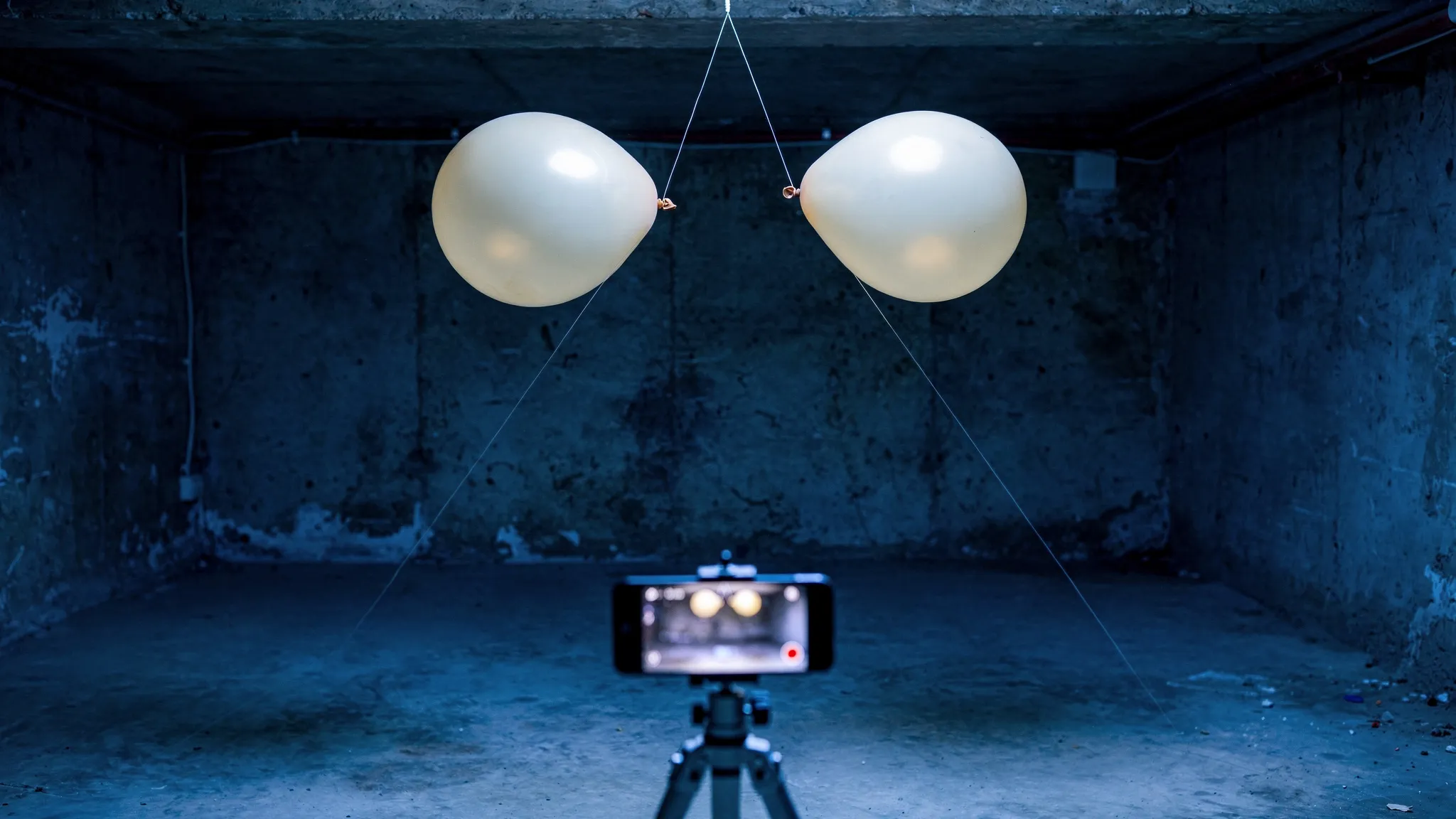
It is a classic of the physics classroom. Rub two balloons with fur, hang them side by side, and they push each other apart: each carries a negative electric charge. Measure the angle of the strings and the distance between the balloons, and Coulomb’s law gives their charge. Wait a while, though, and the balloons slowly sag back towards each other. The charge is leaking away. But where to?
Insulators can lose charge through their bulk, along their surface, by emitting ions — atoms or molecules carrying an electric charge — into the air, or by attracting oppositely charged ions from the air. Here the strings are thin fishing line with a huge electrical resistance: the current through them is negligible. That leaves the air.
Radioactive air
The air in a room is never entirely neutral. Radon, a radioactive gas that seeps from the soil, decays in it along with its short-lived descendants. Each decay launches a fast alpha or beta particle that strips electrons from the air molecules in its path. Making one pair of ions costs about 34 electronvolts, a tiny unit of energy suited to single atoms, so a single alpha particle of 5.49 million electronvolts leaves hundreds of thousands of ions behind it. Cosmic rays and gamma rays from the ground add a few more.
The same process once served to measure radiation itself: in the pioneering work of Röntgen, Becquerel and Hess, the rate at which a charged electroscope — a simple instrument whose thin metal leaves spread apart when charged — lost its charge revealed how strongly the air was being ionized.
A garage, a phone and a rabbit fur
J. Pantaleone, a physicist at the University of Alaska Anchorage, set up the experiment in an empty basement garage of 81 cubic metres. A cheap radon detector and a gamma-ray detector measured the air. In January, with the ground frozen, radon reached 0.74 picocuries per litre (a unit of radioactivity: the more radon atoms decay each second in a litre of air, the higher the figure) and the humidity 28%; in early summer, radon fell to 0.39 and the humidity rose to 52%.
Pairs of balloons of three sizes were rubbed with rabbit fur for about a minute each, then filmed from 2.5 metres away for 60 minutes, after the experimenter left the room. A video-analysis program measured the strings’ angles every 40 seconds, giving the charge over time. A typical starting charge was about 0.7 microcoulombs, enough to raise each balloon to an electric potential of around 30,000 volts.
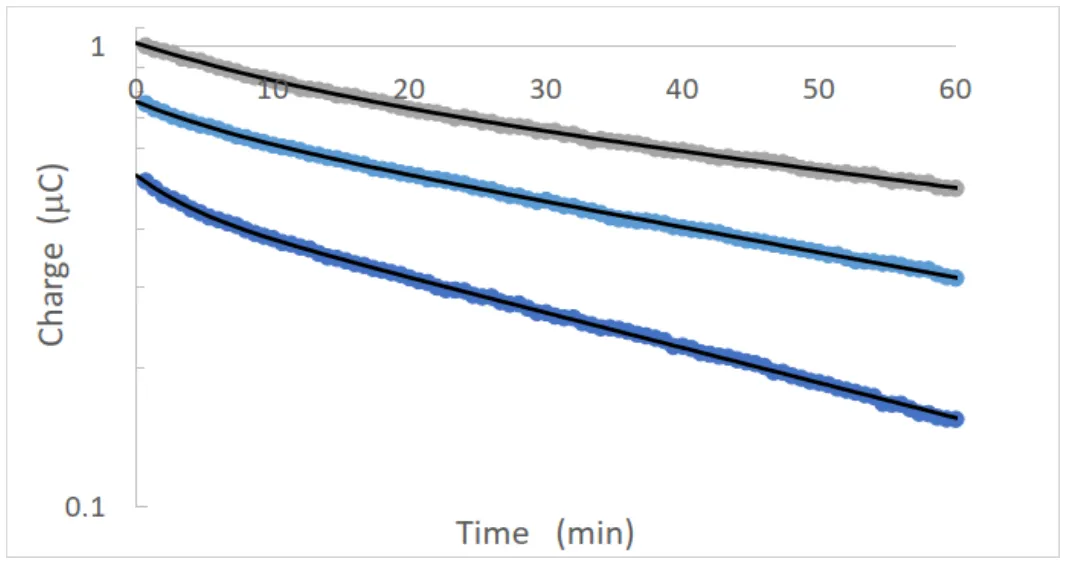
Charge on a large, a medium and a small balloon (top to bottom) over one hour, in winter; black lines are fits. — Figure 2, Pantaleone (2026), arXiv:2611.08521.
Two leaks, two speeds
The charge always drains quickly for the first few minutes, then more slowly.
At the start, the leak is too fast to come from ions in the air: the currents — the rate at which charge flows off the balloons — exceed the 0.20 nanoamperes the model allows from slow, heavy ions (ions stuck to the tiny dust and droplets floating in the air), and they are about three times higher in humid summer air than in winter, for the same charge. The author attributes this early leak to water ions leaving the balloon’s surface, a known effect in polymers.
After an hour, the picture changes. The currents are far smaller, steadier, and similar in both seasons. They fit a simple model: small ions — freshly made ions not yet stuck to any particle — are created everywhere in the room by radioactivity, and the balloons pull in every one born close enough to reach them before it disappears. A small ion lives about 16 seconds on average; to fit the data, the author set the time allowed for that trip at 17 seconds in summer and 9 in winter. The bigger the charge, the farther the reach.
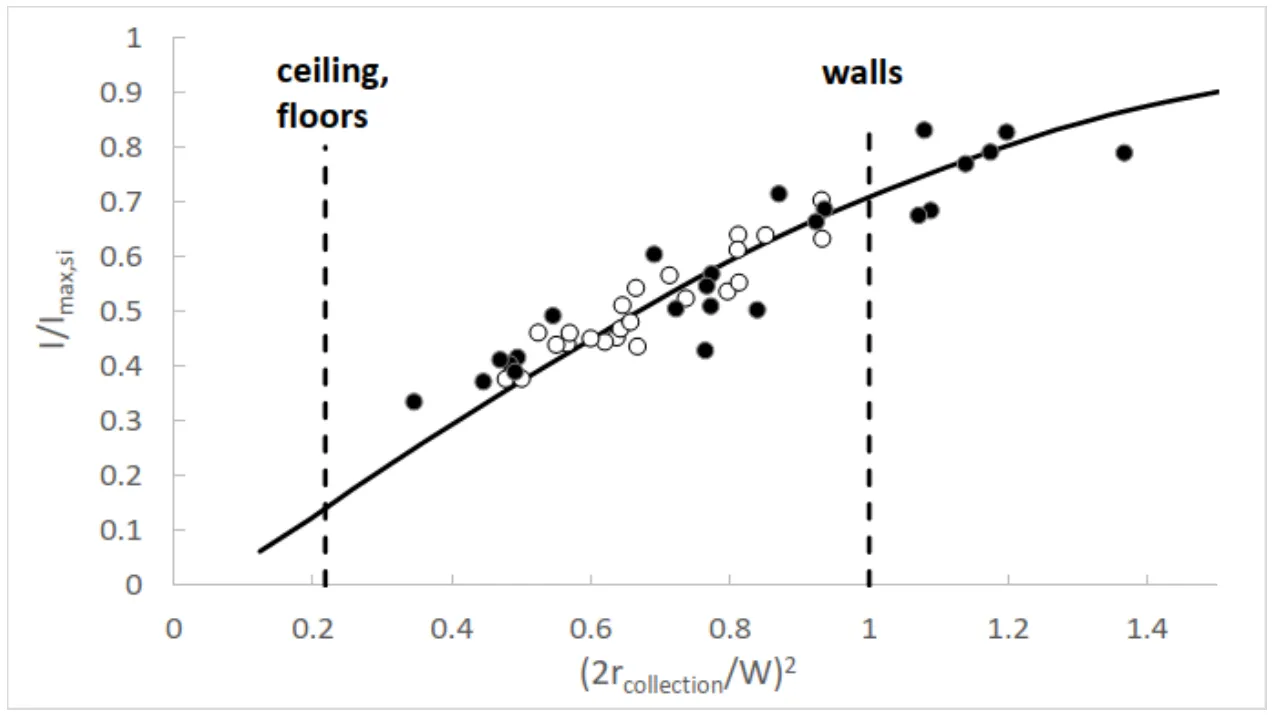
Current after 60 minutes divided by the maximum possible current from the room’s small ions, against the reach of the balloons’ charge: summer (open circles) and winter (filled) follow the model (curve). — Figure 4, Pantaleone (2026), arXiv:2611.08521.
For the largest charges, the measured current comes close to the maximum the radioactivity of the room can supply: the balloons are sweeping up almost every positive small ion created in the garage.
A lab for the price of a phone
The author stresses that the most expensive equipment was the smartphone; the radon and gamma detectors now cost much less than a smartphone. The paper ends with projects for students. Smoke from a fog can should slow the late leak, because small ions stick to the smoke particles and travel less far; filtering the air should speed it up, unless the filters also remove the radioactive atoms. A smaller room, balloons of vinyl or mylar, or a coat of corn starch could each test a different part of the story — a static balloon turns out to be a radiation detector in disguise.