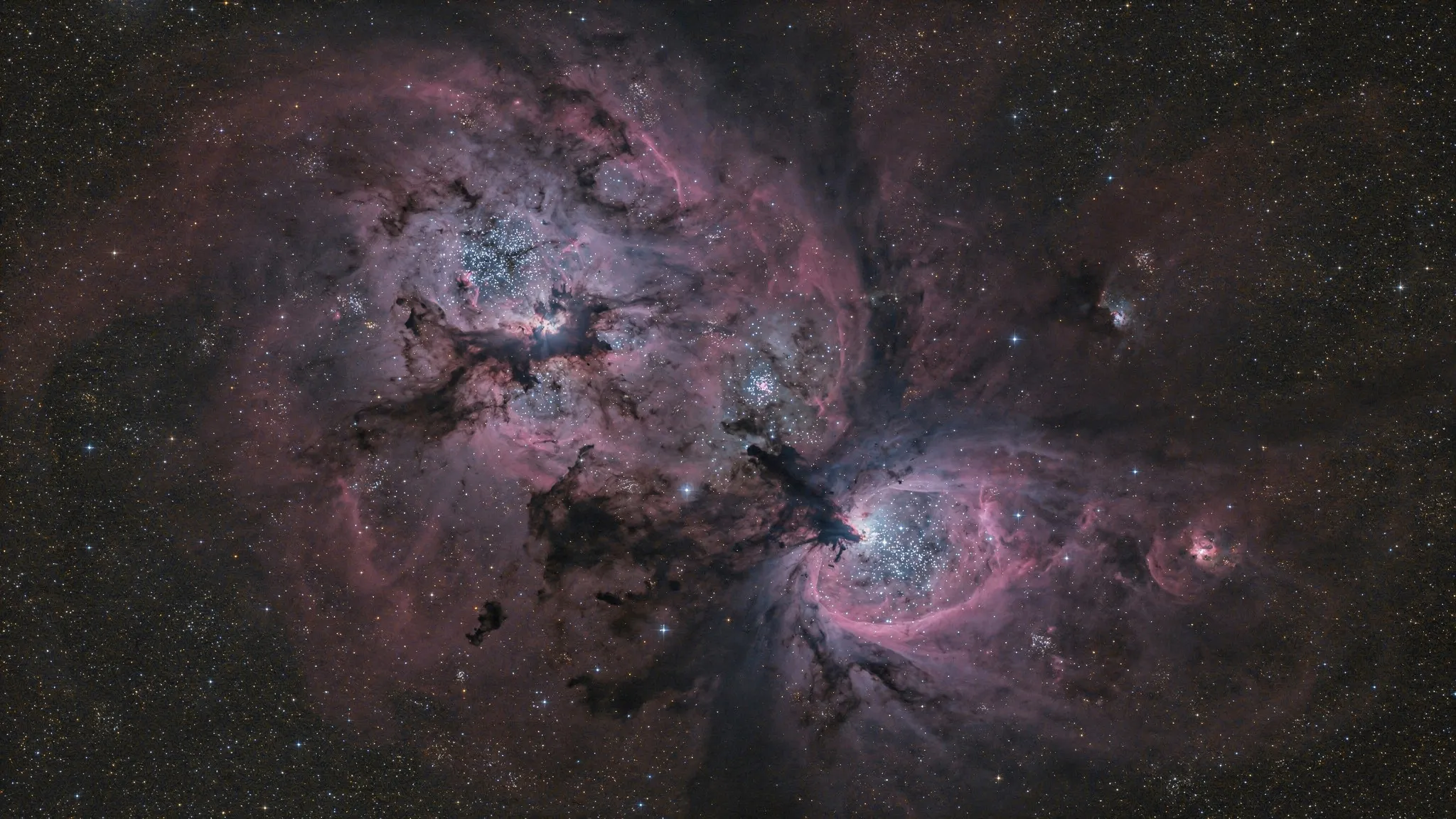
ORION MAKES STARS IN WAVES, EVERY 5 MILLION YEARS
Stars are born in clouds of gas, often in large complexes that keep producing new generations for millions of years. How that production unfolds says a lot about what drives it. Does star formation proceed at random, or does it follow patterns that can be reconstructed? Are new stars triggered by older ones, whose winds and explosions compress the surrounding gas?
There is no consensus, the paper notes: a 2022 review found little to no evidence of coherent patterns. Separating the loose, scattered groups of young stars finely enough only became possible thanks to the Gaia satellite, which measures the positions and motions of stars across the sky.
A precedent next door
In the nearby Scorpius-Centaurus complex, a study published in 2023 found coherent structures in space and time, including several episodes of increased star formation spaced by about 5 million years, spreading outward from the inside, apparently driven by feedback from earlier stars. Would the same hold in Orion, the best-studied star-forming region near us?
Alena Rottensteiner, João Alves and colleagues at the University of Vienna, working with researchers in Barcelona, Prague, Cambridge (Massachusetts) and at the European Southern Observatory, used a recent census of Orion built from Gaia data: 47 groups of stars, aged 1.5 to 25 million years, with 11,996 reliable members, and ages derived the same way for every group. In this work, “cluster” means a statistical over-density of stars, not necessarily a group held together by gravity.
Four waves
The ages are not smooth. Weighted by their number of stars, they form four peaks, at 6.4, 11.3, 16.2 and 21.4 million years, separated by 5.0, 4.8 and 5.2 million years. Each peak holds more stars than the one before it.
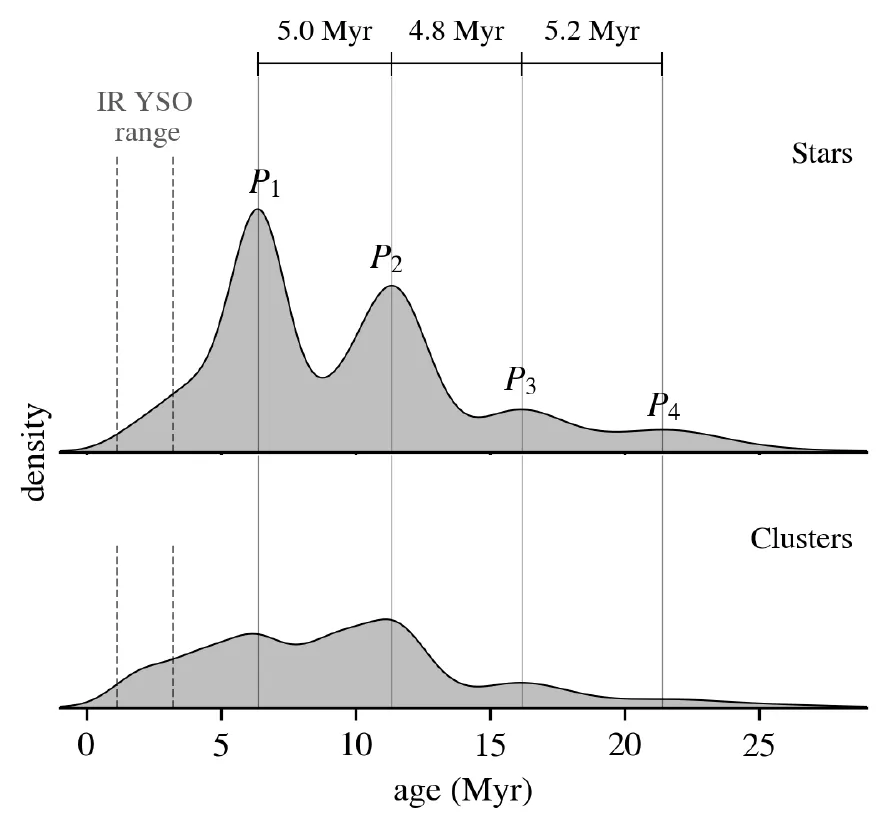
Age distribution of Orion’s 47 groups, weighted by their number of members (top) or not (bottom); the four peaks and their spacing are marked. — Figure 1, Rottensteiner et al. (2026), arXiv:2610.00481.
The authors are careful about what they claim:
- The two most recent peaks, at 6.4 and 11.3 million years, can be located statistically, together hold about 59% of all stars, and survive resampling of the data and changes in how ages are fitted. A test for multiple peaks rejects a single smooth bump for the star distribution at the 10% level.
- The two older peaks, at 16.2 and 21.4 million years, are visible but cannot be shown to be robust yet. Older groups have lost about a third of their members, which have drifted away, and that weakens their signal.
- Fewer than 0.5% of 10,000 simulated smooth histories produce three gaps as regular as these. The authors stress that this is a statement about the peaks in their figure, “not a claim that four distinct episodes definitely occurred”.
They also checked that the method could not create the pattern. The grouping step uses only positions and motions, not ages. And the age grid is evenly spaced in the logarithm of time, which cannot produce peaks evenly spaced in time itself. Groups born in the same wave also tend to sit next to each other: 68% have their nearest neighbour in the same peak, against 34% if peaks were assigned at random.
Same beat, different dance
Unlike Scorpius-Centaurus, Orion shows no single outward-spreading pattern across the whole complex. Instead, the team finds local sequences: three candidate chains of star groups that get younger along their length, one of them stretching about 130 parsecs from the Orion A cloud to the stars of Orion’s Belt, and two regions of related groups. Two of the chains start inside an expanding cavity known as the Orion Shell and get younger outward.
The authors see no contradiction with feedback-driven star formation. Orion is more massive than Scorpius-Centaurus, holds much more leftover gas, and its biggest burst is its most recent one, whereas Scorpius-Centaurus peaked 15 million years ago. More gas and more massive young stars leave room for more complex interactions: feedback can compress gas into new stars, or blow clouds apart.
Buried stars, unknown beat
Very young stars still buried in dust are missing from the Gaia census — between about 1,850 and 2,430 candidates. They could add a fifth, more recent peak, though not change the four already found. Absolute ages also depend on the stellar models used, by 1 to 3 million years.
What remains is a rhythm seen in two separate nurseries. “The cause of the ~5 Myr separations remains a mystery,” the authors write; it might relate to how fast stellar feedback travels through the gas, a question they leave for further research.