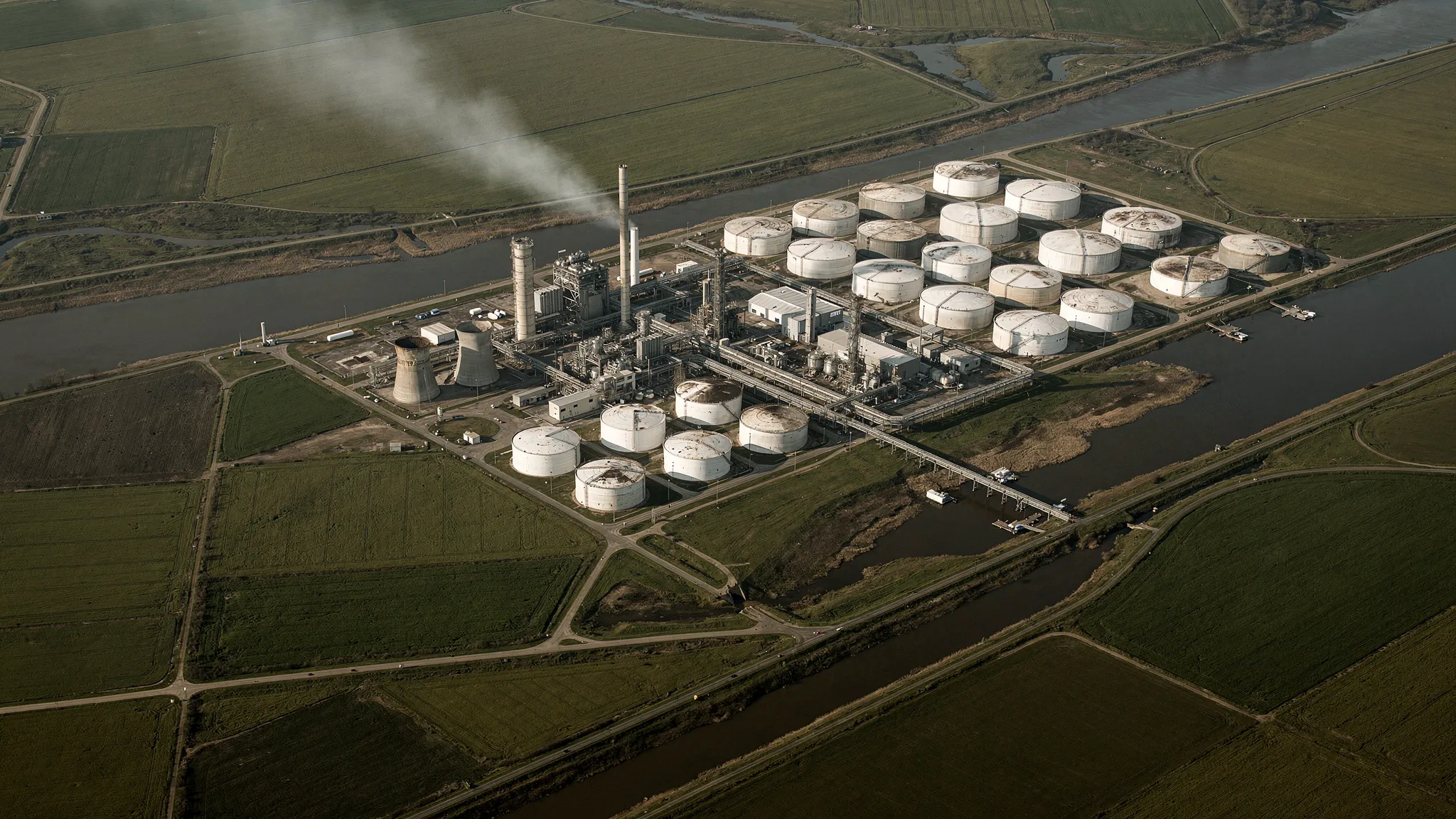
THREE NYLON PLANTS SEEN FROM SPACE
Nitrous oxide (N₂O) is a discreet but formidable greenhouse gas: gram for gram, it warms the climate 273 times more than carbon dioxide, and it is a major contributor to the destruction of the stratospheric ozone layer. Agriculture is its largest human source, and the hardest to curb. Industry is easier to fix — starting with the production of adipic acid, mainly used to make nylon.
A by-product that can be destroyed
Making adipic acid releases nitrous oxide almost molecule for molecule: the Intergovernmental Panel on Climate Change uses a factor of 0.3 kg of N₂O per kg of acid. There are fewer than 50 production sites in the world. From the 1990s, many plants in the United States and Europe installed thermal or catalytic systems that destroy over 90% of the gas. The technology is still cost-effective today.
China is now the world’s leading producer. Some Chinese plants once destroyed nearly all their N₂O, paid by carbon credits from a United Nations programme, the Clean Development Mechanism. The design backfired: selling credits became more lucrative than selling adipic acid, which likely pushed global emissions up. In 2011, the European Union banned these credits from its carbon market, and abating stopped paying. Since then, nobody has known whether the plants still destroy their nitrous oxide.
Reading a gas in sunlight
Nicholas Balasus and Daniel Cusworth, of Carbon Mapper, a philanthropy-funded organisation in Pasadena, California, went to look from orbit. Nitrous oxide absorbs a little sunlight at specific wavelengths in the shortwave infrared, between 2,050 and 2,350 nanometres. The Tanager-1 satellite records this light in fine detail, with pixels 30 metres wide.
For each pixel, the team compared the spectrum with the expected absorption signature of N₂O, which reveals the extra gas in the column of air. Adding up the excess gas in a plume and combining it with the wind speed gives an emission rate. The same approach has passed blind tests for methane.
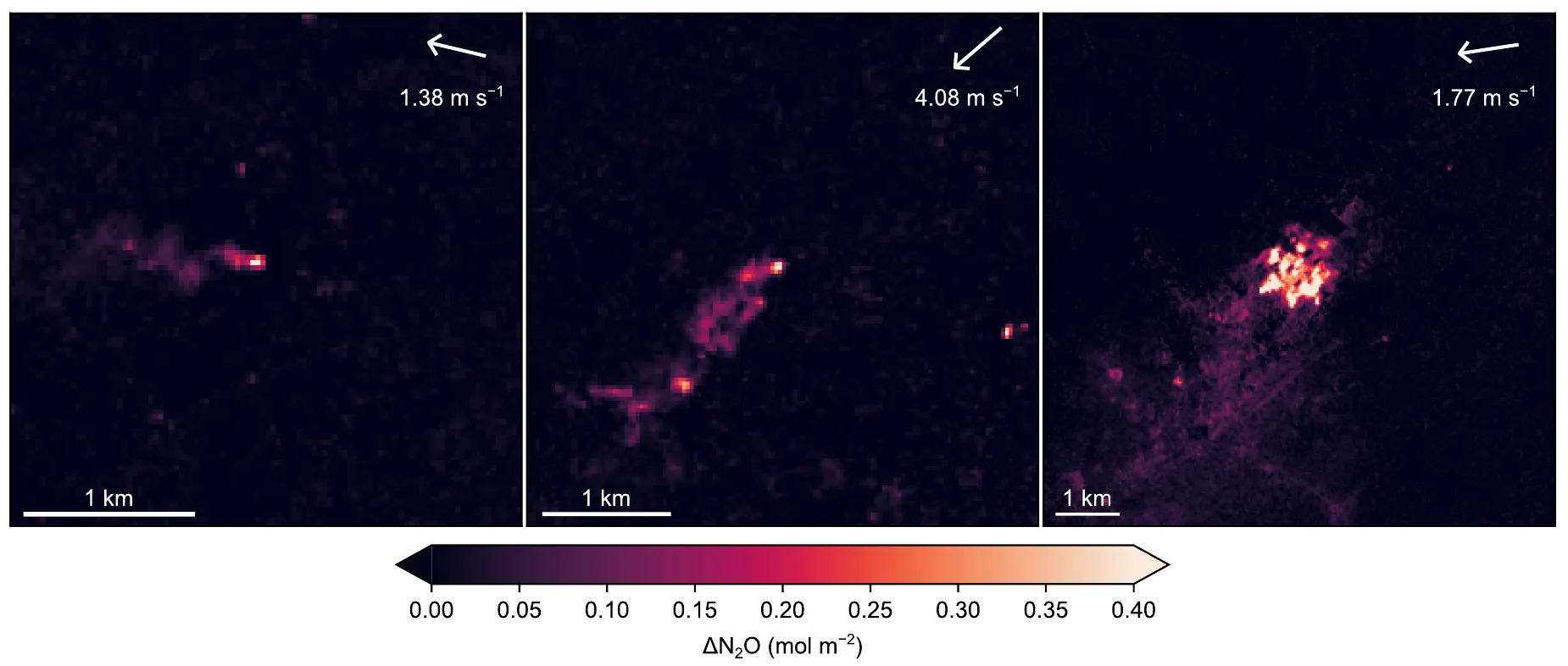
Nitrous oxide plumes over the adipic acid plants of Taiyuan, Dezhou and Chongqing, in summer 2026; arrows show the wind. — Figure 1, Balasus & Cusworth (2026), arXiv:2610.07542.
Three plants, 680,000 tonnes
From single passes in the summer of 2026, the authors estimate:
- Taiyuan: about 2.2 tonnes of N₂O per hour;
- Dezhou: about 19.6 tonnes per hour;
- Chongqing: about 55.6 tonnes per hour.
Over a year, that adds up to 0.68 million tonnes. For Dezhou and Chongqing especially, these rates imply that emission abatement is limited, given how much acid the plants are expected to produce.
To make sure a single snapshot was not a fluke, they checked with EMIT, a less sensitive instrument aboard the International Space Station. Averaged over several days in 2025 and 2026, it gives 1.9 tonnes per hour for Taiyuan and 19.2 for Dezhou; a single pass over Chongqing in April 2024 gives about 60. All consistent.
A blind spot in the world’s accounts
Recent “bottom-up” estimates of global N₂O emissions from adipic acid are less than half the total of these three plants alone. According to the authors, this is likely due to outdated production data and uncertainty about abatement — which means the industry’s role in the global nitrous oxide budget is probably underestimated.
Converted with standard US Environmental Protection Agency equivalences, eliminating these emissions would be like shutting down 49 coal-fired power plants or taking 43 million petrol cars off American roads for a year.
The count is not complete. At another site, Pingdingshan, plumes came and went between visits, so the authors left it out of their total. At least six other Chinese adipic acid plants remain unmeasured, their exact locations uncertain. With production still rising in China and a solution already on the shelf, the authors see abating these emissions as an urgent target for the climate.