
A 1959 CONJECTURE, A PROOF FROM OPENAI, AND A MATHEMATICIAN WHO READ IT
This article is about notes written by a mathematician to explain someone else’s proof. Everything said here about OpenAI’s proof comes from those notes, second-hand.
Curves through points
The problem grows out of a school exercise called interpolation: pick a few values of x, decide what value a function should take at each of them, and some polynomial always does it. In the plane, the same game asks a curve to pass through a set of points, which it can do if its degree is high enough. A curve of degree d — drawn by a polynomial equation in x and y whose highest power is d: a line has degree 1, a circle 2 — has (d+1)(d+2)/2 coefficients, and asking it to pass through a point is one equation.
Now ask more: the curve must pass through each point with multiplicity m — several times over, like a knot of branches crossing there. Each such point imposes m(m+1)/2 equations. For large d and m, the counts are about d²/2 coefficients against r m²/2 conditions, so, for r points, the count guarantees a curve as soon as d/m is a little above √r — exactly, as soon as the coefficients outnumber the conditions.
Nagata’s conjecture (1959) makes this precise: for r ≥ 10 points placed in a “very general” way — with no special coincidence among them, as points picked at random would be — every such curve has degree greater than m√r. The condition r ≥ 10 is needed: nine points always lie on a cubic (a curve of degree 3), and that cubic taken m times over is a curve of degree 3m passing m times through each of them — exactly m√9, the equality the conjecture rules out. Nagata proved it when r is a perfect square.
Two examples from the notes: no curve of degree 9 passes three times through each of 10 general points (only 55 coefficients for 60 conditions — not enough on its own to conclude, since conditions can overlap; what rules it out is Nagata’s bound, 9 being below 3√10 ≈ 9.5), and no curve of degree 12 passes three times through 16 general points — the equality case 12 = 3√16.
The proof, as Tevelev tells it
The reference is “OpenAI, Nagata’s conjecture for plane curves”, an OpenAI Math Release preprint dated 23 September 2026, with companion manuscripts on related questions released on 23 September and 5 October. Jenia Tevelev, of UMass Amherst, studied it for a talk and turned that account into these notes, hoping they “will be useful, especially to non-experts”. Tevelev claims no originality and reorganised the argument.
The standard first steps squeeze the plane down onto a smooth cubic curve and merge the r points into one. The new idea, in this account, is to let the cubic develop a node — a point where the curve crosses itself, pinching off a loop — and to follow its theta functions, the standard way of writing down functions that live on such a curve, as that pinch closes. A duality then trades the question “which curves vanish at the points?” for its mirror image, “which values can be prescribed there?”, and what is left is interpolation on a triangle of whole-number grid points — a finite table of values to fill in, “which is straightforward”.
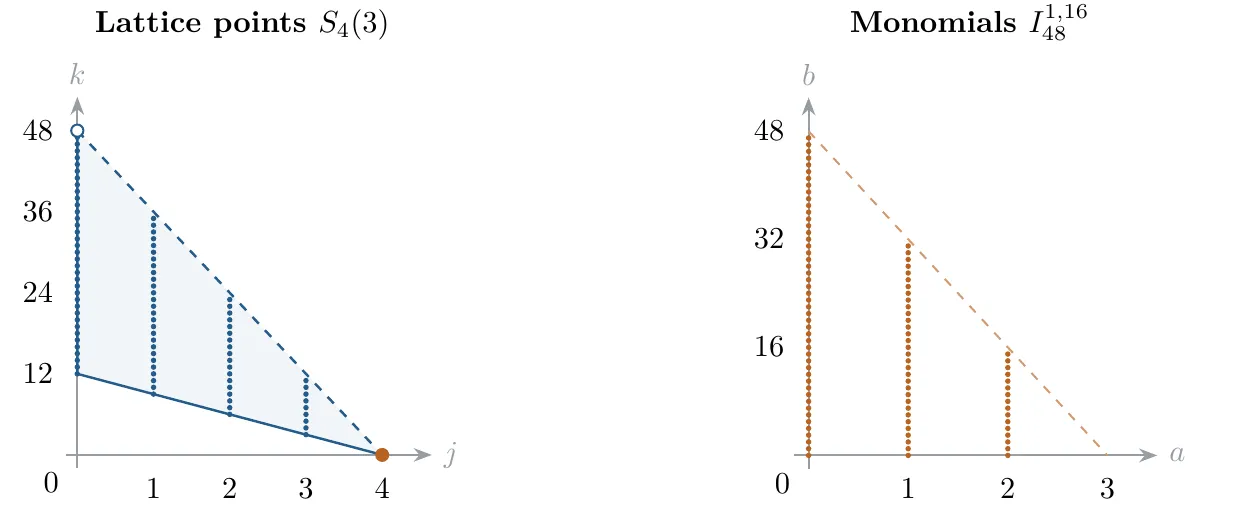
The case of sixteen triple points: the 91 lattice points of the triangle (left) and the 96 monomials, the elementary terms such as x²y from which polynomials are built (right). Showing that these 96 terms can take any values on the 91 points — the 96 × 91 matrix has “full rank” — rules out the curve. — Figure 3, Tevelev (2026), arXiv:2610.30050, CC BY 4.0.
The same calculation settles a related, more technical question, in which the plane is magnified around one point by different amounts in two directions (“weighted blow-ups”), when the ratio of those amounts exceeds nine — a case of a conjecture by Dumnicki, Harbourne, Küronya, Roé and Szemberg.
The notes present the argument as a proof. They do not mention any independent formal check, such as peer review or a computer-verified proof.
“Their first human reader”
The notes also carry the author’s opinion. Reading the released manuscripts, Tevelev “wondered whether I might be their first human reader. They seemed almost entirely unedited.” Tevelev suspects the company expected mathematicians to sort them out, an editorial effort that “demands expertise and time, yet brings little of the recognition associated with original research”. Like many others, Tevelev believes this approach harms the profession, “especially the motivation and training of young people”.
“At the same time, I think these manuscripts are a stunning achievement,” Tevelev writes: the model solved problems many experts thought out of reach, and “the old underbrush of mathematical conjectures” is “rapidly being burned in the AI fire”.
The proposal: an independent foundation funded by AI companies, offering grants, fellowships and access to the best models for young researchers, with peer review modelled on the US National Science Foundation.
The notes say they were “edited and illustrated with ChatGPT Astra”.