SIGNS OF CHARGED WHIRLPOOLS IN A FLUID OF NEUTRAL PAIRS
In a superfluid, particles move together as one quantum wave; a superconductor carries current without resistance. Set the first rotating, or place the second in a magnetic field, and both show a defining feature: a lattice of quantized vortices, tiny whirlpools that each carry a fixed, indivisible amount of swirl. In a fluid made of excitons, such a lattice had remained out of reach: excitons carry no electric charge, and a magnetic field, which sets a charged fluid swirling, has no grip on them.
Pairs that carry nothing
An exciton is an electron bound to a hole, the gap left by a missing electron. Made with light, excitons live only briefly, and being neutral, they are hard to probe electrically. Keeping the partners apart, electrons in one layer and holes in another, makes the pairs last much longer and lets each layer be wired on its own.
Cooled far enough, such pairs condense and share a single quantum phase — a common rhythm — across the whole fluid, much like the electron pairs of a superconductor. Electrical signatures existed, but, the authors write, unambiguous evidence of this global phase coherence had remained elusive.
Where the extra charge would go
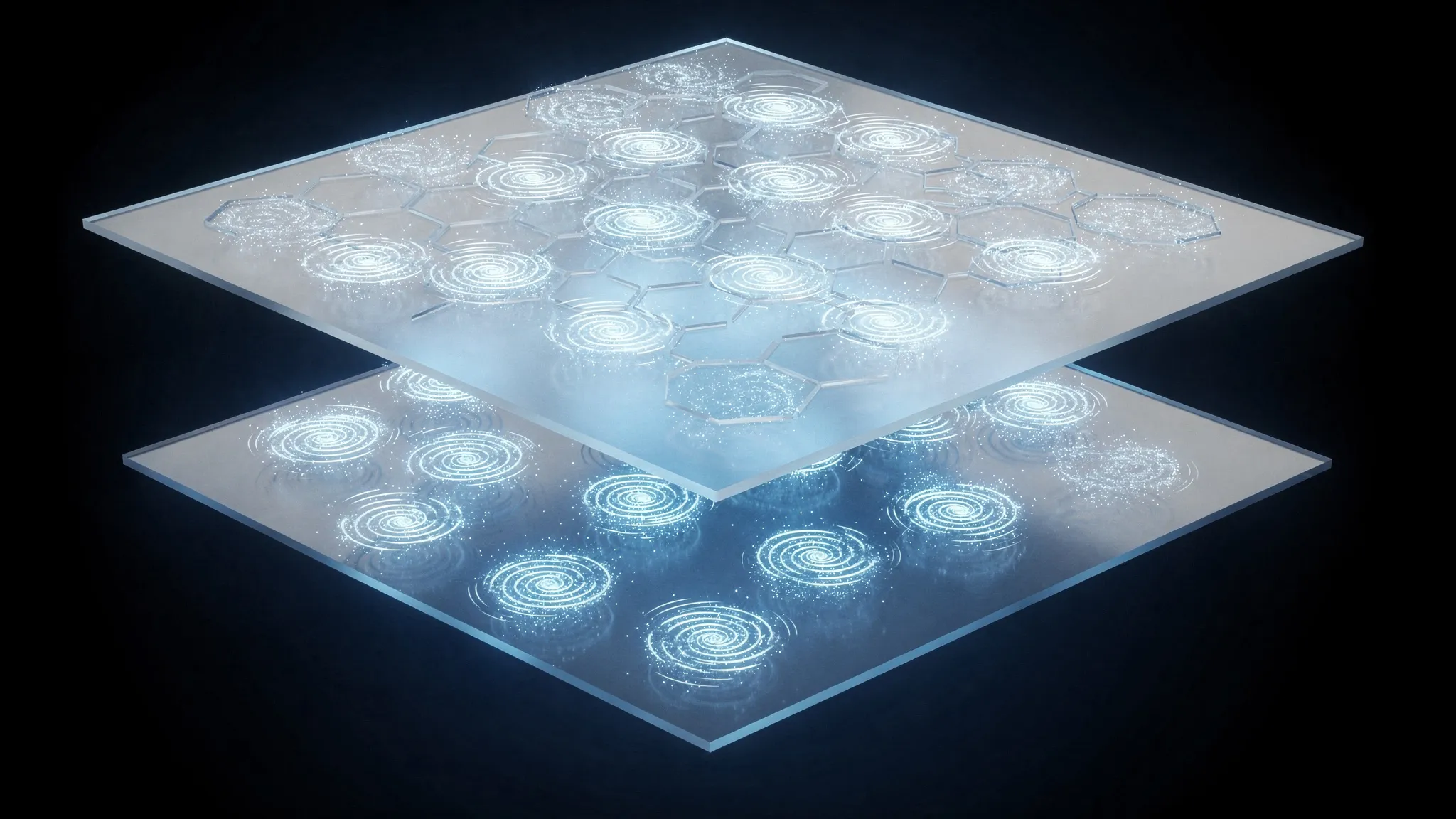
What such a fluid should do: in a strong magnetic field, add a few extra electrons, and their charge should split into fractions that settle in the cores of vortices and antivortices, whirlpools in the shared phase turning in opposite directions. These normally annihilate. Here their charged cores repel, and in 2025 two of the authors, Bo Zou and Allan MacDonald of the University of Texas at Austin, predicted that they would lock into a honeycomb: vortices on one set of sites, with their charge in the top layer, antivortices on the other, in the bottom layer.
Unlike the vortices of a superconductor, which carry magnetic flux, these carry electric charge. Each cell of the honeycomb holds exactly one elementary charge, that of one electron. So the more charge is added, the smaller the cells: their area shrinks in inverse proportion to the extra charge.
Two sheets of carbon and a needle
Ryan Lee, Jungwoo Lee, Viliam Vaňo and colleagues in Ali Yazdani’s group at Princeton University stacked two one-atom-thick sheets of graphene 3.2 nanometres apart — about three millionths of a millimetre — with a barrier of hexagonal boron nitride from Japan’s National Institute for Materials Science, under a field of 9 tesla (the tesla is the unit of magnetic field strength). There, electron energies bunch into steps called Landau levels. Two voltages set how full they are: one, from a gate beneath the sheets, tunes the total charge; the other moves charge between the sheets. When the sheets together fill a whole number of levels, each only partly full, an electron in one pairs with a hole in the other, forming the condensate.
The team imaged it with a scanning tunnelling microscope at 0.2 degrees above absolute zero: electrons hop between a sharp tip and the top sheet, and the current depends on what lies underneath, including charge in vortex cores.
A lattice that tightens with charge
With a few electrons added or removed, current maps of defect-free areas about 400 nanometres across showed regular bright spots. A Fourier transform, a calculation that turns a repeating pattern into sharp peaks, gave six: a lattice with sixfold symmetry.
As electrons were added, the lattice grew denser, its spacing falling from about 135 nanometres at first to about 60, close to the predicted curve. It went from sparse to well ordered, then melted as more were added. The spots form a triangular pattern rather than a honeycomb: the tip senses the top sheet, where the vortices carry more charge than the antivortices below.
The test a crystal of electrons fails
Electrons that repel one another can also freeze into a lattice on their own, a Wigner crystal. One in the top sheet would have a spacing set by that sheet’s charge alone. Near the condensate, that charge barely changes, because the bottom sheet shields the top one from the gate; the measured spacing changed anyway. Below an extra filling of 0.17 of a level, the Wigner-crystal prediction clearly misses the data.
The decisive test: the spacing of the vortex lattice should depend only on the total extra charge, not on how the sheets share it, because the whirlpools are defects in the phase the pairs share across both sheets, and that phase only “sees” the total charge added. The team held the total fixed and moved charge between the sheets, changing each sheet’s filling by up to 30%. A Wigner crystal in the top sheet would have shifted its spacing by about 20 nanometres. The measured spacing stayed at about 60. Only the image contrast faded, as charge passed from vortices in the top sheet to antivortices in the bottom one, without moving them.
Near an extra filling of 0.17, the bottom sheet stops taking charge and all the extra electrons sit in the top one. There, the spacing converges to that of an ordinary Wigner crystal in the top sheet: the transition the theory anticipated.
Holes draw the same pattern, inverted
Removing electrons instead produced the same kind of lattice, even better ordered, probably because that region holds less disorder. Its contrast is reversed, as expected if the charge in the cores changes sign, and its spacing again follows the total extra charge alone.
What a 400-nanometre picture can say
In a superconductor, a vortex lattice that spans an image shows that the fluid keeps its phase over at least that distance. Here, the lattice filling the field of view sets a lower bound of about 400 nanometres on the reach of the condensate’s phase coherence. Each sheet’s filling, moreover, is computed from the two voltages with an electrostatic model rather than measured directly.
The team presents its images as evidence, the word in its title, for the predicted lattice and for phase coherence in an exciton superfluid. The same microscope could now follow these whirlpools as they move, snag on defects and melt, in a superfluid made of electrons alone.