A GIANT PLANET FULL OF HEAVY HYDROGEN
Deuterium is hydrogen with a neutron added to its nucleus. It was made in the Big Bang, at about 2.5 atoms for every 100,000 hydrogen atoms, and since then stars have only been burning it. Yet in the very cold places where stars form, chemistry can pile deuterium into certain ices and organic molecules, raising their share by orders of magnitude. The deuterium-to-hydrogen ratio, written D/H, is therefore a record of where matter has been.
In the Solar System, Jupiter and Saturn sit close to the original value of the solar nebula, about 2 × 10⁻⁵. Uranus and Neptune have about twice as much, usually attributed to the icy bodies they swallowed, whose leftovers survive as comets.
A planet in the glare of its star
ε Ind Ab is the first mature, cold Jupiter imaged around another star: about 4 billion years old, 6 to 8 times the mass of Jupiter, orbiting 16 astronomical units (one unit is the Earth–Sun distance) from a nearby K-type dwarf star, 3.6 parsecs away (the parsec is astronomers’ unit for distances between stars). Its temperature is about 275 kelvin.
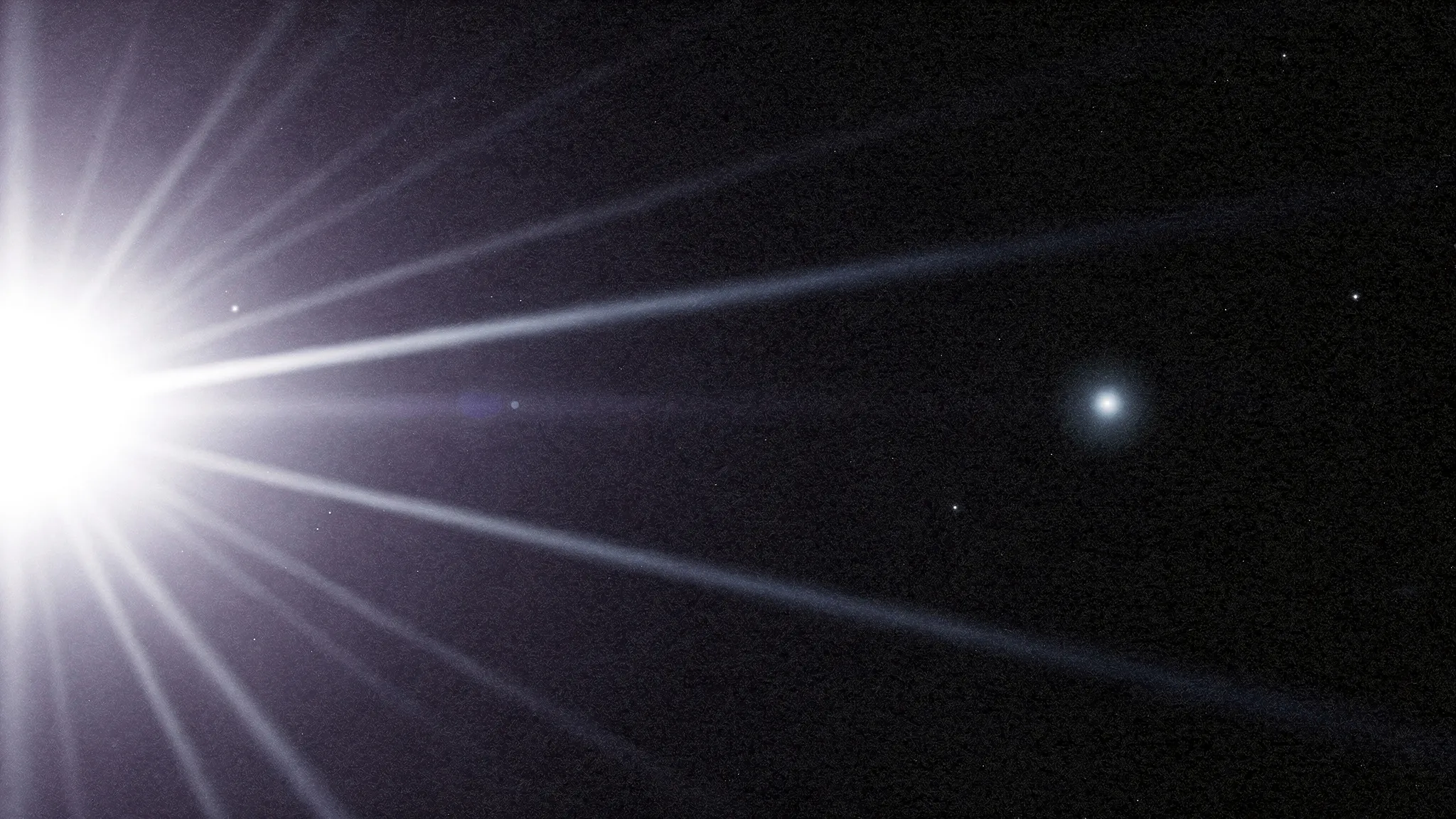
On 25 October 2025, a team led by Jerry Xuan, of the University of California, pointed the near-infrared spectrograph NIRSpec of the James Webb Space Telescope at it for 4.4 hours. The difficulty: at a wavelength of 4.1 micrometres, the star is nearly a million times brighter than the planet. Its core was kept outside the field of view, but the rings and spikes of light the telescope spreads around it (its diffraction pattern) still dominated the raw images. The team told the two apart by their spectra, since a 4,700-kelvin star and a 275-kelvin planet have very different absorption lines — the dark bands each molecule carves into the light at precise wavelengths. Summed over all wavelengths, the planet stands out with a signal about 600 times stronger than the background noise.
Twelve variants, including a heavy methane
The spectrum reveals twelve molecular variants: ordinary and heavier versions of methane, water and carbon monoxide, plus carbon dioxide, hydrogen sulphide and ammonia. Among them, CH₃D — methane with one hydrogen atom replaced by deuterium — is detected at 48 sigma, a statistical confidence so high that a chance fluke is ruled out.
Carbon, oxygen, sulphur and nitrogen are all enriched by about the same factor, 4.5 to 5.7 times the levels of the host star. That uniform pattern is the one seen in Jupiter.
Methane gives D/H = 5.4 × 10⁻⁵. But hydrogen molecules, which make up most of the atmosphere, are invisible in these data, and methane and hydrogen do not share deuterium equally. Two independent calculations put the correction factor between 1.10 and 1.35. The planet’s overall ratio comes out at D/H = (4.4 ± 0.7) × 10⁻⁵: about twice Jupiter’s, like Uranus and Neptune. As a check, the same method recovers the published value for WISE 0855, a brown dwarf — a body too light to shine as a star — of similar temperature.
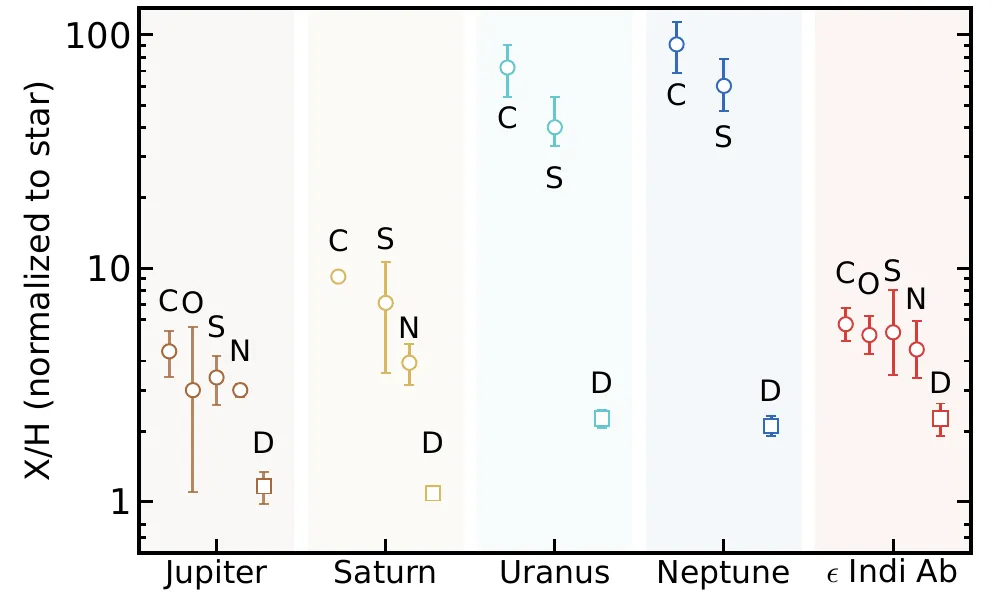
Carbon, oxygen, sulphur and nitrogen (circles) and deuterium (squares), relative to each planet’s star: ε Ind Ab has Jupiter-like heavy elements but the D/H of an ice giant. — Figure 4, Xuan et al. (2026), arXiv:2611.10129.
Not the birth cloud, so the ice
Could the planet’s birth cloud simply have been richer in deuterium? No. Since stars only destroy it, no cloud can exceed the Big Bang value, 2.527 × 10⁻⁵ — and the planet is above it.
The other route is the one invoked for Uranus and Neptune: swallowing deuterium-rich solids. The uniform enrichment points to solids gathered beyond the frost lines of nitrogen or carbon monoxide — the distances beyond which even these gases freeze, so that solids carry all four elements together — about 56 and 36 astronomical units from the star. That is farther out than the present orbit, so the planet may have migrated inward. A composition model gives about 89 Earth masses of heavy elements delivered by solids. To match both these elements and the deuterium, the water ice must have had D/H ≈ 1.5 × 10⁻², or the refractory organic matter — carbon-rich dust that withstands heat — about 5 × 10⁻². If both contributed, half as much would do.
Solar System comets, measured in their water, range from 1.4 to 5.3 × 10⁻⁴. The ice ε Ind Ab swallowed was thus at least 30 times richer in deuterium than typical comets. Building the planet from such comets would require carbon and oxygen at about 200 times the star’s level, instead of the 5 observed. Gas from the disc around the young star fails too: it would only become rich enough in deuterium once the disc had almost entirely dispersed, and with so little gas left, the planet would need about 2 billion years to double its mass — far too slow.
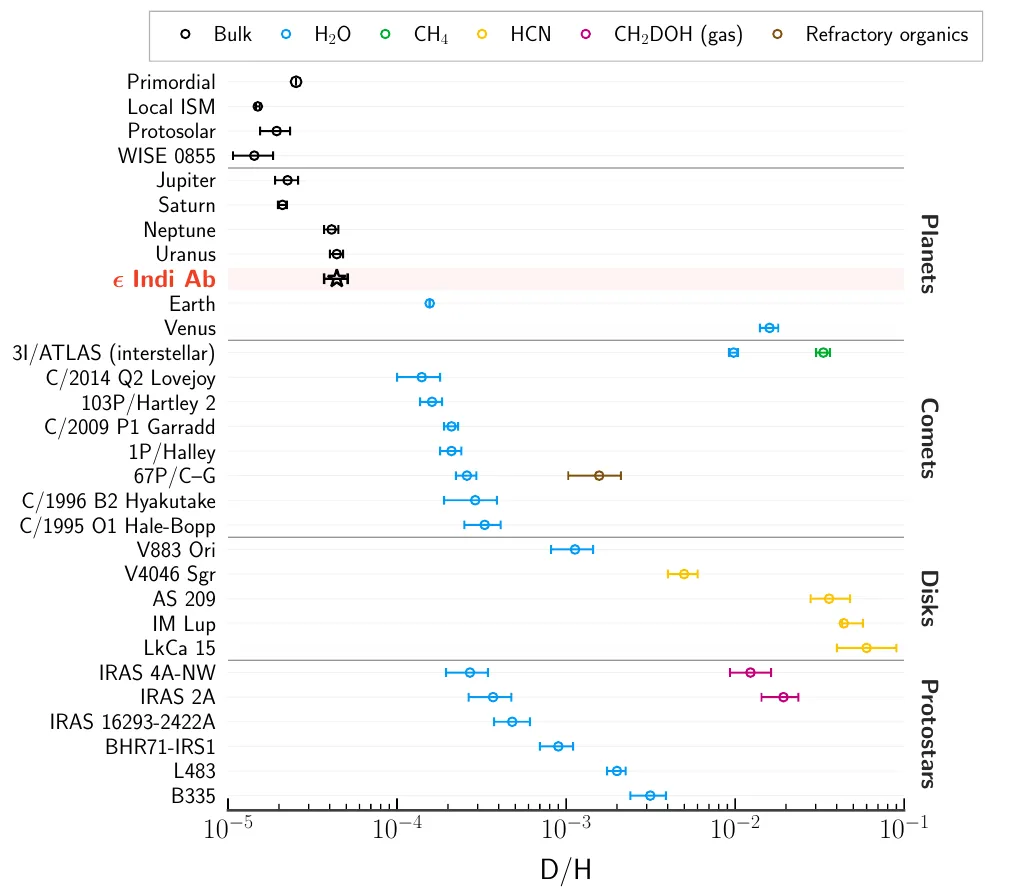
D/H measured in planets, comets, discs and protostars. ε Ind Ab (star, name in red) sits with Uranus and Neptune; Solar System comets lie around 10⁻⁴, 3I/ATLAS near 10⁻². — Figure 3, Xuan et al. (2026), arXiv:2611.10129.
Ice that came from the cold
Values that extreme do exist: in the interstellar comet 3I/ATLAS, with D/H ≈ 10⁻² in its water and ≈ 3 × 10⁻² in its methane, and in organic molecules around protostars. For the authors, ε Ind Ab accreted pristine solids born in a very cold environment and inherited from the molecular cloud without being reheated.
Interstellar material, in other words, can leave a sizable imprint even on a gas giant. Next on the team’s list: the same D/H measurement on a larger sample of cold planets, to see how planetary systems inherit and rework the matter of their birth clouds.