Ainda não traduzido: versão original em inglês.
A 281-GRAM ROBOT JUMPS 7.6 METRES
Jumping lets a machine clear obstacles, change direction fast and fly over gaps. Researchers even imagine small hopping rovers for low-gravity worlds. But getting a robot to jump high usually involves a spring.
There are three broad ways to power a jumping robot. A series-elastic design puts a spring between the motor and the leg: the spring stores energy and releases it faster than the motor could on its own. A parallel-elastic design uses a small motor and a large gear reduction to slowly load a spring, held by a latch until a trigger releases it. That is how the record holders work: one robot by Hawkes and colleagues reaches 32 metres, using a 1,000-to-1 reduction — but it must stay on the ground for about 120 seconds to recharge between jumps.
The third option is direct drive: the motor is rigidly connected to the leg, with no spring at all. The jump can never be more powerful than the motor at that instant. In return, the machine is simpler and lighter, spends less time on the ground, and its push can be adjusted continuously. Until now, direct-drive jumpers had stayed modest: 1.14 metres for the quadruped Stanford Doggo, 1.6 metres for the one-legged RAMIEL, 0.59 metres for an earlier one-legged robot by Wagner and Yim, driven by a rack and pinion.
Two levers: leg length and power per gram
Gihyeok Na and Justin Yim, at the University of Illinois Urbana-Champaign, started from a simple scaling law. Ignoring air drag, the maximum jump height of a power-limited actuator grows with the length of the leg’s stroke and with the motor’s power per unit mass:
h_max ∝ l_leg (P_max / M)^(2/3)
So instead of adding springs, they pushed those two levers as far as they could.
Their robot weighs 281 grams. Its leg is a carbon-fibre tube 1,981 millimetres long, 6 millimetres wide and weighing just 27 grams; the usable stroke is 1,867 millimetres. At the bottom sits the body, with a brushless motor, a battery and a microcontroller (192 grams). At the top sits a balancing module (55 grams).
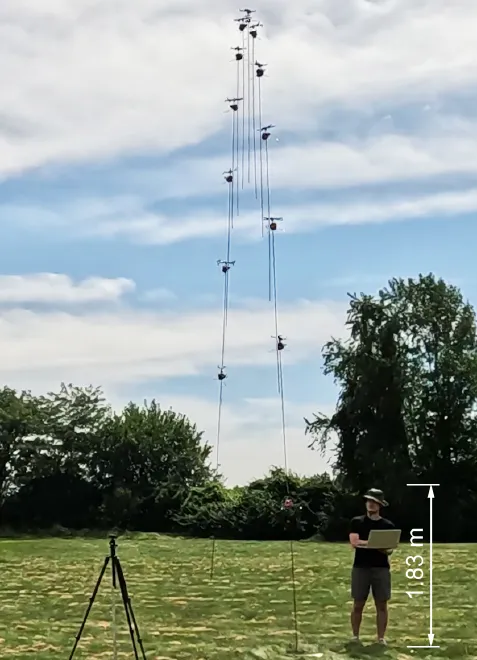
One vertical jump, composited from frames 166.7 milliseconds apart, with a person 1.83 metres tall for scale. — Figure 1, Na & Yim (2026), arXiv:2609.30530.
A ribbon wrapped around the leg
The key part is what the authors call a fabric-wrap transmission. A ribbon of Dyneema composite fabric, 6 millimetres wide and 0.13 millimetres thick, spirals around the leg at a shallow angle of 2.5 degrees. One end is anchored near the top of the leg; the other winds onto a spool turned by the motor. As the motor pulls the ribbon in, the body slides up along the leg, pushing the foot against the ground.
Here is the clever part. As the ribbon piles up on the spool, the spool’s radius grows. At the start of the push, the radius is small and the motor has a strong mechanical advantage; as the leg extends, the radius grows and the advantage drops. This keeps the motor close to its peak power for most of the stroke, without any gearbox. A rack and pinion, with its fixed radius, would instead sweep the motor through its whole speed range in a single stroke.
The wrap does two more jobs. It braces the long, thin tube so it does not buckle under the force of the jump, and it damps the tube’s vibrations.
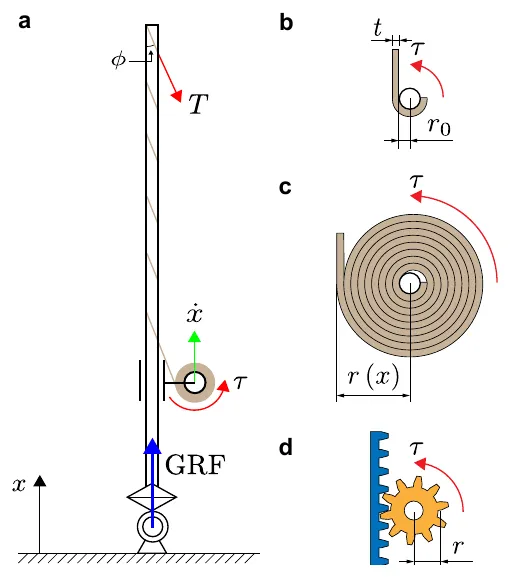
The fabric-wrap principle: the ribbon spirals around the leg (a) and winds onto a spool whose radius grows from r₀ to r(x) as the leg extends (b, c); a rack and pinion keeps a constant radius (d). — Figure 4, Na & Yim (2026), arXiv:2609.30530.
Propellers on a long lever
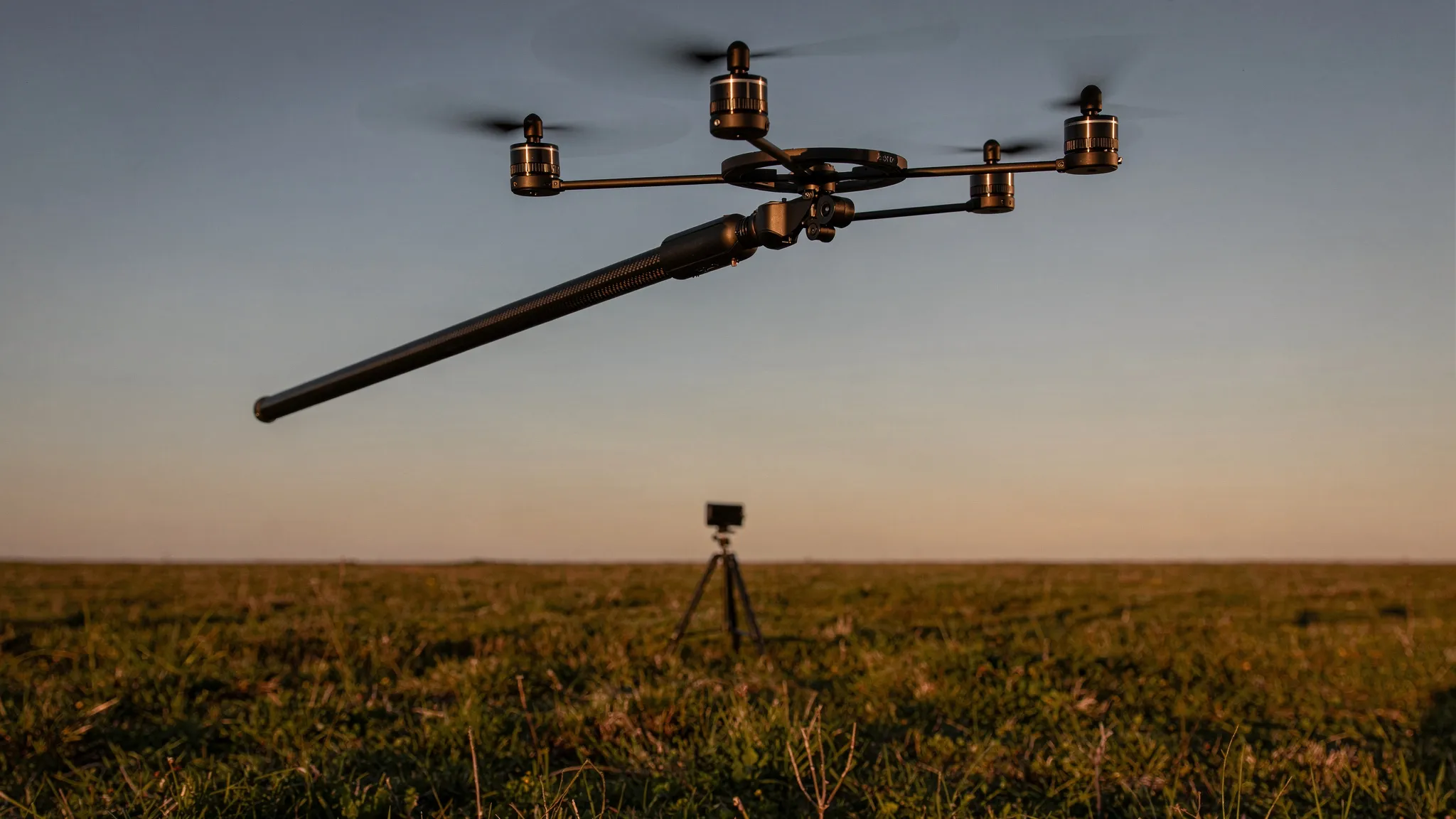
A one-legged robot has to stay upright. The balancing module at the top carries four small propellers, each 76.3 millimetres across. Together they push with at most 0.50 newtons, about 18% of the robot’s weight. That sounds feeble, but they act at the end of a lever almost two metres long, which is enough to hold the leg upright on the ground or tilt it on command.
7.6 metres in a grassy field
The team tested the robot outdoors, filming it with two GoPro cameras at 120 frames per second and rebuilding its trajectory in 3D. The body rose about 7.6 metres; the whole jump lasted about 2.5 seconds, and the robot drifted less than 1.6 metres sideways. Its foot was on the ground for only 190 milliseconds. Motor telemetry showed the power climbing, then holding near its peak for the rest of the stroke — exactly what the ribbon was designed to do.
The authors describe this as the highest jump yet reported for an electrically actuated system without springs. Combining height and speed in a measure called vertical jumping agility, the robot scores 5.30 metres per second, the highest of all the electric jumping robots in their comparison table, whatever their transmission.
The robot can also lean about 20 degrees before taking off, to choose the direction of its jump. In the air, the propellers reduce wobbling but do not fully cancel it: the body stays at the top of the leg, close to the propellers, which shortens their lever. Moving the body back toward the foot in flight is not implemented yet.
Next stop: hopping
This study demonstrates single jumps. Continuous hopping — taking off again the moment it lands — is the next goal, along with repositioning the body in mid-air. The authors also point to the Moon, where lower gravity would let such a robot clear crater rims or take overhead pictures in a place where drones, with no air to push against, cannot fly.