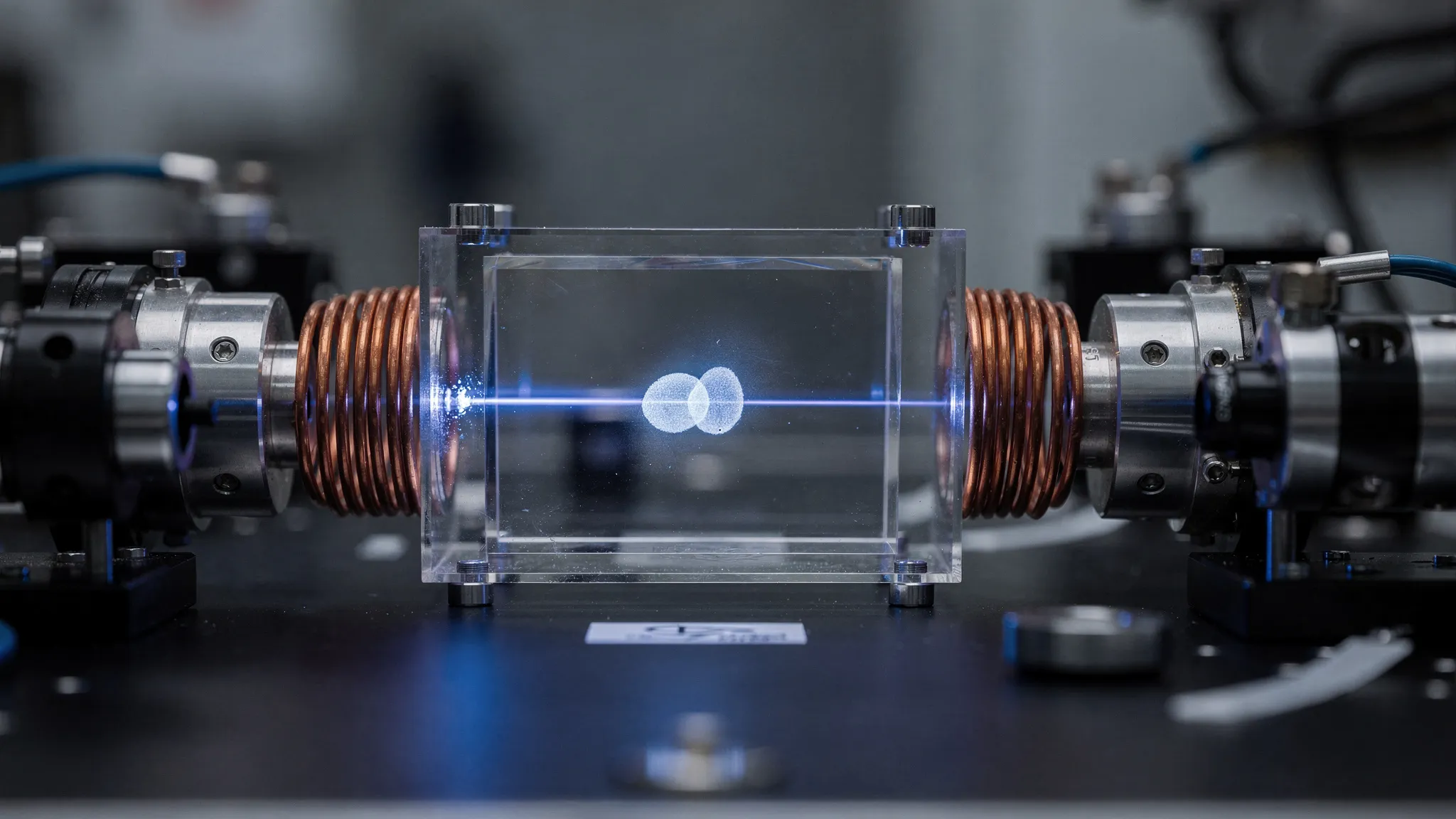
ఇంకా అనువదించలేదు: మూల ఆంగ్ల పాఠం.
A SPIN THAT CAN ONLY BE ±½ READS 7
Measure the spin of a “spin-½” particle along one direction, and quantum mechanics allows exactly two results: +½ or −½. No in-between, nothing beyond. A team at the University of Toronto has nevertheless measured the spin of such a system and found 7.
No law was broken. The result is what physicists call an anomalous weak value, and it was predicted almost forty years ago.
A gentle measurement, then a sorting
In a quantum measurement, the measuring device — the “pointer” — is itself a quantum object. Normally, the pointer is sharp: it moves by an amount set by the result, +½ or −½, and you read it.
In 1988, the physicists Albert, Aharonov and Vaidman looked at the opposite case. Make the pointer very blurry, so that a single measurement tells you almost nothing: this is a weak measurement. Then keep only the systems that end up in a chosen final state — a step called post-selection. On average, the pointer then shifts by the “weak value”:
⟨A⟩_w = ⟨f| Â |i⟩ / ⟨f|i⟩
When the starting state |i⟩ and the chosen final state |f⟩ barely overlap, the denominator becomes tiny and the weak value can lie far outside the normal range. They proposed to show it on a particle’s spin, with a gentle version of the classic Stern-Gerlach experiment, where a magnetic field gradient pushes particles one way or the other according to their spin.
The effect has since been seen many times with light, with superconducting qubits and with neutrons. But the spin experiment itself had never been carried out. The reason: the effect is an interference, and matter waves stay coherent over tiny distances — less than a micrometre for a typical atomic cloud near condensation.
A cloud of atoms as a single wave
Joseph McGowan IV, Nicholas Mantella, Noah Baker and Aephraim Steinberg used a Bose-Einstein condensate: 5,000 to 10,000 rubidium-87 atoms cooled until they behave as one coherent wave.
Their “spin ½” is a pair of internal states of the atom. In a magnetic field gradient, these two states feel equal and opposite forces — exactly like the two spin directions in a Stern-Gerlach magnet, but weak enough for the two halves of the cloud to keep overlapping and interfering. The pointer is the atoms’ velocity. The team then releases the cloud into a gentle optical guide; a quarter of an oscillation later, the velocity difference has become a position difference that a camera can see.
A microwave pulse of adjustable length chooses the final state. Its angle, δ, sets how unlikely the selection is: near δ = 0, very few atoms are kept.
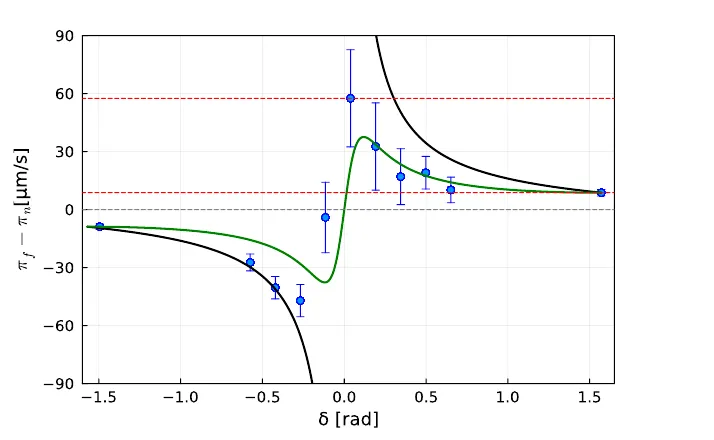
Measured shift between the two halves of the cloud versus the selection angle δ. The two dashed lines mark the shift without amplification and the most amplified point, about seven times higher. Black: weak-value prediction; green: model for a cloud of the same size. — Figure 2, McGowan et al. (2026), arXiv:2609.37822.
Fourteen times the push
Far from δ = 0, the two halves of the cloud separate by just twice the applied push, as expected. Close to it, the separation shoots up on both sides, then drops to zero at δ = 0, where the “weak” approximation breaks down.
The magnetic push was tiny: 4.4 micrometres per second. For the most amplified point, the selected atoms moved as if pushed 14 times harder (with an uncertainty of ±6). Translated into spin, that is a weak value of 7 ± 3: as if the spin of this two-state system had read m_z = 7.
When the push is made twice as strong, the measurement becomes less “weak” — and the amplification shrinks, as theory predicts.
Feasible after all
The authors note that this kind of experiment had been called “infeasible”. It is the first weak-value amplification with atoms, and the closest realisation of the original 1988 proposal. The price is high: near δ = 0 so few atoms survive the selection that some images cannot be analysed at all.
They see possible uses in measuring tiny magnetic field gradients or very small magnetic moments. A next version could use atoms whose interactions can be tuned, to keep the cloud denser and the signal cleaner.