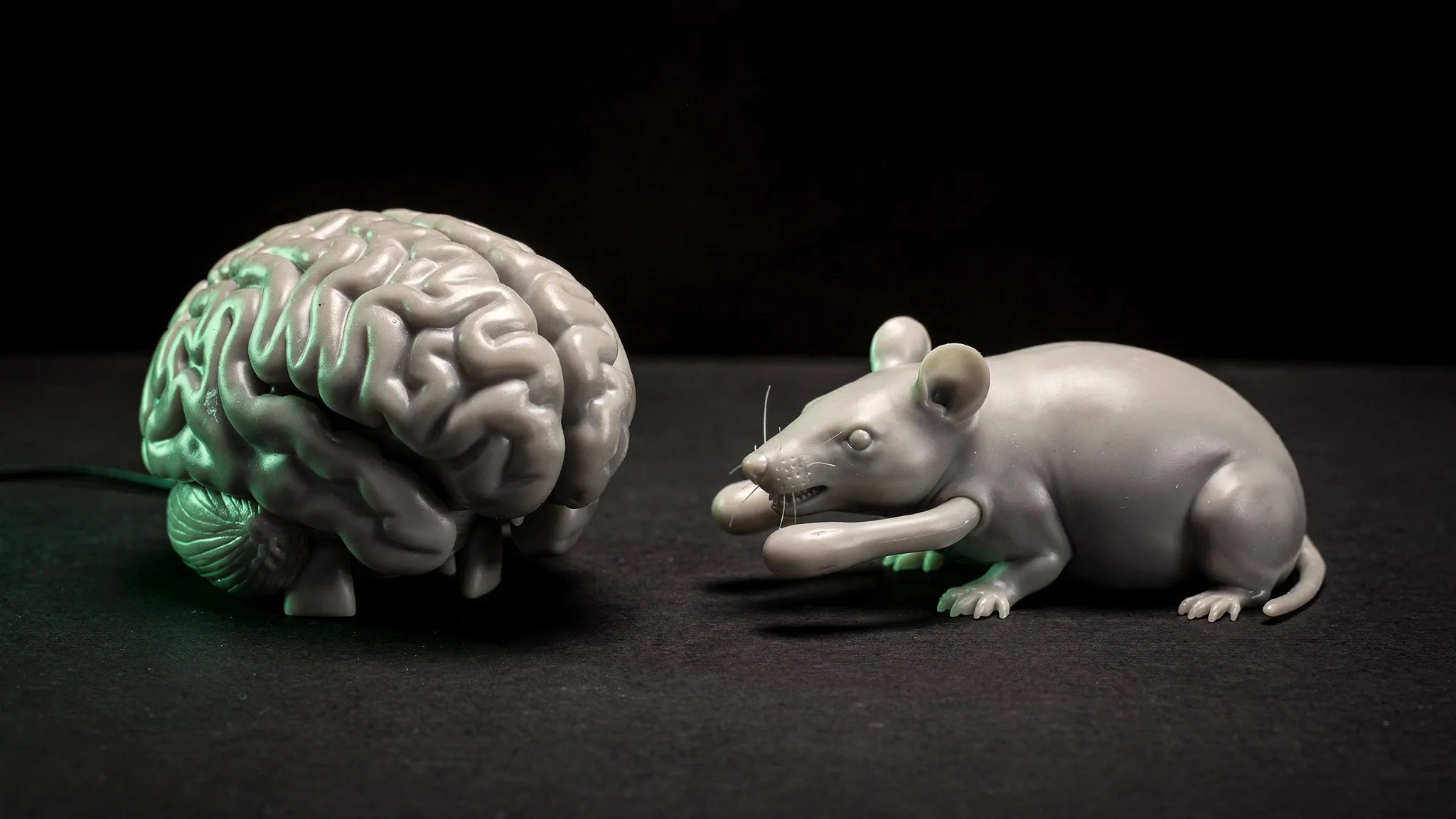
OTTERS AND SKUNKS, OPPOSITE BRAINS
How much does the way an animal lives shape its brain? For decades, researchers mostly compared brain size with body size. Today they also look at the brain’s proportions and shape, which can reflect what the senses and the body demand. Margot Michaud, of UniLaSalle (University of Artois) and the University of Liège, and colleagues from France, Belgium, the United States, the United Kingdom, Germany and Spain chose an ideal family to test it: the musteloids.
One family, very different lives
Musteloids are a group of carnivores made of four families: the Ailuridae, the mustelids (among them badgers and otters), the skunks, and the raccoons with their relatives. In one closely related group, there are swimmers (otters), diggers (badgers and skunks), tree-dwellers (kinkajous) and ground-dwellers. A natural experiment in brain evolution.
Casts of brains that are gone
The brain itself does not survive in museum collections, but the cavity that held it does. By scanning skulls with X-rays and micro-computed tomography, the team rebuilt 113 virtual casts of the brain cavity — called endocasts — from adult animals of 41 species, covering 91.4 percent of musteloid genera. In mammals, the shape of such a cast matches the outer surface of the brain.
On each cast, they placed 47 anatomical landmarks and more than 200 extra points along curves and surfaces, and split the brain into three regions: the olfactory bulbs (the centre of smell, at the front), the cerebrum (the large main part) and the hindbrain (cerebellum and brainstem, at the back). Statistical methods then took into account how closely related the species are, so that two cousins are not counted as two independent cases.
Otters and skunks at opposite ends
Two lineages break away from the others:
- Otters have the largest share of cerebrum, 74.3 percent, and the smallest olfactory bulbs, 8.6 percent, with the smallest hindbrain too (17.1 percent).
- Skunks show the reverse pattern: much larger olfactory bulbs (14.5 percent) and the smallest share of cerebrum (66.3 percent).
The authors had predicted both: smell plays little role underwater, while skunks rely heavily on their nose. They connect the otters’ large cerebrum to earlier studies showing enlarged touch-related areas in semi-aquatic carnivores, which forage by feel and handle prey with their forepaws — perhaps, they suggest, an otter cerebrum is not only bigger but tuned to touch. Skunk results come from only three species and call for caution.
Size explains most of the rest
Beyond these two lineages, the main rule is size. The bigger the brain, the larger the share of cerebrum and the smaller the shares of olfactory bulbs and hindbrain; the brain also becomes rounder. Smaller brains are longer, with prominent smell bulbs pointing forward. The surface of the neocortex follows brain size almost perfectly. This, the authors write, matches patterns seen across many mammals, where shared developmental rules weigh more than separate pressures on each region.
Diet adds its mark: fish eaters — mostly otters in this sample — have proportionally smaller smell bulbs than meat eaters and omnivores.
Surprise: how they move barely shows
The team expected the hindbrain, which handles balance, to differ between climbers, swimmers and diggers. It does not: in their models, the way of moving adds almost nothing once size and family history are accounted for. Overall brain shape shows no detectable ecological effect either.
The authors propose that such adaptations may hide inside the brain — in the folding of the cerebellum or the density of neurons — or in small structures they could not measure in every species. The external cast shows the outline of the brain, not its wiring. Their conclusion: musteloid brains follow a shared scaling rule, bent in places by family history and diet. The study has been peer-reviewed and published in the Journal of Anatomy.