A PLANET TURNING INTO VAPOUR
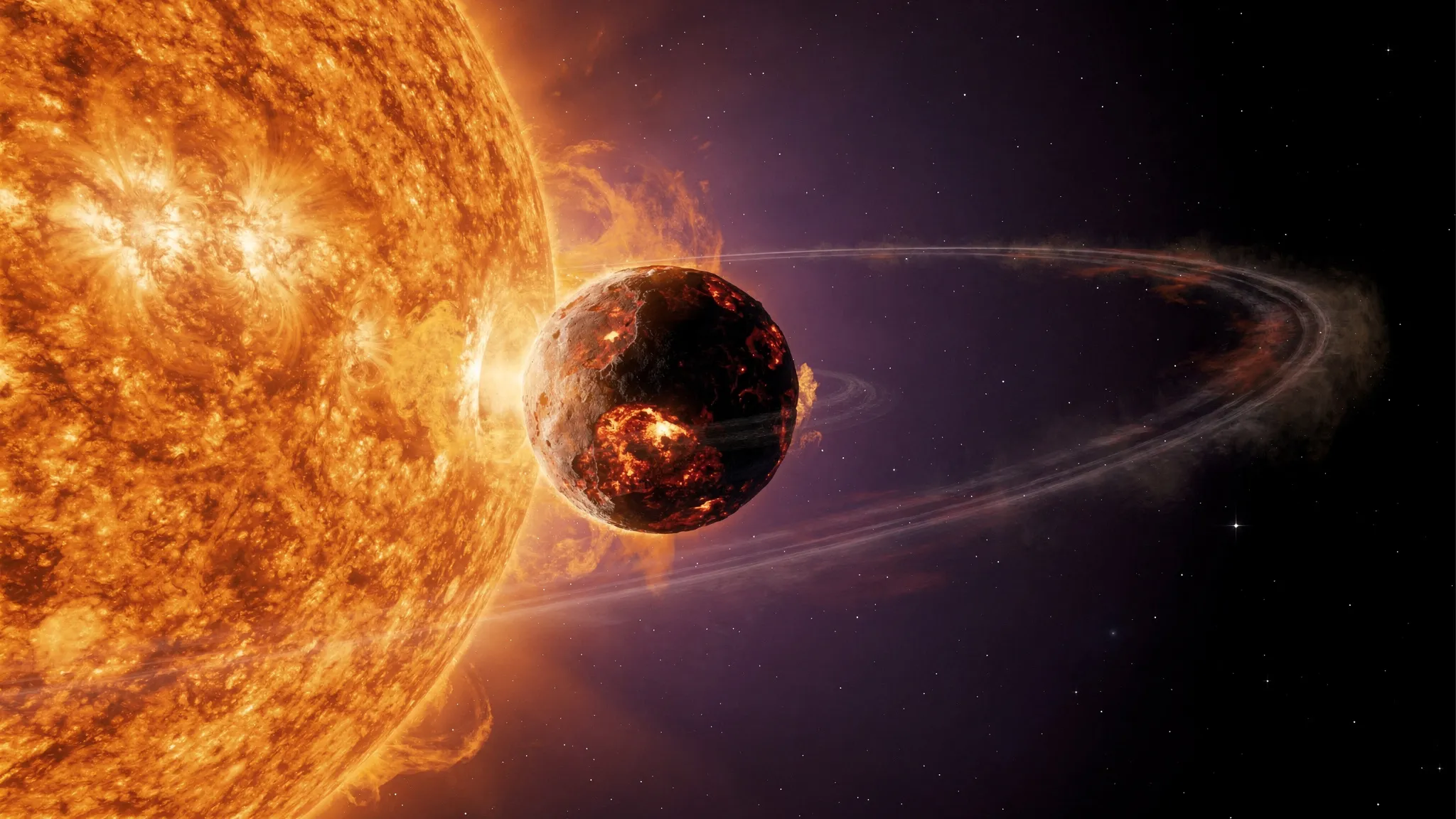
Some rocky planets orbit so close to their star that their surface reaches temperatures at which rock vaporises. If the planet is small enough, this mineral vapour escapes, spreads out and partly condenses into dust. Seen from Earth, such a planet does not cast a neat round shadow when it passes in front of its star: the starlight dims irregularly, unevenly, from one passage to the next, because a trailing cloud of dust does most of the hiding. These are disintegrating rocky planets. Only a handful are known.
Until now, what astronomers have seen escaping from them is mostly dust. Yet calculations predict that the vapour also contains atoms and molecules — sodium, silicon monoxide, magnesium, iron, and above all oxygen, a major ingredient of rock. Searches for sodium or calcium in such systems have mostly come back with upper limits.
A planet that orbits in 30 hours
BD+05 4868 Ab circles a bright K-type dwarf star in 1.27 days. Its passages dim the star by 0.8 to 2 percent, with a short dust tail in front and a much longer one behind. According to the earlier study the paper builds on, it sheds dust at about 2 × 10¹² grams per second, and its surface facing the star sits near 1,820 kelvin.
Looking for oxygen with a small telescope
Kody Walker and James Wallace, of Indiana State University, targeted a precise fingerprint of oxygen: a trio of absorption lines near 7,774 ångströms, at the red end of the visible spectrum. These lines start from an excited state of the oxygen atom that heat alone cannot fill at 1,820 kelvin — the odds are about 5 in 10²⁶. If they show up, something else must be exciting the atoms: ultraviolet light from the star knocks electrons off, and atoms that recapture one cascade down through that excited state.
Their instrument is modest: a 43-centimetre telescope at the Leif Everson Observatory in Sturgeon Bay, Wisconsin, with a low-resolution spectrograph. It blurs the three oxygen lines, only 3.45 ångströms apart, into a single 13-ångström smudge. Over eight nights between May and July 2025, they recorded 24 spectra during passages of the dust tail and 73 outside them. Spectra were sorted by orbital timing, not by their appearance, and corrections for Earth’s atmosphere were computed without looking at the oxygen region. Photometry from two other telescopes confirmed the planet was actively shedding dust at the time.
A 9 percent dip
During the passages, the spectrum shows an extra absorption near 7,774 ångströms that is absent outside them: up to about 9 percent deep, as wide as the instrument’s blur. The authors stress that the uncertainty they give is a range covering reasonable analysis choices, not a formal statistical significance.
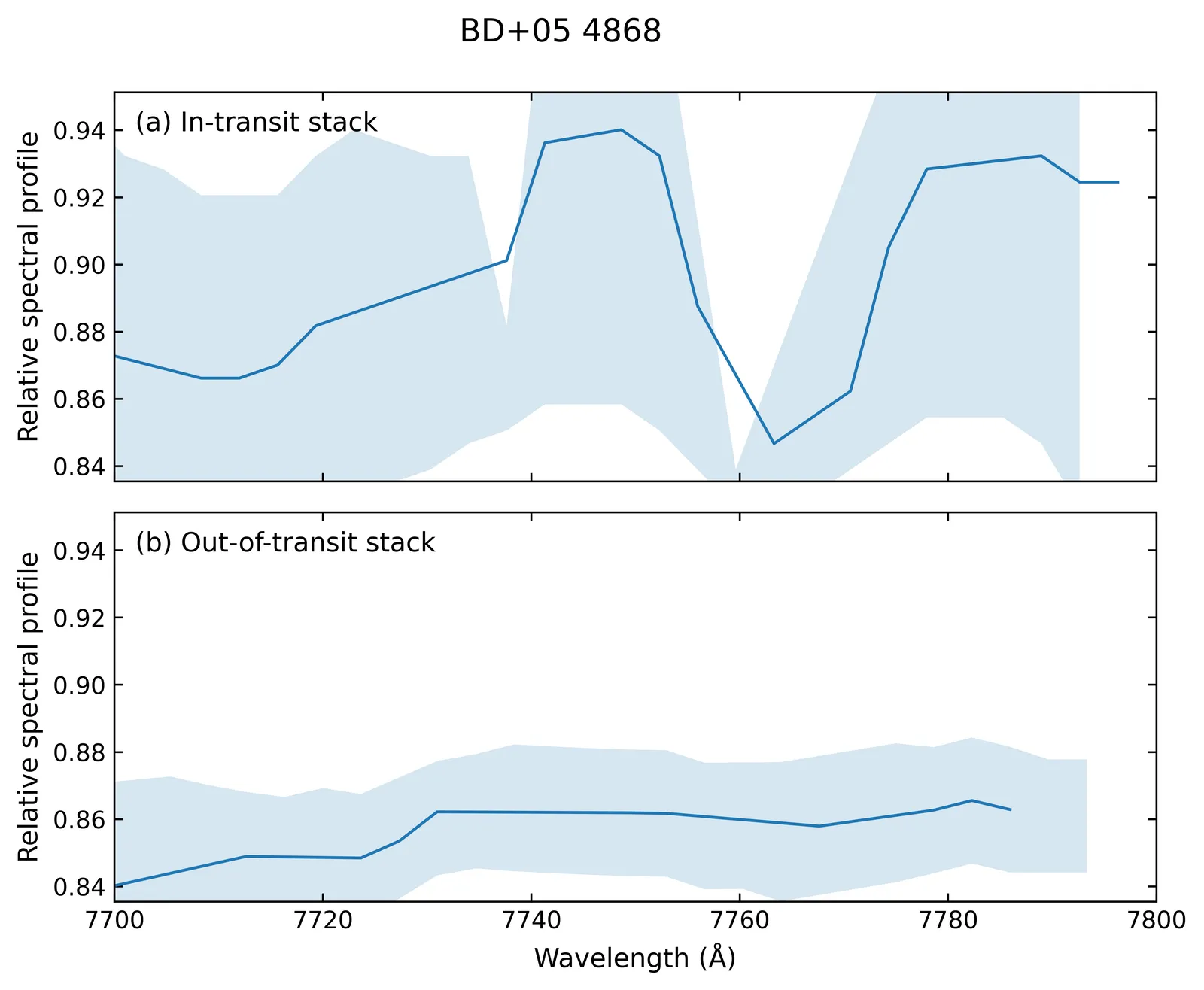
Spectrum averaged during transits (a) and outside them (b); the shaded areas show the uncertainty. — Figure 3, Walker & Wallace (2026), arXiv:2610.04986.
Gas that reaches beyond the dust
A simple model of oxygen gas lit by the star can reproduce the dip: same strength, same depth, same width once blurred by the instrument. Only one oxygen atom in ten million needs to be in the excited state. But the gas must extend well beyond the thin layer of dust, covering roughly a third of the star’s disc; confined to the dust layer, it would require absurd amounts. In the representative solution, the planet would lose about five times more gas than dust — a number the authors call model-dependent, not a measurement.
The star could be the impostor
The authors keep the label “candidate”. The star itself has these oxygen lines, and their shape varies across its disc. When the dust tail hides part of that disc, the comparison between transit and non-transit spectra could show a dip even without any planetary oxygen. At this resolution, the two cannot be told apart. Contamination by Earth’s atmosphere looks less likely to them, but is not entirely ruled out.
Sharper spectra already exist
The test is already within reach: seven high-resolution spectra of the star, taken by an earlier team with the 3.5-metre WIYN telescope, separate the three lines cleanly. A planetary signal should come and go with the planet’s orbit; the star’s lines should not. If confirmed, it would be the first link between the dust and the atomic gas of a planet that is boiling away.