EARTH'S LITTLE COMPANION IS NOT A PIECE OF THE MOON
Most near-Earth asteroids are thought to come from the main asteroid belt: collisions there make fragments, which slowly drift until gravitational resonances push them onto orbits that cross Earth’s. Models built on that story explain the population well — down to objects a few tens of metres across. Below that, things stop adding up. Earth is hit by 1-to-10-metre rocks about ten times more often than these models expect, and a couple of tiny objects caught near Earth do not look like typical asteroids.
One proposed missing source is the Moon. Impacts on the Moon throw out fragments, and some could end up circling the Sun on orbits almost identical to Earth’s. But simulations of how many there should be carry uncertainties spanning nine to ten orders of magnitude. The only way to settle it is to look at the rocks themselves.
Kamo’oalewa’s fall from grace
The best places to look are quasi-satellites: small bodies whose orbits keep them in Earth’s neighbourhood for long stretches, which makes them observable. About a dozen are known. Until recently the star witness for a lunar origin was Kamo’oalewa, target of the Tianwen-2 sample-return mission, whose spectrum looked very red, like lunar rock. More precise observations with the James Webb Space Telescope have since reclassified it as an ordinary stony asteroid.
One image out of six
Grigori Fedorets, Zuri Gray, Mikael Granvik and Eric MacLennan, of the University of Helsinki and partner institutes, caught a rare window: in early August 2026, the quasi-satellite 2025 PN7, discovered by the Pan-STARRS 1 survey in August 2025, briefly became bright enough to study. On 5 August 2026 they pointed the 8.2-metre Very Large Telescope of the European Southern Observatory and its FORS2 spectrograph at it.
Things went wrong. The slit’s angle had been set incorrectly — a “user error”, the authors write — and the predicted motion of the asteroid was slightly off, so it drifted out of the slit. Of six exposures, only the first was usable, and its blue end was partly cut. The team binned the data heavily, trading resolution for signal.
Grey, not red
That single spectrum was enough to classify the object. It is flat and close to the colour of sunlight, best matching a B-type asteroid, with a C-type not excluded — dark, “primitive” classes. Lunar surfaces and silicate (stony) asteroids typically look redder. The authors therefore reject a lunar origin for 2025 PN7.
- With a dark surface reflecting about 7% of light, it would be 20 to 36 metres across.
- Orbital models give it about a 75% chance of having escaped the inner asteroid belt through a resonance called ν6, probably from the Eulalia or “new Polana” asteroid families.
- It is only the second quasi-satellite of Earth ever physically characterised, and the first definite “primitive” object among Earth’s co-orbital companions.
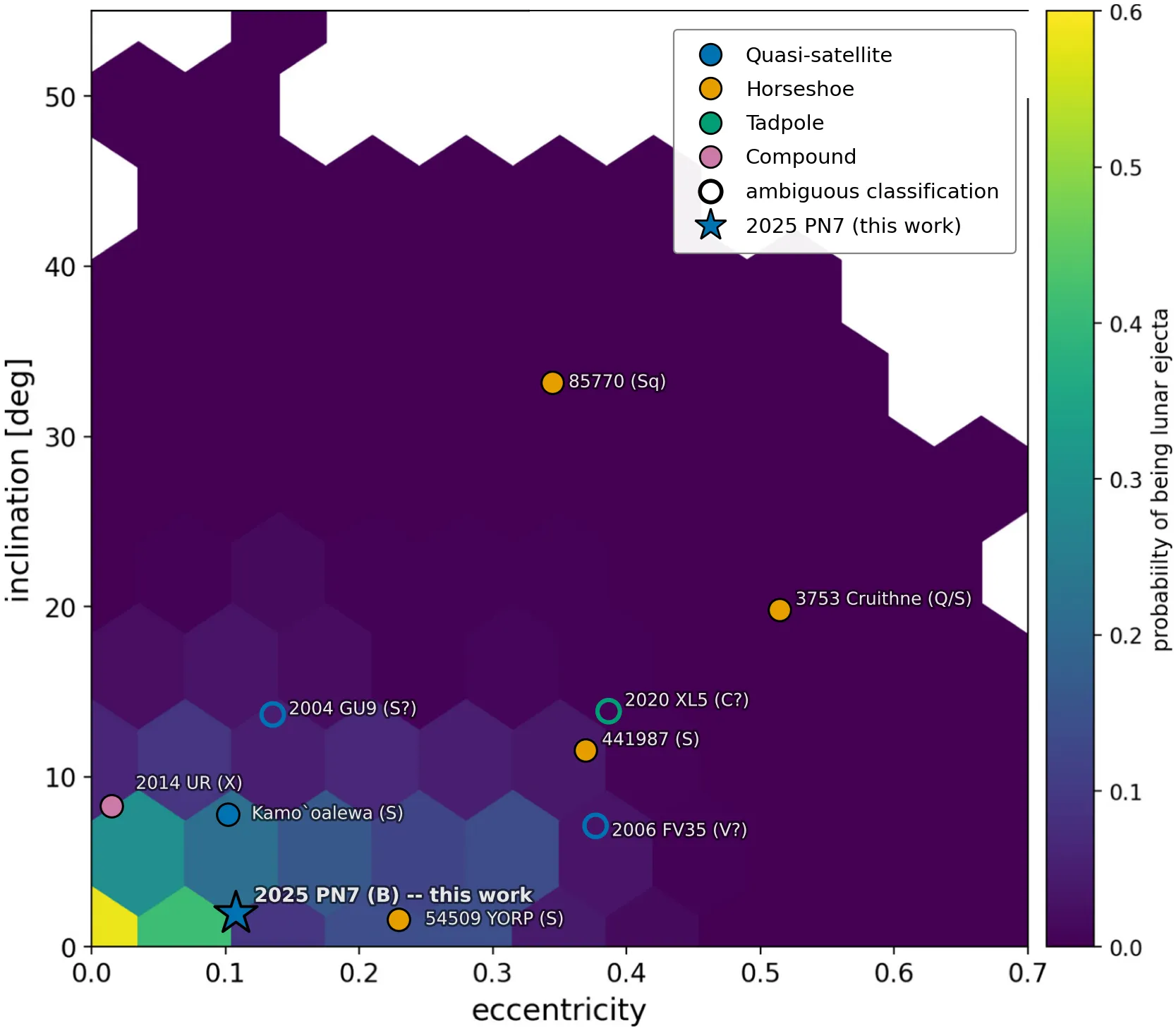
Known Earth co-orbitals over a model map of the probability of lunar origin (background from Alessi and Jedicke). 2025 PN7 (star) sits in a region where a lunar origin should be relatively common — yet it is a B-type asteroid. — Figure 2, Fedorets et al. (2026), arXiv:2610.17981.
The Moon is not off the hook
Looking at every classified co-orbital, the authors see no clear observational evidence of lunar fragments so far. But the sample is tiny. In the region closest to Earth’s orbit, a lunar-origin model predicts that about 32% of objects come from the Moon. Three classified objects sit there, none of them lunar — far too few to reject that figure. It would take about ten non-lunar results in a row to do so with reasonable confidence; for now, the data only cap it at 72%.
A lunar origin for some of Earth’s companions, they conclude, remains possible but looks rare. More spectra — including in the near-infrared, which can break ties between classes — are needed. And since this result rests on one noisy image, a second look at 2025 PN7 would not hurt.