THE WAY PATIENTS WALK HINTS AT A BRAIN TUMOUR'S PROGRESS
Glioblastoma, the most common brain tumour in adults, has a median survival of about 15 months even with surgery, radiotherapy and chemotherapy. Like other high-grade gliomas, it brings a progressive loss of function, and the disease typically progresses four to six months after diagnosis. Progression is confirmed by contrast-enhanced MRI — an expensive, claustrophobic scan, often impossible for people with a pacemaker, done only every two to three months, and able to show the disease only once it has already advanced.
Wearable sensors could fill the gaps between scans. But every patient moves differently, and the changes depend on where the tumour sits and how it spreads. The simplest summary, the number of steps, may miss what matters: how a person walks, not just how much.
A sensor worn every day
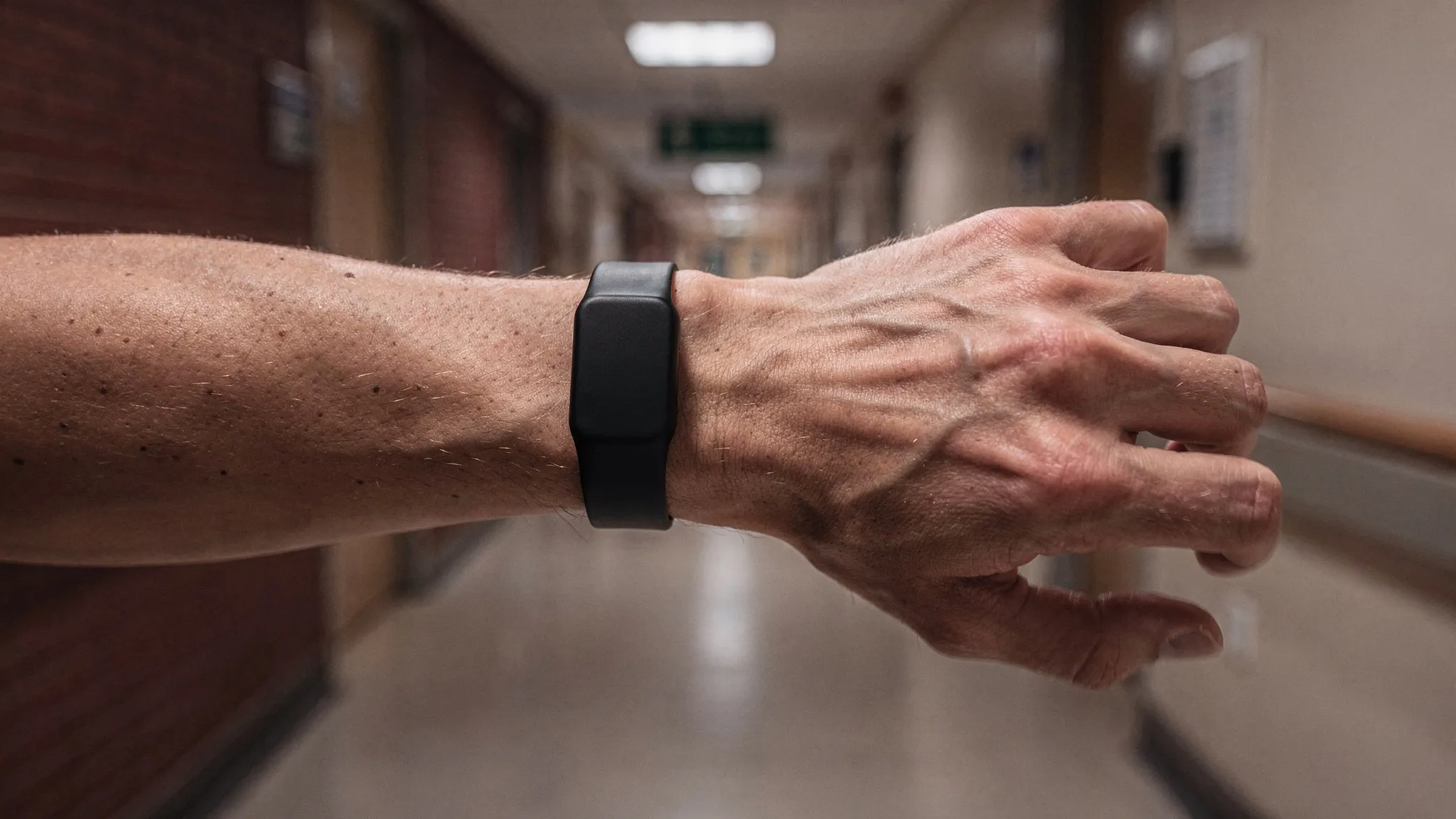
Rishit Das, Barbora Barancikova and Matt Williams, of Imperial College London, used data from the BrainWear study, in which patients with high-grade glioma wore an accelerometer on the wrist and each clinic visit was labelled stable or progressive. The full dataset covers 78 patients and 114 labelled visits.
From the raw signal, a classification tool developed for the UK Biobank picked out the stretches of walking. These were filtered, cut into 15-second pieces and reduced to a single curve of movement intensity over time.
Reading the shape of a walk
To compare walks, the team borrowed a tool from a branch of mathematics called rough path theory: path signatures. A signature summarises the “shape” of a signal that unfolds over time, through a sequence of nested integrals, with no need to train a model first. Signatures have already served to recognise handwritten Chinese characters and human actions. A related measure, SigMMD, quantifies how different two collections of signals are: the larger it is, the more they differ.
As a sanity check, the signatures clearly told walking apart from sleeping, sitting, standing or riding in a vehicle.
Each patient as their own reference
For each period between two clinic visits, the first two weeks or so of walking served as the patient’s baseline. Every later day was compared with it using SigMMD, and the daily values were averaged into one number per visit.
On their own, these numbers barely separated stable from progressive visits: patients simply walk too differently. So the authors divided each value by the same patient’s average during stable visits. A ratio above 1 means that this time, the patient’s walking strayed further from its baseline than it usually does when the disease is stable.
What the numbers say
Enough data and at least one stable visit were available for 11 patients and 26 visits — 11 progressive, 15 stable — amounting to 3,030 hours of walking. The personalised ratio was higher at progressive visits (p = 0.016 in a test that shuffles labels within each patient: about a 1.6% chance of a gap this large if the labels meant nothing).
Used as a single warning threshold, and tested each time on a patient left out of the tuning, the ratio reached an area under the curve — a score of how well it ranks progressive visits above stable ones, from 0.5 (chance) to 1 (perfect) — of 0.85 (95% range 0.66 to 0.99). It flagged 8 of the 11 progressive visits and correctly called 80% of the stable ones stable. Step counts, by contrast, did no better than chance: 0.44 for the same personalised approach, 0.42 for a conventional model using the 60 days before each visit.
A first step, not yet a test
The authors stress the limits. The cohort is tiny. And the stable reference for each patient can include stable visits that came after a progression, so the ratio cannot yet be computed in real time. The study shows that walking differs between stable and progressive periods; it does not yet show that a wrist sensor can spot progression before the scan does. For that, the reference would have to rely only on earlier stable visits, in a much larger group followed over time.
The next step they propose is to follow the daily values continuously rather than one per visit, to see whether a shift in how patients walk could mark the very start of their decline. Until then, the wristband remains a research idea, meant one day to complement, not replace, the scans and clinical checks.