LISTENING WHERE ALIENS MIGHT LOOK FOR US
The search for extraterrestrial intelligence (SETI) looks for technosignatures: traces of a technology that is not ours, here radio emissions. SETI usually assumes that a transmitter spraying in every direction would be wasteful, and that accidental radio leakage would be too faint. So it looks instead for beacons — signals deliberately aimed somewhere. The problem is the size of the sky. Where, and when, should we listen?
A meeting place without a phone call
Isabel Gerrard, of the University of Oxford’s Breakthrough Listen team and the SETI Institute, and Sofia Sheikh, of the SETI Institute and the Berkeley SETI Research Center, borrow an idea from game theory: the Schelling point. It is the solution two players naturally converge on without communicating, because it stands out for both of them.
Their reasoning starts with how we find habitable planets: the transit method, which spots the slight dimming of a star when a planet passes in front of it. A civilisation using the same method could see Earth cross the Sun once a year — provided it sits near the plane of Earth’s orbit, the ecliptic. The salient moment is when the transmitter, the Sun and the Earth line up. Seen from Earth, the transmitter is then exactly opposite the Sun, at the anti-solar point. Seen from there, Earth is halfway through its transit. (The idea assumes the senders account for the travel time of light.)
SETI researchers had proposed listening there before. According to the authors, this campaign gives the anti-solar point its first observational coverage.
Two beams to unmask a fake
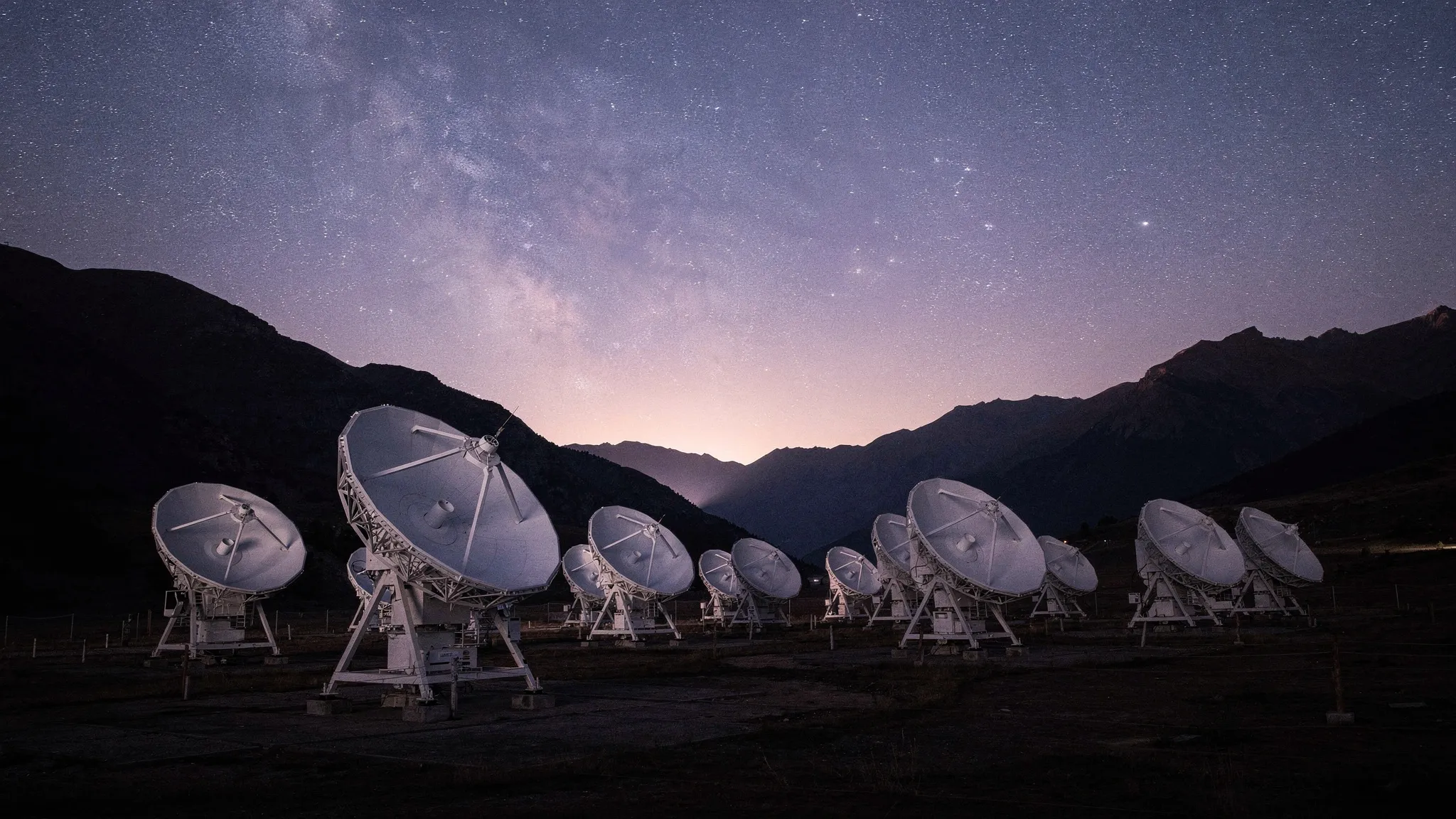
The survey uses the Allen Telescope Array, a network of 6.1-metre dishes at Hat Creek, in northern California, built for SETI. Twenty-eight of its 42 dishes have new cooled receivers. They listen between 2,356 and 3,700 MHz, slicing the band into channels 1.9 hertz wide.
Three tests separate a possible beacon from noise:
- Narrow band. Natural radio sources spread over wide frequencies; our own telecommunications, like a beacon, are narrow.
- Drift. A distant transmitter moving relative to us shifts slowly in frequency through the Doppler effect. Local interference barely drifts.
- Position. The array forms two beams, one on the anti-solar point and one beside it. A real distant signal must be at least 5.29 times stronger in the first.
Each point is observed for five minutes, at night, when the anti-solar point is above the horizon. Software called ATSAT, released as open source, does the sorting. The last survivors are inspected by eye and filed into six categories: four kinds of interference, an “other” category, and “signals of interest”.
From 169 million to 25
Between August 2024 and August 2026, the array spent 126 sessions and about 876 hours on the sky: 11,313 pointings, around 1.3 petabytes of data. That covers about 12% of the ecliptic.
For the 84 sessions analysed so far, the funnel is steep:
- 168,721,405 narrow, drifting signals detected;
- 74.8 million left after masking the most polluted frequencies;
- 27.2 million after comparing the two beams;
- 11,212 plots for human eyes, 8,473 of them classified so far.
Almost all of them are interference: horizontal lines (46%), fading signals (43%), blocks (1.9%). Only 25 signals — 0.29% — are narrow, drifting and brighter in the anti-solar beam alone. They fall on 10 frequencies and 10 positions in the sky, over seven nights; 14 of the 25 come from a single pointing.
The authors announce no detection. All 10 positions are scheduled for re-observation.
A survey measured in petabytes
Covering the whole ecliptic means 87,660 pointings. Because half the ecliptic is in daylight at any time, and Earth’s year is not a whole number of days, it will take at least four years, more than 700 sessions and over 11 petabytes of data — the largest campaign ever run on the Allen Telescope Array.
The authors acknowledge a weakness: the masked frequency bands were adjusted along the way, so the sessions were not all processed alike. A full re-analysis with uniform settings is planned, starting with the year 2025. Meanwhile, thousands of hand-labelled spectrograms form a catalogue of radio interference that could train future classifiers. Whether the 25 survivors hold up will only be known once the dishes turn back to those 10 points in the sky.