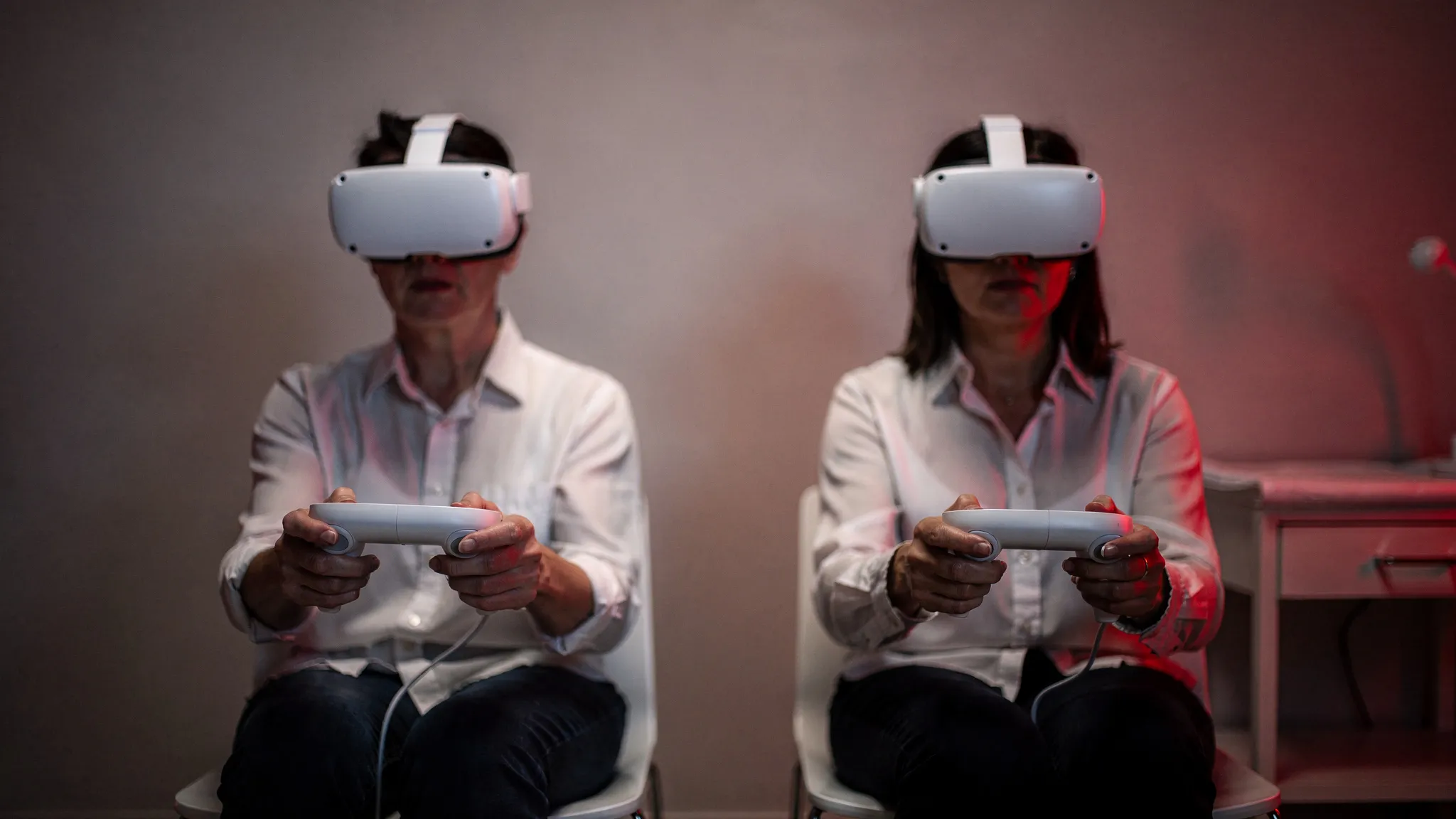
IS IT THE THERAPY, OR JUST THE HEADSET?
Put on a virtual reality (VR) headset and, for a while, you feel present somewhere else. That illusion has made immersive virtual reality (IVR) a growing tool in therapy. Patients with phobias or trauma can gradually face what they avoid, in a setting that looks real but stays safe; others use it to train social skills, or to relax through guided imagery.
Randomized controlled trials, the gold standard for testing a treatment, are now commonplace in the field. But a trial is only as convincing as what the treatment is compared with. A team from the University of Tartu, in Estonia, and the University of Leiden, in the Netherlands, looked closely at that comparison.
The sugar pill problem
In drug trials, the classic control is the sugar pill: it resembles the real treatment but lacks the active ingredient; in a double-blind trial, nobody knows who gets which. Virtual reality has no obvious equivalent. Part of its benefit may have nothing to do with the therapy’s content: the expectation of a high-tech treatment, the novelty of the device, the simple act of putting on the goggles. The effect of, say, exposure to spiders must be separated from the general effects of immersion, distraction or positive expectations.
Headsets make this harder. The authors point to what has been dubbed the “device gap”: the goggles make it obvious to participants and experimenters alike who is receiving the intervention, which can bias their behaviour.
An international working group, VR-CORE, has proposed a ladder of five types of control, from usual care up to an immersive, interactive experience inside a headset. No formal guidelines had been adopted as of February 2026, the authors note.
Twenty-two trials on a five-rung ladder
Madis Vasser, Mary-Ann Kubre, Kadi Tulver and Jaan Aru searched four databases (PubMed, Web of Science, Scopus and PsycINFO) in January 2026 for journal articles with both “immersive virtual reality” and “randomized controlled trial” in their title. Of 135 results, 88 were duplicates. They then removed 11 studies that did not rely only on a wide-field headset, and 14 with no psychological or quality-of-life outcome, or no results. Twenty-two trials remained, on anxiety in children around surgery, fear of heights, depression and anxiety in pregnant women, patients undergoing chemotherapy and older women, among others.
Two of the authors placed each control condition on the VR-CORE ladder, agreeing 95% of the time from the start. They stretched the bottom rung, “no intervention”, to cover any condition without a multimedia component: usual care, a waiting list or a text-based therapy.
The tally: 14 of the 22 trials compared the headset with no intervention. Four used a passive activity outside VR, such as listening to music; one used a game of dodgeball; three used a passive experience inside a headset. None tested its therapy against another active, interactive VR experience.
13 out of 14 versus 3 out of 8
The authors then counted which trials reported a statistically significant difference in favour of VR. Among the 14 with a no-intervention control, 13 did. Among the 8 with some kind of active control, only 3 did — and in those trials, both groups usually improved.
The gap is statistically significant (Fisher’s exact test, p = 0.011: if the type of control made no difference, a gap this large would arise by chance only about once in a hundred times). The odds of a positive result were about 14 times higher with a no-intervention control. Odds compare positive with negative results; in plain shares, that is 93% of trials against 38%. The uncertainty is enormous, though, because so few trials used an active control: the 95% confidence interval runs from 1.64 to 121.96, and the true value could plausibly lie anywhere in that range.
For the authors, this “hints that regardless of content, an IVR experience in itself could lead to overall clinical improvements.” They also mention a possible bias on the researchers’ side: enthusiasm for a new technology can unintentionally shape how a study is designed, run or interpreted.
Building a virtual placebo
Their proposal is a “virtual placebo”: a control experience that matches the intervention in everything except the specific mechanism being tested. Same headset and controllers, same session length and frequency, same level of interactivity, similar graphics and sound — but the supposed active component removed or altered.
They give examples. Imagine a snowy virtual scene meant to lower fever through a feeling of cold: the right control would be a scene without snow, just as passive or just as active. Or a psychedelic tunnel where participants catch flying angels with their hands, matched with a mundane pedestrian tunnel where they catch flying debris. Same shapes, same movements: seen from outside, the two groups would behave identically.
The balance is delicate: a control should be neither too boring nor too interesting. And a perfectly inert virtual placebo is out of reach, because immersion has strong effects of its own, so both groups will probably improve. The real question is whether the therapy does significantly better. Because such controls cost time and money, the authors suggest a shared library of reusable placebo experiences.
What twenty-two trials can and cannot say
The authors call their statistics exploratory. The 22 trials differ widely, so they only counted significant versus non-significant results, without weighing effect sizes or risk of bias. They searched titles only, had no pre-registered protocol, and note that trials with weaker controls may also differ in sample size or statistical power. Their review describes research habits, not whether virtual reality therapy works.
What it does expose is a question of money. Against usual care alone, a trial cannot tell whether a specific and possibly costly snowy program like the one above — the authors call it “Winter IVR” — is doing the healing, or whether a random immersive video would work just as well.