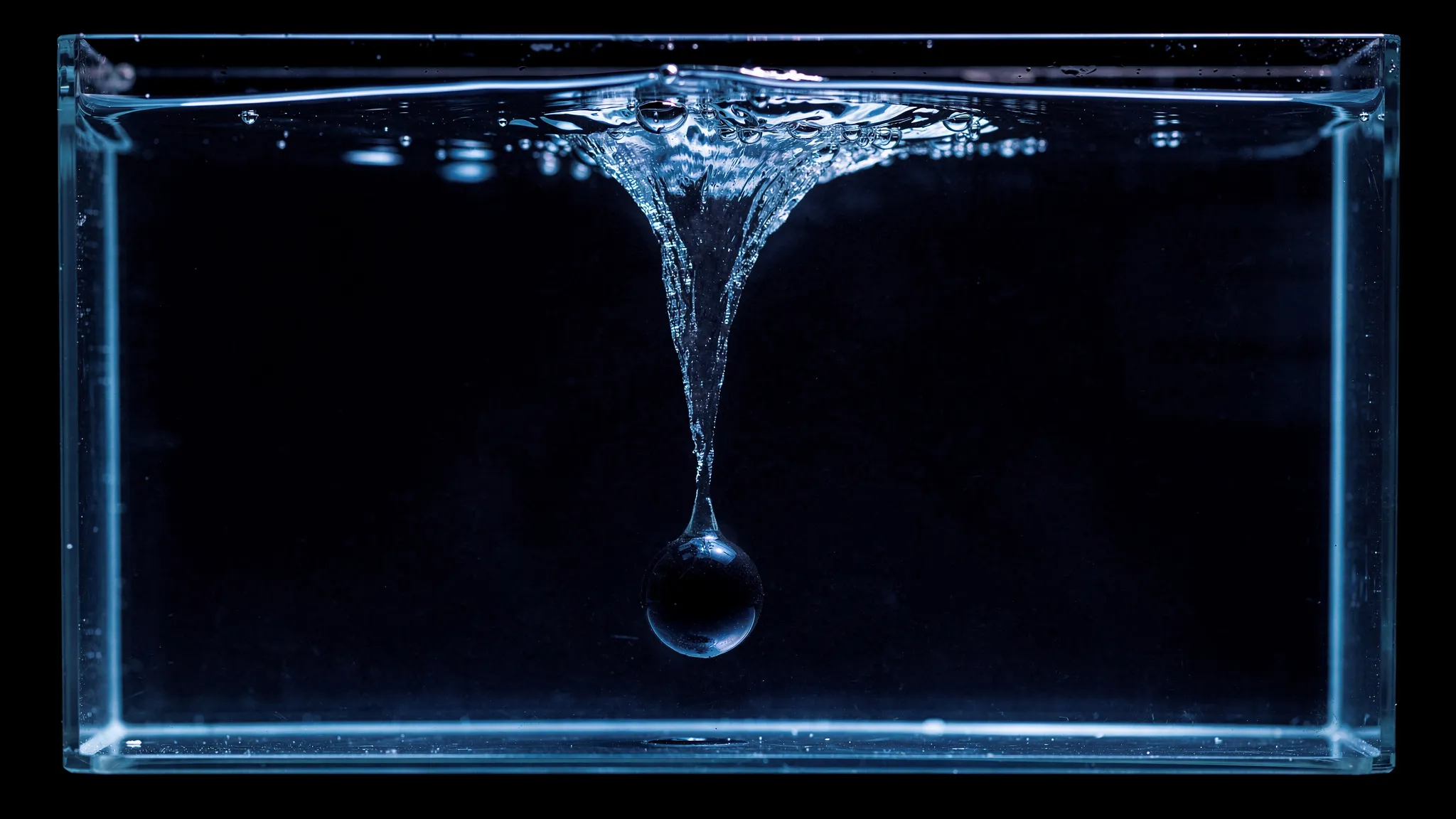
DROP A BALL IN A POOL: A SECOND AIR PINCH DECIDES IF IT COMES BACK
When a solid object plunges into water, it drags air along, opens a cavity behind it and feels sudden forces that steer its path. This “water-entry problem” matters for seaplane landings, projectiles and underwater robots, and it has counterparts in nature. Its study began with high-speed photographs of a sphere hitting water by Worthington, in 1883.
Much is known about the first moments. The air cavity behind a sinking sphere stretches, then pinches off — the primary pinch-off — leaving a pocket of air attached to the sphere. What happens next is less explored, especially for light spheres. Prasanna Kumar Billa and Pallab Sinha Mahapatra, at the Indian Institute of Technology Madras, and Cameron Tropea, at IIT Madras and the Technical University of Darmstadt, went after the sequel.
Balls, coatings and fast cameras
The team dropped spheres of 4, 6 and 10 millimetres, from 1.12 to 7.92 times as dense as water, into a tank 40 centimetres deep. A vacuum pipette released them from heights between 49 and 633 millimetres, so that they hit the surface at 0.89 to 3.52 metres per second. High-speed cameras filmed at 1,000 and 2,000 frames per second, and every condition was repeated at least three times.
The surfaces came in two kinds. Hydrophobic spheres repel water, with a contact angle — the angle a water drop makes where it touches the surface; the higher, the more the drop beads up — of about 100 degrees. Superhydrophobic spheres, coated with a commercial water-repellent spray, reach about 155 degrees; above 150 degrees, a surface counts as superhydrophobic.
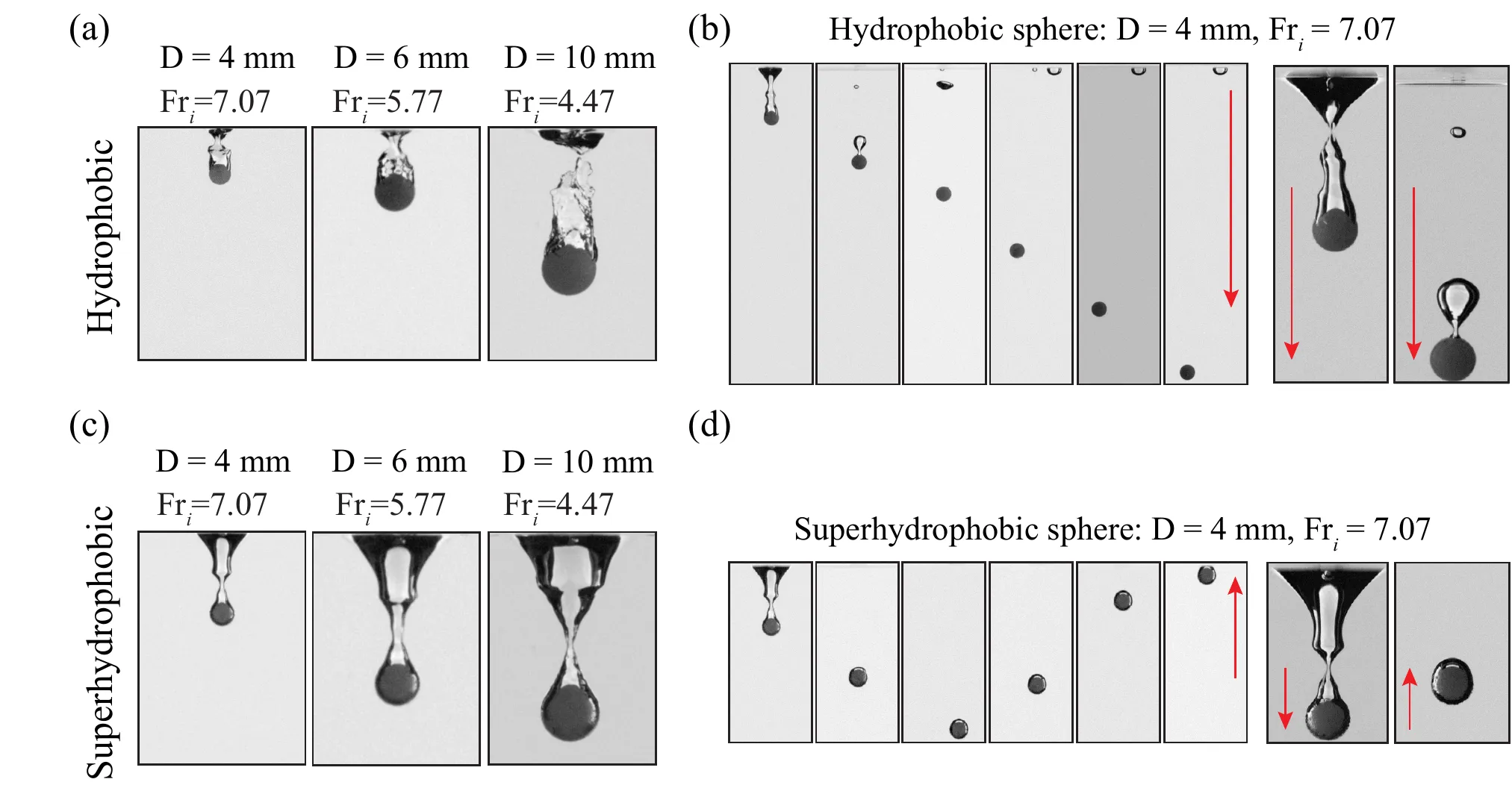
Water entry of hydrophobic (top) and superhydrophobic (bottom) spheres. (b) A 4 mm hydrophobic sphere loses its air and keeps sinking; (d) a 4 mm superhydrophobic sphere keeps an air layer and rises back. — Figure 2, Billa, Tropea & Sinha Mahapatra (2026), arXiv:2610.41942.
The difference is visible at once. Behind a hydrophobic sphere the cavity is ragged, and water wets the sphere up to its equator. A superhydrophobic sphere is wrapped entirely in air, and its cavity has smooth walls.
A one-way door
From the films, the team tracked each sphere’s position, speed and acceleration, and measured the volume of sphere plus attached air. After the primary pinch-off, accelerations are small and the balance is simple: weight pulls down, buoyancy from the whole displaced volume pushes up, drag resists the motion.
So the rule for coming back is plain buoyancy: the sphere returns to the surface only if the volume it displaces, counting its air, exceeds its own volume times its density ratio. A 6 mm sphere whose volume, counting its air, was 1.42 times its own, with a density ratio of 1.12, turned around and rose. A 10 mm sphere of the same density ratio, whose air pinched a second time, was left with 1.02 — below 1.12 — and kept sinking.
The key observation is a one-way door: whenever the attached cavity pinched off a second time, the sphere never came back. No sphere at least 3.26 times as dense as water rose again, and none with a contact angle below 97 degrees.
Size, speed and chance
Wettability helps, but it does not settle the matter. Among the lightest superhydrophobic spheres, every 4 mm sphere rose, every 10 mm sphere sank, and the 6 mm spheres did both from one repetition to the next. Faster impacts can trigger the second pinch and send even water-repellent spheres down. And under two conditions, hydrophobic spheres rose in two runs out of four.
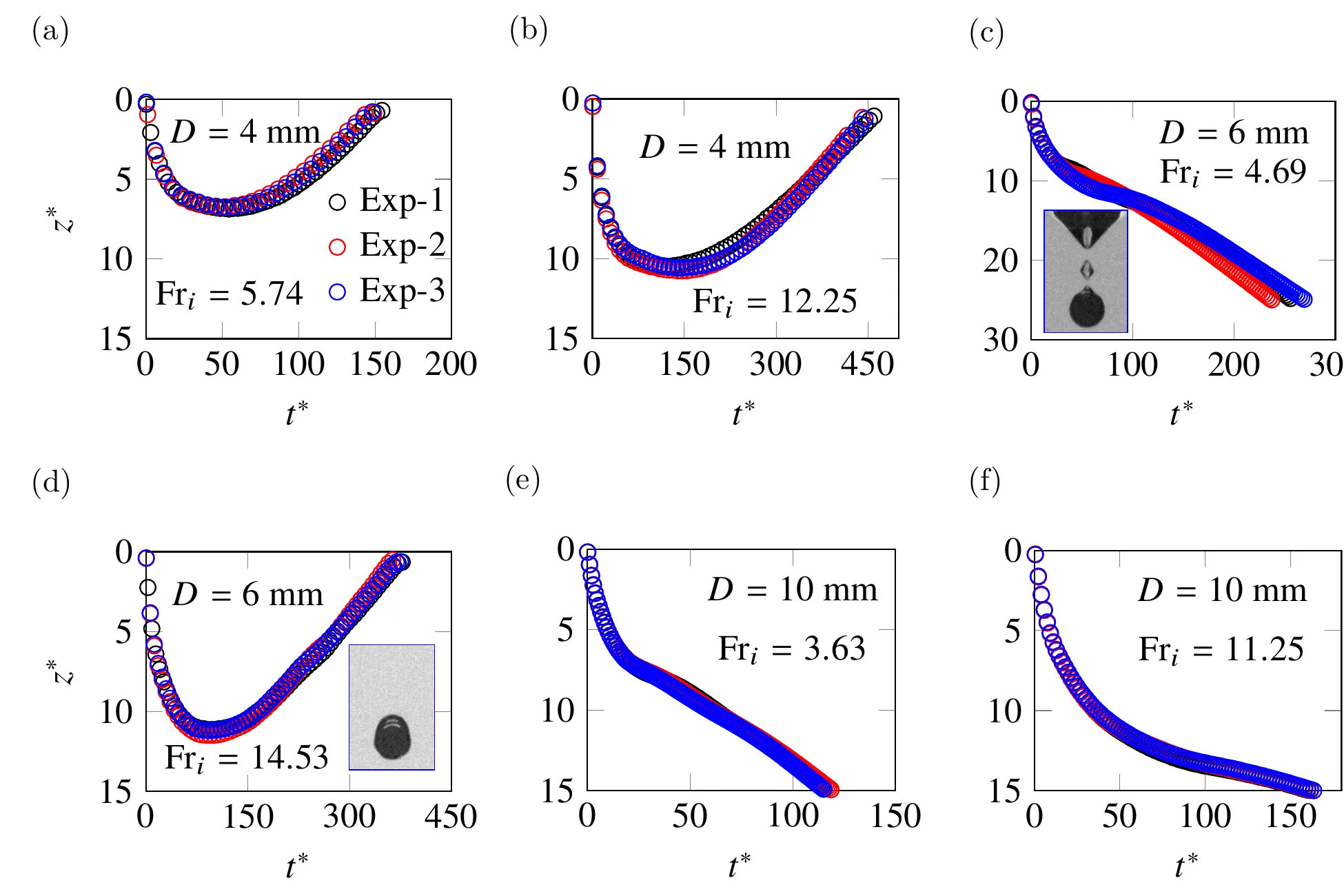
Depth against time for the lightest superhydrophobic spheres, three runs each: 4 mm spheres come back (a, b), 10 mm spheres keep sinking (e, f), and 6 mm spheres can do either (c, d). — Figure 6, Billa, Tropea & Sinha Mahapatra (2026), arXiv:2610.41942.
Watching the neck
What decides the second pinch? The team zoomed in on the neck of the attached cavity, its narrowest point. In the 4 mm spheres, the neck starts wide, at 65 to 97% of the sphere’s radius, then contracts, while the line where water, air and sphere meet shifts on the surface.
Comparing the buoyancy of the trapped air and the weight of the sphere with the surface tension holding the neck gives a reference radius. Cavities that survived and cavities that broke generally fell on opposite sides of it. But the authors are careful: a neck that is closing will eventually cross any threshold, so this separation is drawn after the fact and does not predict pinch-off. Predicting it would require the air pressure and the shape of the neck, coupled to the moving sphere, which the films do not resolve.
The firm result is a chain of cause and effect: how the neck evolves sets how much air stays attached, and that air decides, through buoyancy, which way the sphere finally goes. Wettability matters through that air — not on its own.