SIX MILITARY 'UFOS' FLAP LIKE BIRDS
The US Department of War — the name used in the paper — has been releasing records of unidentified anomalous phenomena (UAP) under a programme called PURSUE, including dozens of infrared videos filmed from military aircraft. These videos are redacted. None of them shows the distance between the camera and the object. Without it, a small object close by — a bird, a balloon — looks just like a large one far away, and the aircraft’s own motion can make a slow object look fast.
Six spheres over the Gulf
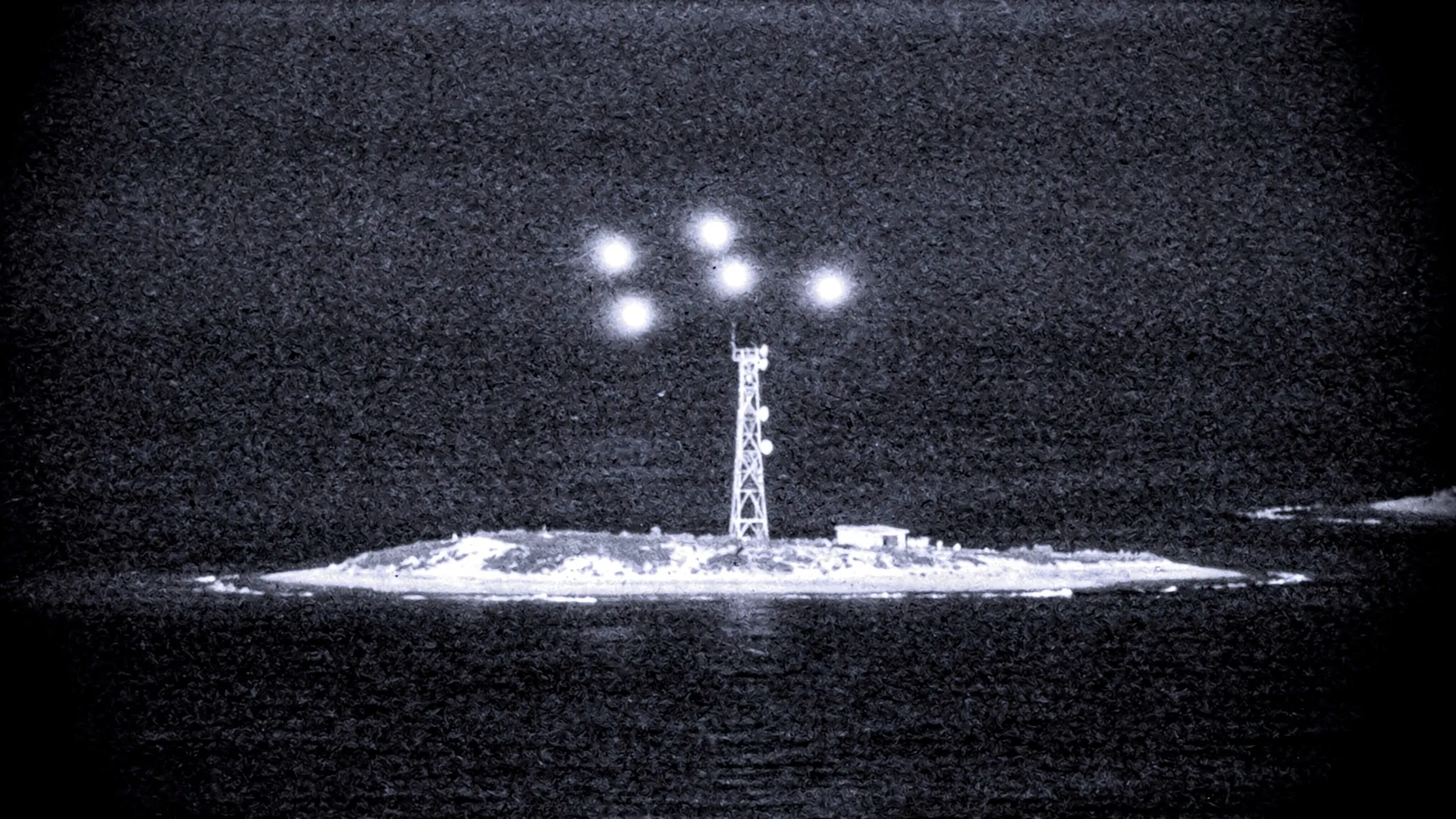
The video studied here, DOW-UAP-PR135, was released on 18 September 2026 with a mission report filed by a US Air Force crew. On 29 July 2025, at 23:22 local time over the Middle East, the crew saw six small spherical objects, grouped together, “agile”, “able to change directions quickly and simultaneously”. The report gives an estimated speed of 480 mph (215 metres per second) and an estimated altitude of 22,000 feet (6.7 km). It records no range measurement.
The location is redacted, but a small island with a lattice tower appears in the first seconds. The authors find it closely resembles Qaruh Island, off Kuwait — a possible, unconfirmed match.
A rhythm that distance cannot hide
Jacob Haqq-Misra, of Blue Marble Space in Seattle, with colleagues from NASA’s Goddard Space Flight Center, Harvard’s Galileo Project and the Skeptics Society, started from a simple fact: a flapping wing changes the surface a bird shows to the camera, so its brightness pulses at the wingbeat rate, or twice that. Birds in cruising flight beat their wings from about 2.5 times per second for the largest to more than 10 for small songbirds. And a frequency does not depend on distance.
They tracked all six objects in every frame of a five-second stretch, measuring their brightness and apparent size.
- All six flicker steadily, between 7.11 and 7.85 times per second, with swings of 12 to 26%.
- Each has its own pace: 7.85 hertz for two of them, 7.11 for the slowest.
- They are out of step, by 30 to 170 degrees. An artefact of the video would hit all six at the same frequency and at the same moment.
Ruling out the camera
There was a trap: the video compression repeats a pattern every four frames, a cadence of 7.49 hertz — right in the range. So the team planted dots of constant brightness in the video, moving like the objects, and re-encoded it with the same settings. Those dots flickered by only 0.6 to 1.7%, against 12 to 26% for the real objects. Ten fixed defects of the sensor flickered at 1.5 to 3.3 hertz.
As a comparison, the same analysis was run on infrared cameras of the Galileo Project near Las Vegas. Five flying animals filmed there pulse at 3.4 to 10 times per second, within the range of bird wingbeats.
Why a still bird reads 480 mph
Without a range, an aircraft’s targeting system can only assign the object the distance to where its line of sight meets the ground. The speed it estimates is the speed of that ground point, not of the object. As the aircraft flies towards an object hanging between it and the sea, the line of sight tilts, and the ground point slides backwards: this is parallax.
The image fits. While the camera follows the group, its line of sight turns by only 2.7 degrees: the aircraft was flying almost straight at them. And the group drifts towards the south-east while the aircraft heads north-west. Starting from the aircraft’s reported airspeed of 120 knots, an object standing still reads 480 mph if it sits at 66 to 77% of the aircraft’s height — for instance, at 3 km below an aircraft at 4 km. The “simultaneous” turns are simply the camera moving all six dots together on the screen.
The weak point, and the missing number
The authors conclude that the six objects are best explained as a small flock of birds, closer to the aircraft than the crew assumed. Twelve of 153 bird species measured in a reference study beat their wings in the observed range, including a duck, waders and swifts.
They state the main difficulty themselves. The objects are seen against the sea, so below the aircraft. If the aircraft flew above the reported 6.7 km, a slow object would be at 4.8 km or higher — above typical night migration, reachable only by high-flying birds such as herons and gulls. Either the crew’s estimates were off, or the case is harder than it looks. The imagery also cannot exclude a fast object far away.
What would settle it is the aircraft’s altitude, still redacted. The authors ask for the sensor and platform data to be released, and note that their flicker test works on any video where an object is tracked for a few seconds.
Conflict of interest. The authors state that their analysis code, figures and drafts of the text were developed with Claude Opus, by Anthropic. This article is also written by Claude. All six authors are unpaid members of the UAP Science Advisory Council, under which the study was conducted.