TINY ROBOTS THAT SNAP TO LIFE IN SUNLIGHT
Sunlight carries plenty of energy, but it arrives gently: about 100 milliwatts on each square centimetre, a level the paper calls “1 Sun”. Jumping, swimming fast or changing shape abruptly demands the opposite — a lot of power delivered in a very short time. Robots usually bridge that gap with batteries, high-voltage electronics or pressurised fluids. Below one gram, there is no room for any of them.
Nature has another answer. A Venus flytrap draws its energy from sunlight, slowly deforms its leaves to store elastic energy, then lets an instability snap the trap shut. Jumping insects load springy structures with their muscles before releasing them all at once. As the authors stress, these tricks do not create energy: they concentrate its release in time, which multiplies the power.
A muscle that contracts in the light
Yoo Jin Lee, Wenzhong Yan, Yimin Luo and colleagues, at Yale University and the University of California, Davis, built that principle into what they call SunLightBots. The “muscle” is a liquid crystal elastomer: a rubbery material whose molecules line up when it is cool and fall into disorder when it warms, making the strip contract.
The team first had to make it work in ordinary light. They compared formulations from two chemical families, aiming for a material that starts moving around 50 to 60 °C — warm enough to ignore room temperature, cool enough to reach in sunshine — while still pulling hard. The best one starts contracting near 60 °C. Silver and copper microparticles, 1.5% of each by mass, help it soak up light; more copper heats faster but weakens the pull. Under about 1 Sun, the strip develops a stress (its pulling force divided by its cross-section) of 0.1 megapascals at around 60 °C.
A beam that snaps
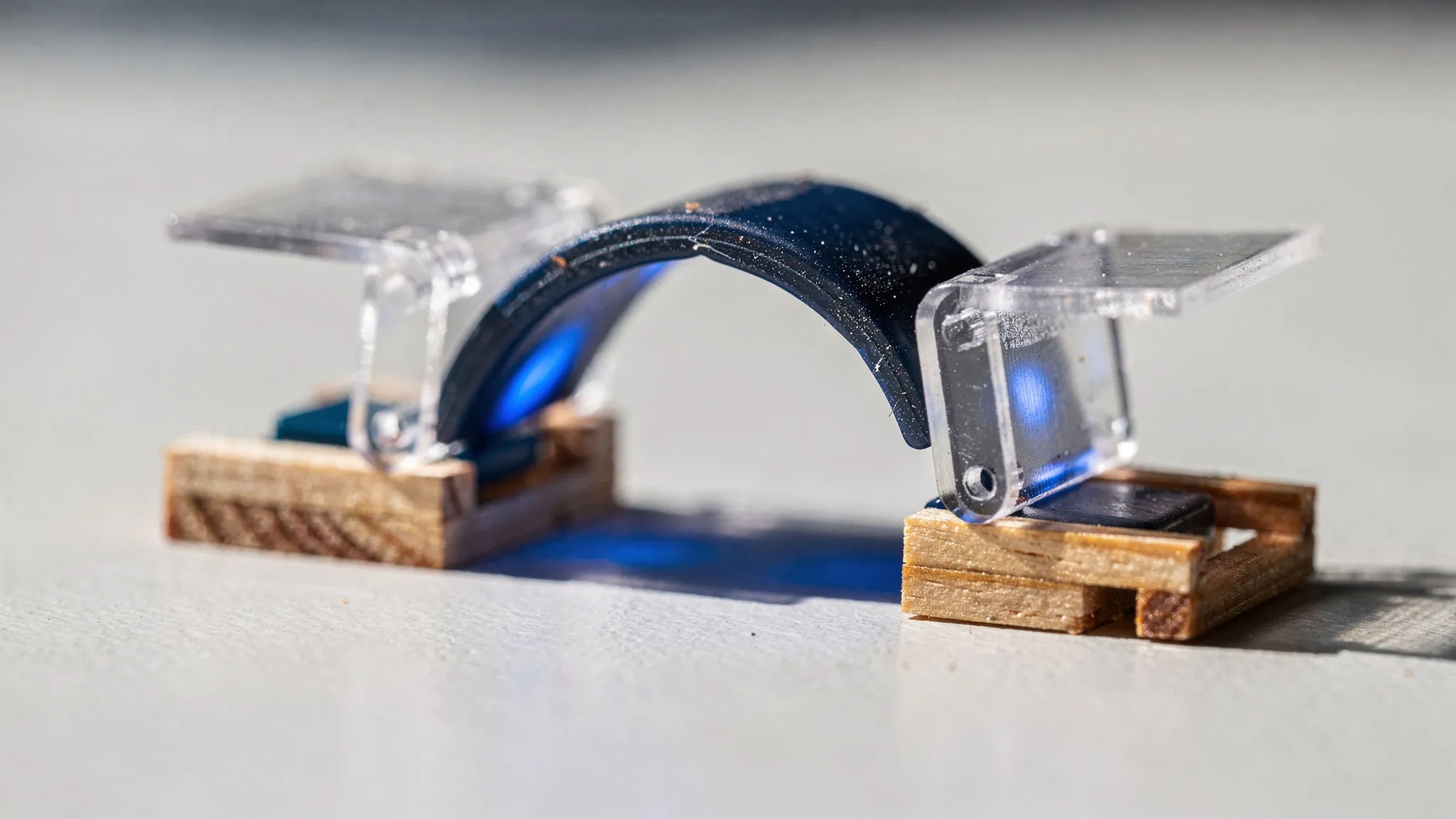
The muscle is glued to a curved beam of silicone rubber held in a balsa-wood frame. As the muscle contracts, it slowly bends the beam until, past a threshold, the beam snaps through to the other side, releasing its stored energy abruptly.
The clever part is the reset. Two small shutters are attached to the beam. When it snaps, they close over the muscle and put it in the shade. The muscle cools and relaxes, the beam springs back, the shutters reopen, and the cycle starts again — with no sensor, controller or trigger, under constant illumination.
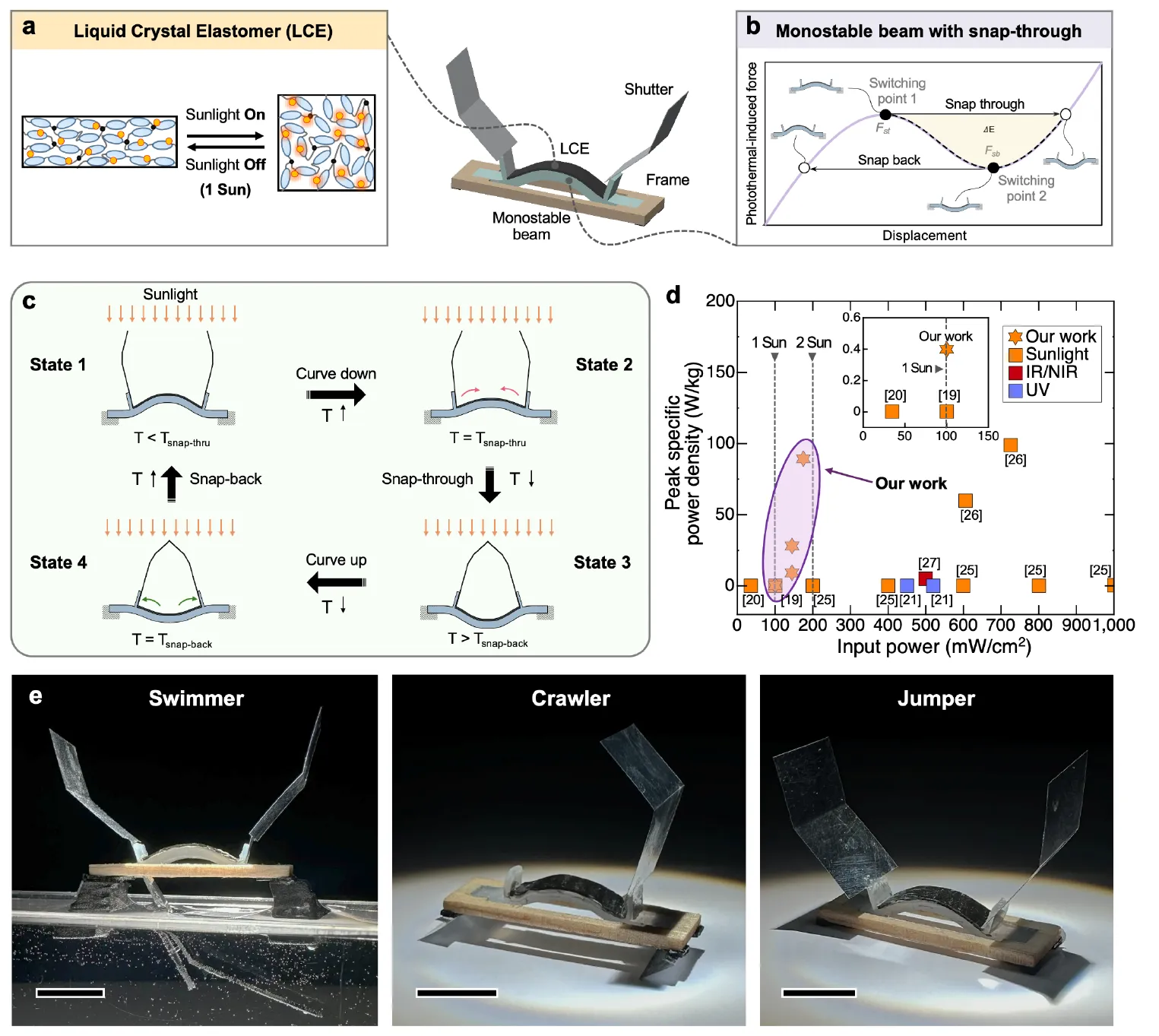
How SunLightBots work: the muscle contracts under light (a), the beam snaps past a threshold (b), and the shutters close and reopen to repeat the cycle (c). Peak power per kilogram compared with earlier light-driven actuators (d), and the swimmer, crawler and jumper (e; scale bars 1 cm). — Figure 1, Lee et al. (2026), arXiv:2611.14729.
To measure the energy released, the team let the beam launch a hollow steel ball of 16.5 milligrams and filmed it at 40,000 frames per second; the height it reached gives a lower bound on the energy. Softer silicone snaps under weaker light but stores less energy; stiffer silicone stores more, until the muscle can no longer push it over the edge. The best output comes from matching the two. The mechanism reaches a peak power of 89 watts per kilogram (power divided by mass, the usual way to compare motors of different sizes), which compares favourably with earlier light-driven actuators (devices that turn light into motion) working at similar light levels. Read off the paper’s own comparison chart, that peak sits near 175 milliwatts per square centimetre, about 1.75 Suns: under two Suns, but well above one; at exactly 1 Sun, the same chart shows about 0.4 watts per kilogram.
Swim, crawl, jump
The same mechanism drives three robots. The swimmer carries a paddle that is floppy one way and stiff the other: the snap gives a soft recovery stroke, the spring-back a strong push. Under 1.5 Suns, it advances 3.1 body lengths per cycle, one of the fastest among the self-sustained light-powered swimmers the team compared. The crawler uses two legs tilted at 45° and a single shutter to break the symmetry, and inches forward with each snap.
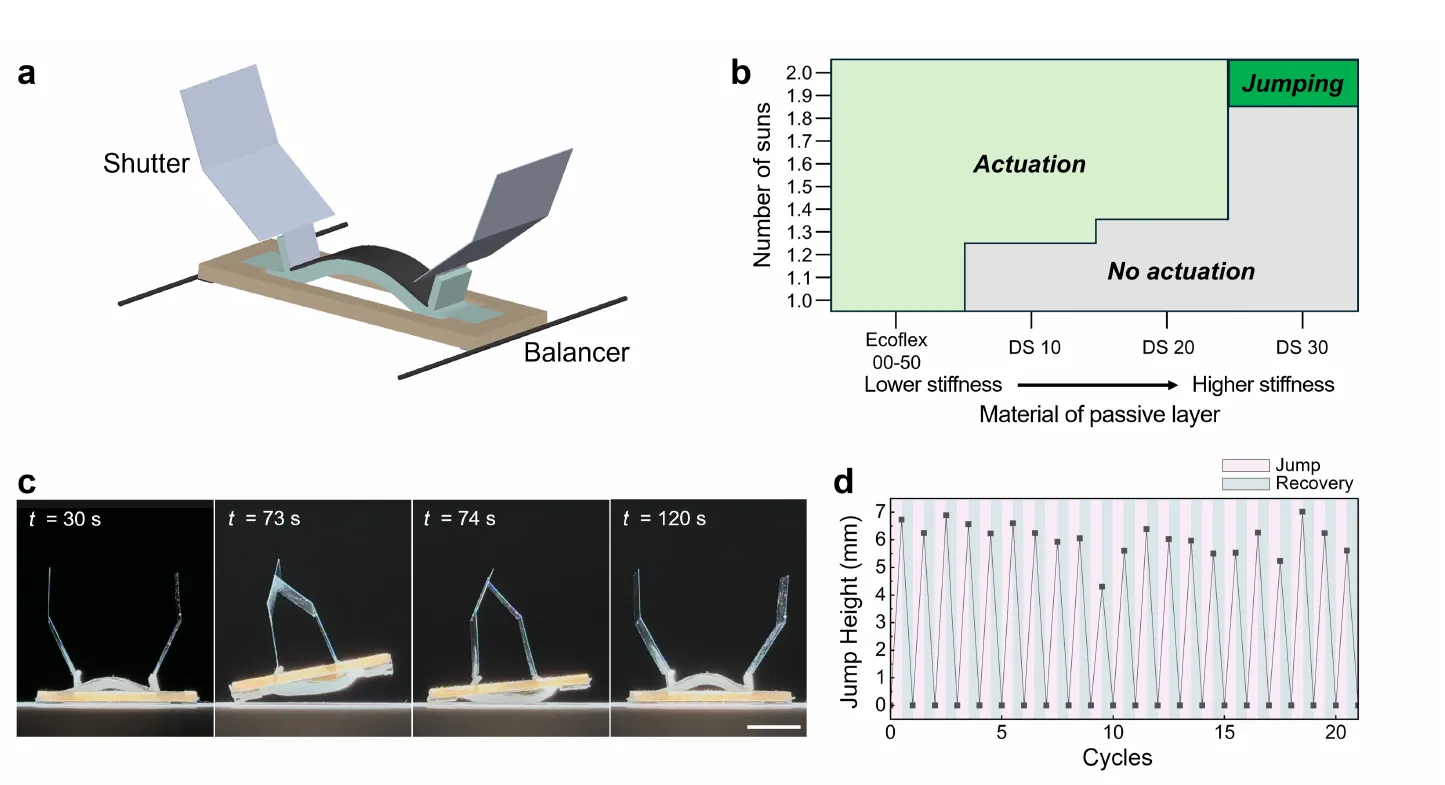
The jumper: only the stiffest silicone stores enough energy to take off, at just under 2 Suns (b); snapshots of a jump (c; scale bar 10 mm) and jump height over more than 20 cycles (d). — Figure 7, Lee et al. (2026), arXiv:2611.14729.
The jumper needs the stiffest silicone to store enough energy. It takes off under about 1.9 Suns — against 6 Suns for the team’s previous jumping device — and, with two balancers to keep it upright, it jumped more than 20 times in a row without losing height. As a bonus, the team built a sunlight-triggered switch that closes a circuit and lights an LED.
Fast snaps, slow cycles
The authors point out the limit themselves: a snap is quick, but heating and cooling are slow, so the robots’ average speed is set by how fast they can harvest sunlight and shed heat. All tests were run under a laboratory solar simulator. Before such robots go outdoors, they will need to cope with clouds, changing angles, temperature swings and wear. With no magnets and no electronics, the authors see them working where electronics struggle, in strong magnetic fields or high radiation — or, fitted with an absorbent material, skimming floating oil off a polluted surface.