WARM NIGHTS COST BRAZIL'S COWS THEIR MILK
When a dairy cow cannot get rid of heat fast enough, she eats less, makes less milk and becomes less fertile. Farmers track this with the temperature–humidity index (THI), a single number combining air temperature and humidity. Classic guidelines put the start of heat stress at a THI of about 72; later work on high-producing cows lowered it to 68. But those thresholds came largely from controlled studies, and may not hold on commercial farms in the tropics.
Brazil, one of the world’s largest milk producers, offers a test. Its dairy herds rely heavily on the Girolando, a cross between the Holstein, bred for high yields, and the Gyr, a zebu breed adapted to the tropics.
A quarter-century of test days
Leonardo Nascimento Ferreira and colleagues at the Pontifical Catholic University of Campinas, the Federal University of Goiás, São Paulo State University and Embrapa gathered 788,528 official milk records from 87,809 Girolando cows in 408 municipalities, from 2001 to 2024. Each record was matched with the weather of its municipality.
The raw data are misleading. Brazilian herds have become far more productive — about 0.56 kg more milk per cow per day every year, from around 15 kg in the early 2000s to over 25 kg by 2024 — and cows tend to calve in autumn and winter, so they peak in the cool season. As a result, the raw correlation between heat and milk is almost zero. The team therefore used statistical models that compare each cow with herself and remove seasonal and long-term trends.
A high threshold that hides two very different cows
At the scale of the whole population, milk yield looks stable up to a daily mean THI of about 76, well above the classic thresholds. The explanation is in the cows. Split by productivity, the lowest-yielding quarter (about 14 kg a day) shows no loss at all, even above 76. The top quarter (about 31 kg a day) starts losing milk around the classic thresholds, 68 to 72, and the losses accelerate beyond 76. A cow making more milk produces more internal heat, and has less room to cope.
Time matters as well. Milk drops on the day of the heat, and again, more deeply, about four days later.
The night shift
The study’s most striking finding concerns the night. On about a fifth of the test days (21.3%), the night stayed so warm that the THI never fell below 68 — a “tropical night”, during which cows cannot shed the heat they built up during the day. Under the same daytime heat, cows facing such nights gave 2.37 kg less milk per day on average than cows that enjoyed cooler nights. Conversely, a large gap between day and night temperatures protected yields by about 1.6 kg per day under moderate heat.
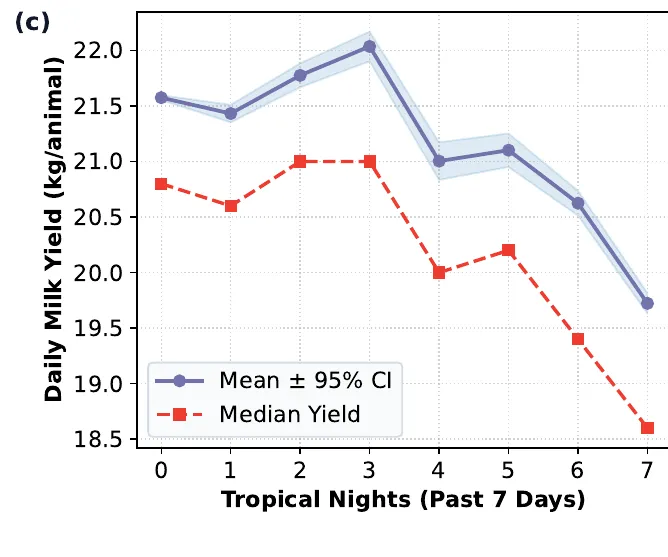
Daily milk yield (mean and median, kg per cow) against the number of warm nights in the previous week. After three such nights, yields fall; seven out of seven leave the mean 1.85 kg (8.6%) lower than none. — Figure 6c, Ferreira et al. (2026), arXiv:2611.22980, CC BY-SA 4.0.
In this raw comparison, seven warm nights in a row cut yield by 1.85 kg, or 8.6%, compared with a week of cool nights — with the heaviest losses in cows at the peak or middle of their lactation.
The zebu advantage
Higher Holstein fractions usually mean more milk, which makes breeds hard to compare. So the team looked only at top producers, all giving about 31 kg a day. Among them, half-Holstein and 5/8-Holstein crossbreds barely felt a week of heat, while 3/4-Holstein cows suffered clear losses. Cows that are 7/8 Holstein began declining at a THI of 68 — the same threshold as in temperate barns — whereas the half-breds held out until 76.
What farms can do
The authors draw practical advice. Many Brazilian barns turn their fans down or off after sunset to save electricity; the results suggest that on warm nights, this leaves the day’s heat debt unpaid. Their recommendations: keep ventilation running at night, cool high producers and early-lactation cows first, and avoid pushing herds systematically towards high Holstein fractions where cooling cannot keep up.
The study has limits. Weather comes from municipal stations rather than individual farms, housing and cooling equipment were not observed, and milk is recorded only once a month. Very hot days above a THI of 80 were rare in the data. But the message is clear enough: for a dairy cow, a cool night is worth kilograms of milk.