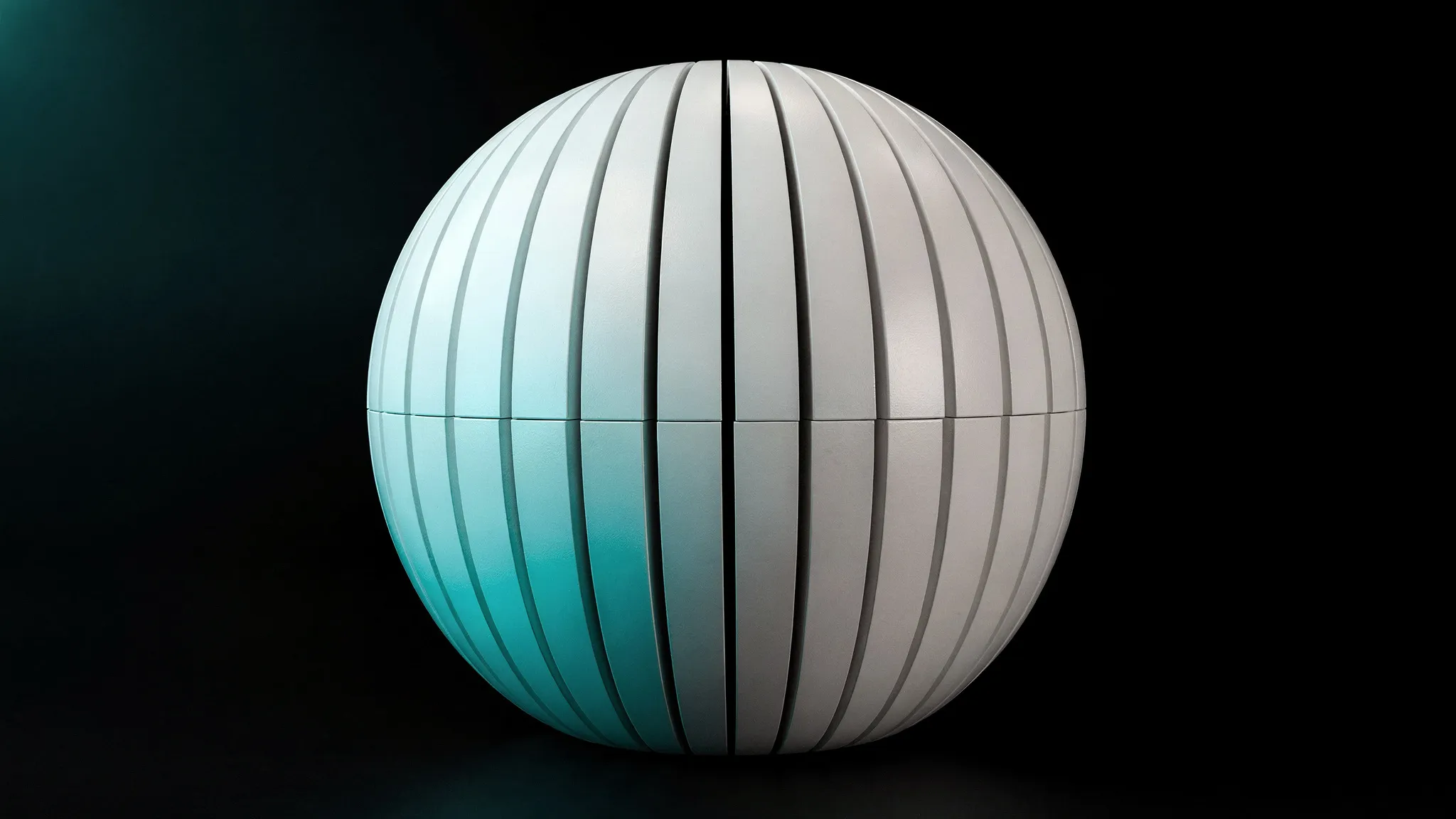
ARCHIMEDES' SLICES ONLY WORK ON A SPHERE
The paper opens with a puzzle: can a disc 100 units across be covered by 99 infinite strips, each 1 unit wide? The solution, writes Mijia Lai of the School of Mathematical Sciences at Shanghai Jiao Tong University, “takes us back more than two millennia to one of Archimedes’ Eureka moments”.
A band whose area ignores its position
Archimedes’ theorem. On a sphere of radius 1, the region between two parallel planes that both cut the sphere, a distance h apart, has area 2πh.
The striking part is what the formula leaves out: where the band sits. Near the equator or close to a pole, only the gap h counts.
The paper’s hint for the puzzle is to lift the strips from the flat disc up onto a sphere, where they become bands. Following that hint with the formula gives the answer. A sphere 100 units across has a radius of 50 and an area of 4π × 50² = 10,000π. Each band 1 unit wide covers 2π × 50 × 1 = 100π. Ninety-nine of them cover at most 9,900π — not enough. So no, the strips cannot cover the disc.
The reverse question
Does this property single out the sphere? For convex surfaces — shapes with no dents — and with the property required at every gap width, the answer has been known for a long time; the paper traces it back to Blaschke. The mathematician Mohammad Ghomi asked a sharper question on the MathOverflow forum in October 2017: if the area between two parallel planes is the same for one single fixed gap, whenever both planes cut a convex surface, must that surface be a sphere?
Lai proves it must, and goes further.
Theorem A. Take a smooth, closed, connected surface in space. Suppose there is a gap h, smaller than the surface’s thinnest width, such that every slice of width h — in every direction and at every position where both planes cut the surface — has area 2πh. Then the surface is a sphere of radius 1.
Convexity is not assumed: it is part of the conclusion.
Two steps, one detour through waves
First, no dents. The slice condition has a geometric consequence: where the surface would curve inwards, away from its outer envelope, it forces a quantity called the mean curvature to be zero or negative. Lai shows this leads to a contradiction, using a classical tool for such equations, the Hopf maximum principle. With no dents allowed, the surface must be convex, and in fact curved outwards at every point.
Then, only a sphere. For a convex surface, the slice condition makes the way area is spread out by height repeat itself every h. Averaging that repeating pattern over all directions produces a solution of the wave equation that repeats in time. Its starting value turns out to be tied to the Newtonian potential — the kind produced by mass or electric charge — that the surface would create if it were uniformly coated. A uniqueness result for such periodic waves, proven in an appendix, then forces this potential to be constant inside and beyond the surface. A known symmetry theorem, due to Reichel, says only a ball can produce such a potential. Archimedes’ formula finally sets its radius to 1.
A separate, elementary section treats the special case where the surface’s width in some direction is a whole number of gaps h.
Help from an AI
In his acknowledgments, the author thanks the AI system ChatGPT 6 Astra “for assistance with proof strategies”, adds that the elementary argument of the last section was found before that help, and takes responsibility for checking and writing the proof. The result is a preprint and has not yet been peer-reviewed.
From a puzzle about strips on a disc to periodic waves and charged surfaces, the proof ends where Archimedes started: a band of width h, and an area of 2πh.