EL NIÑO 2026: WHERE THE LAND WILL LOSE ITS CARBON
El Niño events shake the global carbon cycle. On land, they bring drought and heat to the tropics and more fires — and the land’s carbon sink, the net amount of carbon that vegetation and soils absorb each year, weakens. During the strong El Niños of 1997–1998, 2015–2016 and 2023–2024, that sink fell by about half.
A new El Niño has been emerging since June 2026. By July, several indices already placed it at or above the intensity of 1997–1998 and 2015–2016 at the same stage. Forecast systems, including NOAA’s, agree it should reach the “very strong” category and peak in October–December 2026.
Seasonal forecasts already warn of droughts and floods. Xiaomeng Du, Wei Li and colleagues at Tsinghua University in Beijing, with Philippe Ciais’s team in Paris-Saclay and Pierre Friedlingstein and Stephen Sitch at the University of Exeter, asked whether they could also warn about the carbon cycle — before the damage happens.
51 futures, two models of the world’s plants
The team took the 51 seasonal forecasts issued by the ECMWF forecasting system on 1 June 2026 — 51 plausible versions of the second half of the year. Each one drove two global vegetation models, ORCHIDEE-MICT and JULES, which simulate how plants grow, breathe, decay and burn: 102 simulations in all. A machine-learning model, trained on satellite maps of burned areas, forecast where fires would spread under each scenario.
The key quantity is the land’s net biome productivity: carbon taken up by photosynthesis, minus carbon released by respiration and fires. A negative anomaly means a weaker sink.
A milder average, harsher hotspots
The forecasts are unanimous on one point: drought. All 51 scenarios predict a global rainfall deficit below the usual 10th percentile, with tropical rainfall down about 12% from July to December.
- For the whole planet, the average forecast is a sink weaker by 0.23 billion tonnes of carbon over July–December 2026 — milder than the 0.95 of 2015 and the 1.39 of 2023 over the same months. But the most extreme scenario reaches about 1 billion tonnes, comparable to 2015.
- The loss comes mainly from extra respiration by plants and soils, and from fires, partly offset by more photosynthesis in temperate and northern regions.
- Locally, 2026 looks worse than the past: about 11% of the world’s land would lose more carbon than in both 2015 and 2023 — 16% in the tropics.
Brazil and the peatlands
Tropical South America is the main hotspot, with about 44% of the global decline; 44 of the 51 scenarios agree on the direction. Within it, Brazil stands out: the humid forests of the north-east, and the grasslands and savannas of the centre, with the highest risk between September and December. Southern Africa, central North America and eastern Australia each have their own window of risk.
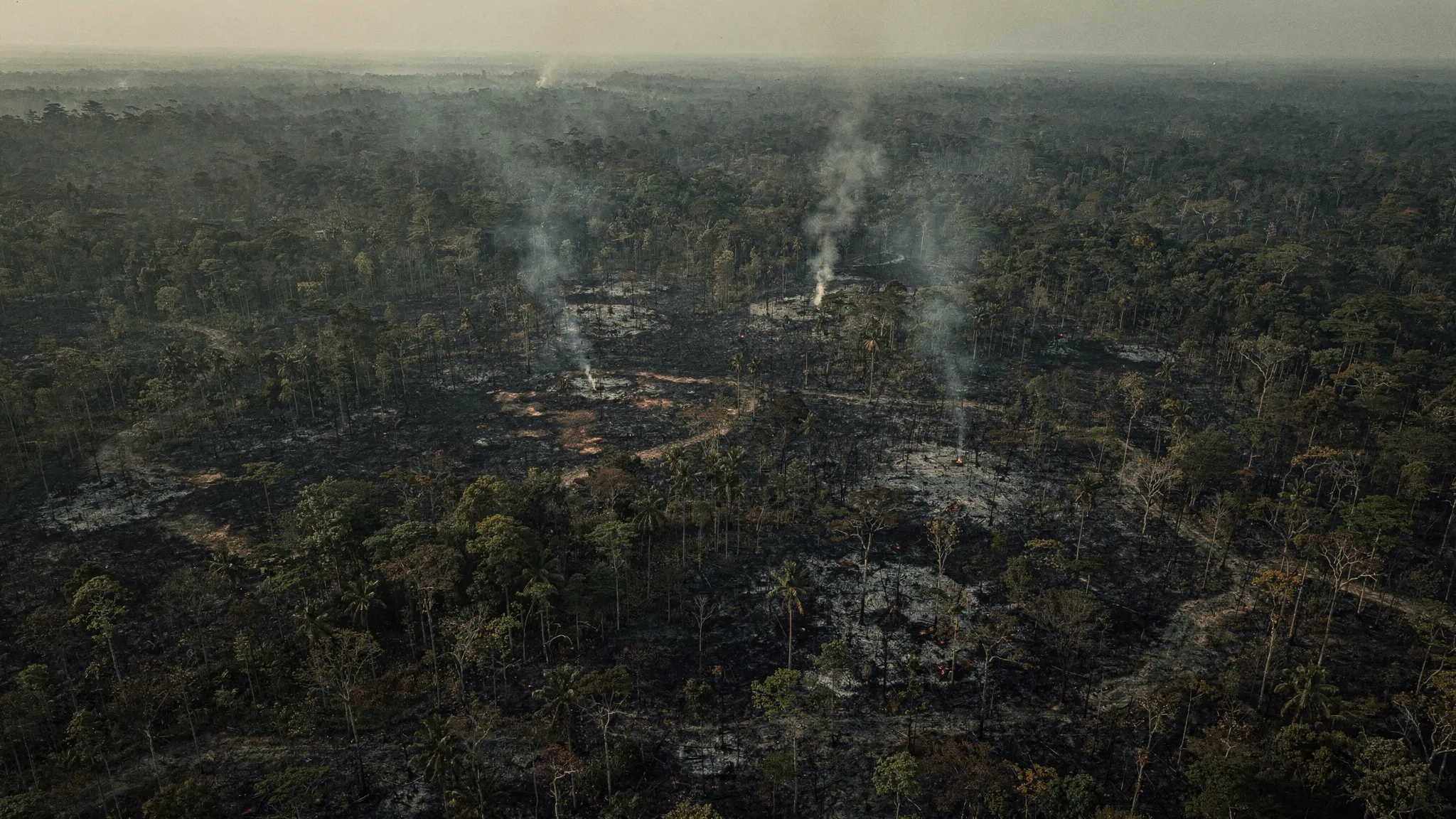
Fires tell a different geography. Equatorial Asia — Indonesia, Papua New Guinea and Malaysia — could see 5.6 times more burned area than its 2016–2025 average from July to December, mostly on peatlands. About 12 million hectares of forested tropical peatland face higher fire risk. Northern Australia’s grasslands could burn about 60% more than usual. Near-real-time satellite fire estimates already support the forecast for Southeast Asia and Australia.
Reality is running ahead
The authors checked their forecasts against the weather actually observed in July and August 2026. The observed temperatures were higher than in all 51 scenarios, and tropical rainfall fell below even the driest ones. The scenario closest to the real temperatures predicts a tropical loss of 1.1 billion tonnes — far more than the average. The actual weakening of the carbon sink, they warn, could exceed even the most extreme forecast.
The study has limits: only two vegetation models, land use frozen at its 2010 state, and forecast uncertainty that grows with time, especially for tropical rain. The authors still call for priority monitoring of Southeast Asia’s peatlands — keeping them wet, avoiding drainage, and reducing fires lit by people.